Fethiye workshop
Clip-In Hair Extensions in Fethiye: Matched in Daylight, Cut Into Your Own Hair
A clip-in set is put in by the person wearing it, so there is no fitting appointment to book here and this page does not offer one. What Fethiye adds is the work a screen cannot do: shades held against your own hair outdoors, widths judged on your head, the placement shown once in a mirror, and the cut that makes a set sit with your own shape.
Almost everything a visitor needs from us with a clip-in set happens before it is worn: a colour decision made outdoors, a set that answers one particular head, and a pair of scissors.
The rest is yours, every morning.
What is here, and the appointment that does not exist
A clip-in attaches nothing to your hair and comes out at the end of an evening: no application to book, no move-up, no removal. That is the format working as intended.
What is local is narrower and more useful: the hair is made here, so a shade can be judged against physical hair, and a set against the head that will wear it. The object itself is on the clip-in page.
What a consultation actually looks at
It is short and mostly involves lifting sections. What is judged is the hair above each row rather than the hair in the mirror: whether enough of it will cover a base, where your shortest layer falls, the density at the nape and above the ears. It can end in nothing being sold, since too little length above a row is a cover problem weight cannot repair.
The colour decision is made outdoors, not on a screen
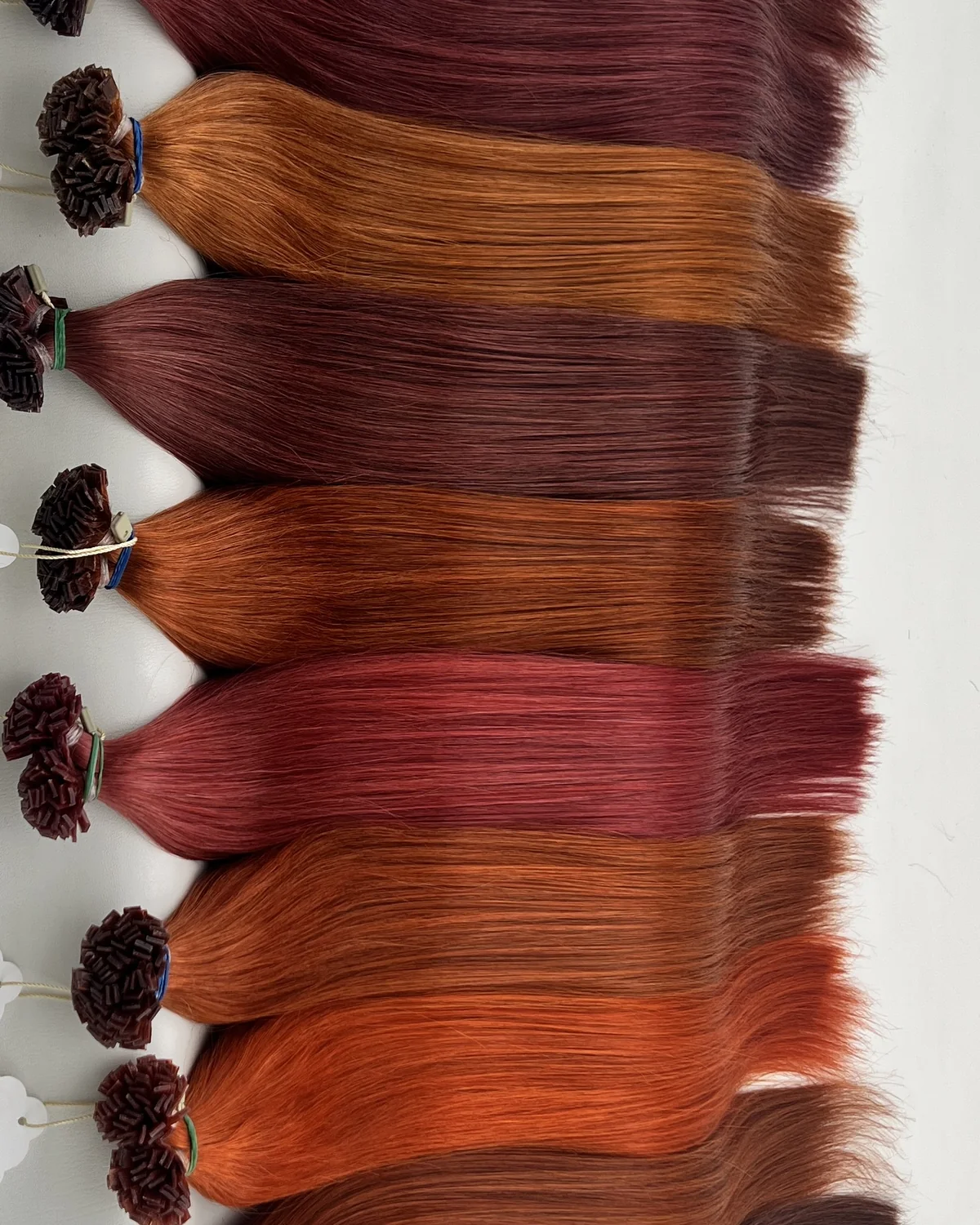
This is the part that cannot be done remotely, and the colour matching page explains why. Shades are laid into your mid-lengths and combed through so both take the same light, then we step outside — shades that agree under a lamp can part on the doorstep.
A panel forgives less than a strand system: a continuous width of hair in one place hands the eye an edge, so a blend usually beats one flat code — the blending page covers the weighting. Have your own colour done first.
Widths judged on your head, and a placement you have to learn
A set sold as one arrangement assumes a head. Yours narrows from the nape upwards at its own rate, and a width that vanishes on one row buckles on the next, so it is settled with a comb, a mirror and the panels themselves: which rows you can carry, which panel suits each, where nothing should go.
Then it has to end up in your hands, since you fit it yourself: the placement is shown on your own head, and you repeat it while somebody watches.
The cut is the part that genuinely needs somebody else
This is where a set stops being stock and becomes yours, and the reason to plan a visit. A set arrives level and uniform; your own hair is not, so the two agree only after somebody works on them together — dry, clipped in, and judged while the hair is moving. None of it can be undone, which is why it is not a job to hand to a photograph.
Fitting all of that into a fixed number of days
The sequence is stubborn: colour work on your own hair first, then the match, then the set, then the cut. Swap any two and a step is wasted. Where a shade has to be blended rather than picked, no lead time is published here — confirm before flights are booked. Leave room after the cut, and come back if a row wants shortening.
A coastal holiday, and what a set is not for
This is the one system that stays out of the water: a soaked band holds moisture in its stitching and hardware long after the length feels dry, and a pillow twists the section under a base. On a coastal trip a set belongs to the evening, which makes storage the thing to get right in a hot country — clips closed, the panel flat or hanging, dry and out of the sun. More on the maintenance page.
What travels home with the set
A set is an object you own, so the question after a visit is different: no move-up to arrange, no technician to find before you fly. What eventually needs hands is the carrier — a loosened stitch, a tired spring, a worn band — small repairs, done wherever you are. Ask for the written detail before you leave; bonded and sewn work is on the Fethiye page.
- The shade codes with their catalogue, and the blend proportions
- Which panel belongs on which row, marked so it can be laid out
- The date it was cut, and a photograph of the set laid out
What this page does not promise
We do not fit clip-in sets as a service, or clip one in for you before an evening. The free monthly check covers one situation only — Micro applied by us, while the client still carries hair supplied or applied by the company — and does not extend to clip-in.
No figure for clip-in work is published on this site: the Fethiye price list covers labour on the bonded, tape and sewn systems, and a clip-in set is not on it. Nor do we promise an exact match from photographs, or publish a set weight, panel count or lifespan. Scalp and hair-loss questions belong with a qualified professional.
Getting in touch
Write with your dates, your colour history and the length you have in mind, and bring any set you own; English is read and answered. The workshop is at Taşyaka Mah., Ölüdeniz Caddesi (TSK), No: 45/1, Fethiye / Muğla, 48300, Türkiye.
Frequently asked
Common questions
Can I have a clip-in set fitted at your workshop?
No. A clip-in is put in and taken out by the person wearing it, which is the point of the format. What is done here is everything around that: the colour decided against physical hair in daylight, the widths judged on your head, the placement shown once, and the cut.
Why does the colour have to be decided in person?
Because a panel puts a continuous width of hair in one place, an error arrives as a block with an edge — the first thing an eye finds. A camera sets its own white point and a screen its own profile, so an image carries depth reasonably and undertone badly. Shades laid into your mid-lengths and looked at outdoors settle it.
Does a set have to be cut, and can my hairdresser at home do it?
Yes — an uncut set is the commonest reason one is visible: your own layers and its level end line do not agree on their own. Putting that right is finish work, done with the set clipped in and the hair moving. It does not have to be us; any hairdresser willing to work on a set can do it, here or at home.
Does the free monthly check apply to a clip-in set?
No. That check exists for one situation: Micro applied by SACH & VOGUE HAIR, while the client is still carrying hair supplied or applied by the company. It inspects attachment points and the base, and a clip-in has neither — nothing is attached to your hair between wears. It is not automatic for every buyer either. What a set eventually needs is carrier repair, done wherever you live.
Tell us your dates, what your hair has had done to it and how you would really wear a set, and we will say what can be settled while you are here.
Method, colour, length and grams are settled by consultation before anything is quoted.