From the factory floor
Micro: A Bonded Keratin Strand System, Not a Ring of Any Kind
Micro is an individual bonded strand system: a small bundle of hair with a keratin bond formed at one end, joined to a section of the wearer's own hair with a heat tool that softens the compound so it can be shaped around the hair and left to set. The bond is an Italian keratin compound, released with the remover made for it. It is not a micro-ring, a nano-ring, a bead or a loop — those crimp a metal tube shut with pliers, use no adhesive and no heat, and are opened mechanically rather than dissolved. Micro holds second place in our own evaluation of seven systems, a manufacturer's list containing its own products, in which the single measured characteristic is weight per strand.
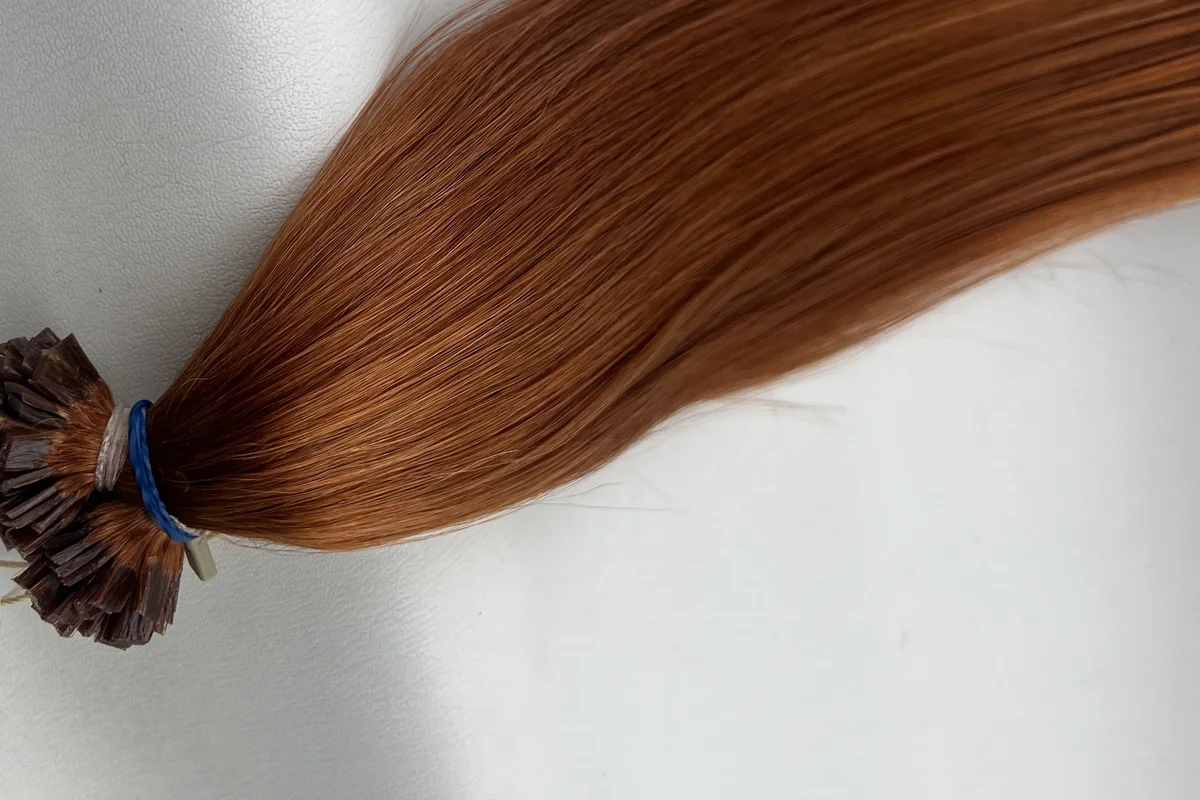
Most people searching for micro hair extensions are expecting a small metal ring, because that is what the phrase has come to mean in retail listings. In our range it means something else, and the difference is not branding. A Micro strand is held by a keratin bond formed around the hair with heat; a micro-ring is held by a tube crimped flat with pliers. They fail differently, they are removed differently, and they suit different heads.
Micro sits second in our own seven-system evaluation — our list, our products in it, one characteristic measured — and second here is not a consolation prize. It has the longest track record of anything we make, and there are situations below where we would put it ahead of our flagship.
What a Micro strand physically is
A Micro order arrives as individual strands. Each is a small bundle of hair, cut to a stated length, with a keratin bond already formed at one end in production. That bond makes a strand a unit that can be counted and attached, rather than loose hair.
The compound is a thermoplastic, and that word carries the behaviour that matters. It softens across a range rather than at a point and hardens again as it cools, with no chemical reaction. Nothing cures and nothing is mixed, which is also why a strand can be re-tipped.
Application repeats one operation: a section of natural hair is separated, the bond is heated until workable, the technician shapes it around that section, and it hardens as it cools. A head is that carried out between roughly a hundred and a few hundred times.
None of this describes the hair inside the strand. Origin, cuticle direction, drawing standard, colour processing and length are a separate set of decisions, and a well-made joint loaded with poor hair is still a poor purchase — that half of the specification is on the hair extensions pillar page.
- Attachment family: individual bonded strand, one unit per attachment point
- Bond material: an Italian keratin compound, thermoplastic, formed on the tip in production
- Per-strand weight: supplied at approximately 0.5–0.6 g, bond included; the batch we weighed averaged approximately 0.6 g
- What we do not publish: bond dimensions, compound composition, application temperature, minimum hair length, retention figures
Micro is a bond. A micro-ring is a crimped metal tube. The prefix is a coincidence
This belongs at the top of the page rather than in a footnote, because it is the misunderstanding most likely to cost somebody their own hair.
A micro-ring — also sold as a nano-ring, micro bead, micro link or micro loop — holds by compression. A short metal tube, usually aluminium or copper and commonly silicone-lined, is threaded onto a section of natural hair, the extension introduced alongside it, and the tube crimped flat with pliers. No adhesive, no polymer, no heat; it opens by squeezing the tube round again.
Micro holds by encapsulation. A keratin compound is softened with heat, formed around the natural hair section and left to harden, so the grip is a mechanical interlock between two bundles of fibre held inside a solid. There is no tube and nothing to crimp. It is released by the remover specified for that compound.
The failure modes follow the mechanisms. A ring slips when under-crimped, crushes fibres when over-crimped, and loses grip as its lining wears. A bond fails when formed too thin, worked outside its temperature range, or wrapped around too many fibres. Suitability splits the same way: a ring needs enough hair to hide a solid object, while a bond can be made smaller and smoother.
The removal procedures are not interchangeable in either direction, and this is where real damage happens. Pliers applied to a keratin bond crush it and the hair running through it. Solvent applied to a metal ring does nothing, so whoever is holding it starts pulling. A client who has worn rings arrives expecting a five-second release.
Two further clarifications. Micro is not Nanofilament: both are ours and both are bonded strands rather than rings, but they are separate products with different construction and unit weights. And Nanofilament is not a ring either, despite the shared prefix — it contains no tube. The retail vocabulary of micro ring, loop, link and tip is untangled on the methods hub.
- Micro — encapsulation. Keratin softened with heat and formed around the hair. Released with the specified remover.
- Micro-ring, nano-ring, bead, loop — compression. Metal tube crimped flat with pliers. No adhesive, no polymer, no heat. Released with pliers.
- Nanofilament — our other bonded strand system. No tube, no crimp, no base.
- What these names share is a prefix, not a mechanism.
Italian keratin: what the compound is, and what naming its origin does and does not buy
The trade calls this material keratin, and the word does less work than most buyers assume. It is a bonding compound engineered to soften, wrap and set. We publish no composition, because we do not formulate it: we specify a compound to a chemical supplier and form it onto our strands.
Origin is nonetheless a real distinction rather than a nicer-sounding adjective. Compounds of this class come from a small number of specialist chemical manufacturers, several of them in Italy, and their formulations differ measurably in the behaviours below. Naming the material and its source begins a specification; the phrase with no behaviour attached is a label.
The honest boundary: we have run no comparative melt-range testing across competing compounds. What we hold is a specification, a supplier relationship, and the evidence of what comes back when something has failed — genuine, but skewed, because nobody returns a parcel to say the bonds held.
That answers a question a careful reader will already have. If Micro is a keratin bonded strand, why does our list place Micro second and generic keratin fifth? Those positions are about joint scale rather than chemistry: a classic keratin bond is a larger unit, and our criteria weight per-point mass and concealment heavily. On coarse, dense hair it remains a sound choice. How we separate a specification we set from an observation we made is described in our testing methodology.
- Softens evenly through its depth, not only at the surface
- Stays workable long enough for the joint to be shaped properly
- Sets clear rather than clouding against light hair
- Stays flexible when cold instead of turning brittle
- Dissolves cleanly in the specified remover rather than going gummy
The working window is narrow, and it is where the skill lives
A thermoplastic has no single melting point. It softens progressively across a range, and a Micro application is a timed operation inside that range. The correct verb is softening rather than melting: the material has to reach a state where it can be shaped around a section of hair, then cool undisturbed.
Below the window the compound never becomes properly workable. It resists shaping, so the technician either forces it into an uneven form or wraps it around only the outer fibres of the section. Both give a joint that looks acceptable on the day and later lets go, or slides down the shaft under brushing.
Above the window it thins. It runs where it was not wanted, loses the body it needs to hold a shape, can cloud, and the excess heat has to go somewhere — into the client's own fibres in the middle of the joint. Heat damage here is not caused by the existence of a heat tool, but by too much heat held too long in one place.
Dwell time matters as much as the temperature reading, and tips carrying residue from earlier joints read differently from clean ones. So we publish no temperature figure: the right setting is a property of the compound, the tool and the technician's rhythm together. This is the skill-dependent part of the system, and the variance between two pairs of hands is larger than the difference between most products.
One joint, two contradictory jobs
Every bond is a compromise between two demands that pull against each other. For months it must not let go under anything the wearer's life produces. Then, in seconds, it must let go completely and take none of the client's hair with it. Failures at that second end are the ones that cost people hair.
The first job is relentless: wetting and drying several times a week; shampoo surfactants, and conditioner and oil at the root whether or not the client was warned; hot air at close range; brush teeth daily; a pillow every night; chlorine, salt and ultraviolet every summer. Through all of it the bond must stay small enough to hide, smooth enough not to saw at the fibres inside it, and rigid enough not to migrate down the shaft.
A Micro joint carries roughly twice the mass of the smallest unit we make, which shifts the balance in both directions. Each joint does more work, so a badly built one shows its weakness sooner; there are also half as many to go wrong, to inspect, and to open at removal.
About our own joint we publish exactly one number, the one we put on a scale: the bond material sits inside the per-strand weight below. No dimension, no hardness, no composition — we hold no measurement to attach to them.
0.6 g per strand: what a heavier unit costs and what it buys
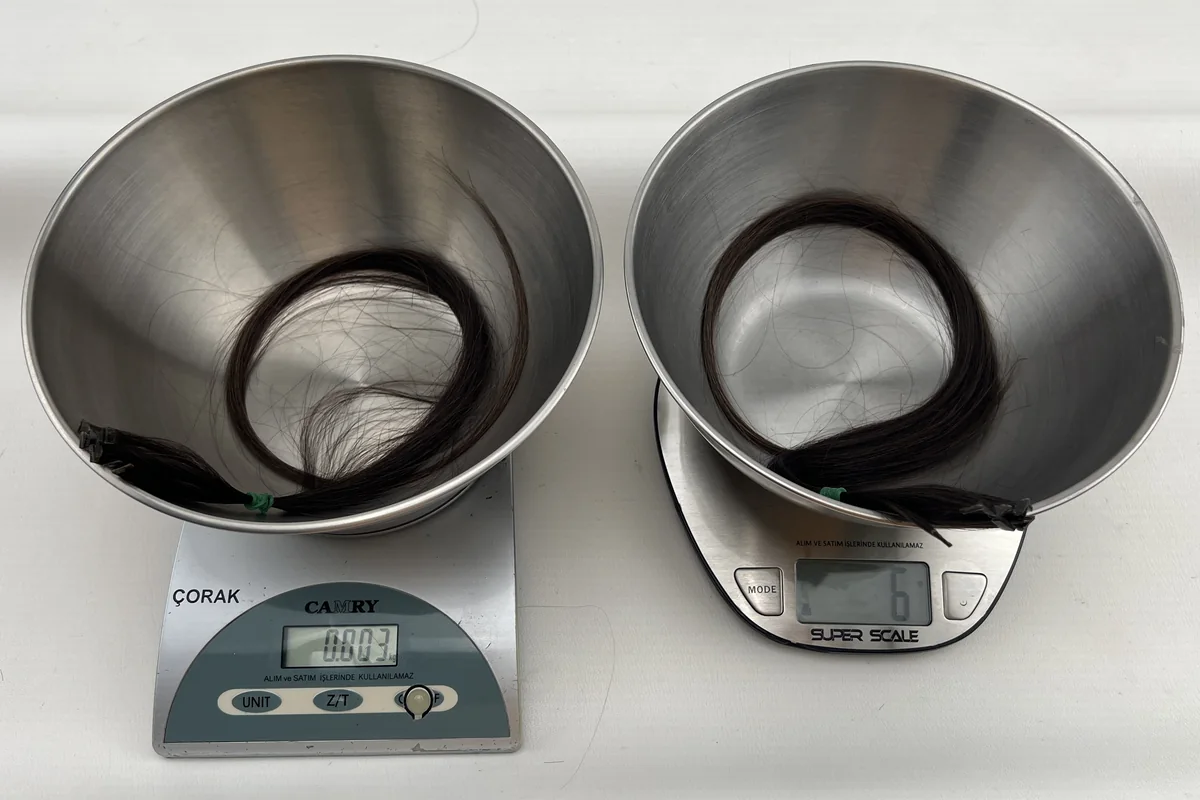
Ten Micro strands, weighed together, came to approximately 6 g. Ten Nanofilament strands came to approximately 3 g. Dividing each by ten gives approximately 0.6 g and approximately 0.3 g per strand. That is the whole of the measurement; the rest of this section is the framing that travels with it.
It is a batch reference comparison from our own production: not a laboratory test, not made on calibrated legal-for-trade equipment, and not a direct single-strand measurement. The per-strand figures were derived by division, which makes them averages, and we have not characterised how far individual strands sit from them — so reading 0.6 g as a tolerance is reading in something we did not put there.
The arithmetic that follows is the practical content, and it uses the measured 0.6 g rather than the lower end of the supplied range, because that is the figure we actually weighed. One hundred grams in 0.6 g units is roughly 170 attachment points; the same hundred grams in 0.3 g units is roughly 330. Identical grams on the head, identical total load, two appointments differing by a factor of two.
A heavier unit is not a fault, and reading it as one gets the trade backwards. Fewer points means a shorter fitting, fewer joints to inspect at every move-up, a shorter removal, and fewer tips to re-form. The cost is just as plain: each Micro point carries about twice the mass, so it needs a larger support section and is a larger object to conceal. On dense hair that is a non-issue; on very fine or sparse hair near a worn parting, it decides the plan.
Micro holds second place in our own evaluation of seven attachment systems, and the disclosure is what makes that placement usable. It is the manufacturer's own evaluation of a set containing its own products; our two products hold the top two places; we chose the criteria and weightings; nobody was blinded and no independent party reviewed any of it. Weight per strand is the single characteristic measured, for two of the seven; retention, comfort and comparative load were not. The criteria are published in the systems comparison.
Support section size, spacing and zone discipline decide more than the product does
Every joint has two sides. One is the strand, whose weight we set in production. The other is the section of the client's own hair taken to support it, whose size is decided in the chair, by eye. How much mass hangs on how many fibres is the real engineering of an application, and only one half of it is ours.
The support section has to be matched to the unit, and a 0.6 g unit needs more hair under it than a 0.3 g one. Take too little and load concentrates onto a few fibres, which is the mechanism behind breakage at the joint line. Take too much and the advantage of dividing the weight is thrown away, while the joint gets larger and harder to hide.
Zone discipline matters more with a heavier unit than a light one. Density on most heads is not uniform — the crown and the area around a parting are usually thinnest — so a plan that spaces every point identically will be right in some zones and wrong in others. Where a zone cannot support a 0.6 g point at reasonable spacing, the honest answers are to place nothing there or to specify a smaller unit for it. The rest is where rows fall relative to the partings the client actually wears, and what the result looks like when the hair is pulled up.
We publish no figures for section size, spacing or distance from the hairline; every number of that kind in circulation is a salon habit repeated until it looked like a standard. A technician holding a bond against the scalp and dropping the hair over it learns more than any table.
Grams are decided first, division second, and the cut is not optional
Total grams is a decision about the result, taken before the system is chosen: how much length and how much fullness are being added, on a head with a given amount of hair already on it. Only once that number exists does dividing it by 0.6 g produce a point count. Length raises the grams requirement disproportionately, because a few long strands read as stringy where the same weight in shorter strands would not.
The blend is where a set becomes hair rather than an addition, and it is the step clients most often underestimate. Extension hair arrives at one length and one weight distribution. It has to be cut into an existing shape, with the natural hair layered over and into it, at the end of an already long appointment.
Double Drawn is our preferred standard for Micro, and it changes where mass sits along the length: shorter fibres are removed in repeated hand passes, so the strand stays fuller towards the tip instead of tapering. What it does not change is what one attachment unit weighs — a 0.6 g strand weighs 0.6 g whether the hair inside it was single drawn or Double Drawn.
That matters because total load is governed by total grams and by weight per point, never by the drawing standard, and treating the two as the same thing is the most common error in specifying for delicate hair. The full reasoning is on the page on extensions for fine hair.
What the appointment consists of, and what we will not tell you about its length
Most of the work that decides the outcome happens before any hair is attached. The hair and scalp are assessed in person: density zone by zone, fibre diameter, elasticity, the hairline, and how short the shortest layers are where joints would sit. Colour is matched against physical samples in daylight, never a screen. Then total grams, then the placement plan.
The fitting itself is repetition. The head is worked in rows from the bottom upwards, each strand joined to its own support section, each joint left to cool before the next section is dropped. Rhythm is what a practised technician has that an occasional one does not, and it shows in the consistency of the joints rather than the speed.
We publish no figure in hours. We manufacture rather than apply, and any duration we quoted would be somebody else's working day with our name attached. What can be stated is the ordering: fitting time tracks attachment points almost linearly, so a Micro specification takes roughly half the point-driven time of the same grams in 0.3 g units, and considerably more than a tape or weft application. Ask your technician for their own figure at your point count.
Hair is priced by gram and length, application by the technician's hours, consumables as a smaller third line. Settle two things in writing beforehand: what a move-up costs, and what happens if a joint fails in the first fortnight.
The move-up interval is set by your growth rate, not by the product
A joint fitted close to the scalp travels outwards at whatever rate that head grows. Once it has travelled far enough, three things happen together: it becomes visible when the hair moves, it gains leverage on the fibres holding it, and it starts collecting shed hair. That is the trigger for a move-up.
So we publish no interval in weeks. Growth rates differ between individuals by enough to make a single figure meaningless, and the intervals circulating between supplier websites are salon habits. Your technician can measure your own growth between two appointments.
Micro is honestly easier to live with here than a smaller unit: half the points means half the joints to check and re-form, and a maintenance appointment that is shorter and usually cheaper. For a client who will not fund a long visit every couple of months, that decides whether a set survives its second year. The arithmetic runs the other way if the interval slips, because a migrated 0.6 g joint has more mass at a longer lever arm. Micro is more forgiving of a budget and less forgiving of a diary.
The failure that actually turns up is rarely a joint letting go. It is matting at the attachment zone, where shed fibres that cannot fall out collect around the joints and are worked into a mass by friction and bulk drying.
- Dry the attachment zone thoroughly — a damp joint plus friction is where matting starts
- Keep conditioner, masks and oils on the mid-lengths and ends, away from the bonds
- Wash with the head upright, and brush from the ends upwards
- Keep straighteners and tongs off the bonds — the compound softens with heat by design
- Rinse straight after chlorine or salt water, and dry the roots
Removal: the remover made for the compound, and why pliers are not an alternative
There is one correct release for a Micro joint: the agent specified for that compound, given time to work, with the softened bond broken down and combed clear before anything is pulled. Almost every case of hair destroyed at removal that reaches this factory involved either the wrong agent, or the right agent used without patience.
That agent is specified for the compound, and a general-purpose solvent from a salon drawer is not automatically a substitute: a chemistry that dissolves one compound may swell another into a gummy state that smears through the mid-lengths. If the supplier will not say what releases their strands, ask before buying.
The point that most needs stating here: a Micro bond cannot be opened the way a ring is opened. A ring is squeezed round again with pliers and slides off in seconds. The same pliers applied to a keratin bond crush the bond, the extension hair and the client's own fibres running through it. Removal is a full appointment and should be booked and priced as one — though with roughly half the point count of our smallest unit, a Micro removal is the shorter of the two.
Expect a rush of loose hair afterwards and do not read it as damage: shed fibres held above a joint cannot fall until it is opened, so months of ordinary shedding arrives at once. A different matter, for a qualified professional before anything is reinstalled, is broken fibres standing up along the joint line, thinning at the temples or nape, or scalp tenderness that persists.
Reuse splits the product in two. The bond is the consumable; the hair usually is not. Strands are released, cleaned of residue, re-tipped with fresh compound and reinstalled close to the scalp, losing a little length at the tip each cycle. How many cycles a specification survives we have not assessed, and we hold no failure counts.
Where we would specify Micro ahead of our own first-placed system
A ranking is only worth publishing if the manufacturer will say when the lower-placed product is the better buy. Second place is the result of criteria we chose and weighted ourselves, not a verdict on the system.
When the technician's experience is in bonded keratin work. This is the strongest case and the one most often ignored. A system fitted confidently by someone with years of rhythm in it outperforms a better-ranked system fitted tentatively for the first time, and heat control is a manual skill built over hundreds of joints. Micro sits inside the tooling and habits most experienced strand technicians already have.
When the client will not fund long maintenance, or cannot sit for the longest fitting we can produce. A set is a purchase plus a service commitment repeated for as long as it is worn, and half the point count means shorter move-ups and removals for its whole life. A client whose budget is a modest visit every couple of months is better served by a system that fits it than by a finer one she stops maintaining.
When the hair is coarse or dense and the goal is a substantial density change, a larger joint disappears effortlessly, so the concealment advantage that puts a smaller unit first buys nothing while its point count still costs the hours. The same applies to a set that will be re-tipped several times: half as many joints to open and re-form is a lower cost of ownership.
None of that makes Micro a lesser product with a consolation argument attached. It is an established professional system with a long track record, and the distance between it and our first-placed system is one measured characteristic weighted by criteria we selected. Weight application hours and cost of ownership heavily instead, and the order changes.
Where Micro is the wrong choice, and what to use instead
Each case below names an alternative, including systems we do not manufacture. None is absolute, but each describes the mechanism working against the brief.
When the natural hair is very fine or sparse in the zones being worked. A 0.6 g point needs a support section proportionate to it, and a solid object has to hide under limited hair; both bite hardest where clients most want fullness, at the parting and the crown. The alternative is our smaller 0.3 g unit, which divides the same grams across roughly twice as many points, or a lower total, or both.
When heat and polymer must not touch the joint at all. Hair with a heavy chemical and thermal history, or a client who reacts to removal solvents, rules out the bonded family however good the compound is. The bead and micro-ring family, sixth on that same self-assessed list, exists for that brief: no heat, no chemistry, mechanical release. We would specify it ahead of our own products there, and again where the correct remover is not reliably available, because a joint that cannot be opened correctly will be opened improperly.
When the appointment has to deliver maximum visible change in minimum time. Micro is faster than a 0.3 g strand specification and slower than anything with fewer attachment points, so where hours are the hard limit, the tape-in family delivers more change per hour and on suitable hair a weft delivers more still.
And the case that rules out everything on our list, ours included: hair or scalp that cannot carry sustained load. Active shedding of unknown cause, an inflamed or broken scalp, a hairline showing traction damage, hair too short where joints would sit, or over-processed hair that stretches and does not recover when wet. The honest options are temporary pieces that come off at night, or nothing until the cause has been assessed by a qualified professional.
What we have not measured about Micro
Our vantage point is a bench, a scale and the parcels that come back when something has gone wrong: good evidence about components, poor evidence about wear.
The compound is the largest gap. We specify Italian keratin against behavioural criteria and have run no instrumented melt-range testing, on our own compound or on competing ones. We cannot tell you a softening range in degrees, or how any of them behaves after a year of ultraviolet. Everything above about the working window describes how thermoplastics of this class behave, not a curve we produced.
We publish no claim about how visible this system is, in any wording. We hold no controlled assessment of concealment: no standardised lighting, no range of hair types, no blinded assessor. Without that, a statement about visibility would be an impression from our own bench presented as a finding.
The formal disclosure, in one place. This is the SACH & VOGUE HAIR technical evaluation of seven attachment systems, in which Nanofilament is first and Micro second, both ours. We chose the criteria, set the weightings and carried out the assessment; nobody was blinded, and no independent party reviewed it. One characteristic was measured — weight per strand, for two of the seven, by weighing batches of ten and dividing. A disclosed conflict of interest is still a conflict of interest.
Two findings would move Micro's position. If individual weighing of a large sample showed variance wide enough that the two-to-one ratio does not hold, the measurement this page rests on would need republishing. And if retention data showed that a larger, better-supported joint outlasts a smaller one, the criterion that puts Micro second would deserve less weight.
- Softening range of our compound in degrees — never instrumented
- Comparative testing against competing keratin compounds — never carried out
- Variance of individual strands around the 0.6 g average — not characterised
- Retention over months of real wear — not measured, no study known to us
- Concealment under standardised lighting — no assessment, and no visibility claim
- Weight of any competitor bond, panel or ring — never weighed by us
- Reinstallation cycles a set survives — no failure counts held
Frequently asked
Common questions
Are micro hair extensions the same thing as micro rings?
No, and the shared prefix is a coincidence rather than a family resemblance. In our range Micro means an individual strand held by a keratin bond formed around the hair with heat, released with the remover specified for that compound. A micro-ring, nano-ring, bead or loop is a metal tube crimped flat with pliers, with no adhesive and no heat, released by squeezing it round again.
Is Micro the same as Nanofilament?
No. Both are ours and both are bonded strands rather than rings, but they are separate products with different construction and different unit weights. Micro is supplied at approximately 0.5–0.6 g per strand and the batch we weighed averaged approximately 0.6 g, so the same total grams divides into a different number of attachment points. Nanofilament is first and Micro second in our own evaluation — a manufacturer's list containing its own products, in which one characteristic was measured.
What does Italian keratin actually mean?
It names the bonding compound and where it comes from. Compounds of this class are made by a small number of specialist chemical manufacturers, several of them in Italy, and their formulations differ in softening behaviour, clarity when set, cold flexibility and how cleanly they dissolve at removal. We specify the compound to a supplier rather than formulating it, publish no composition, and have run no comparative testing.
What does one Micro strand weigh?
Micro is supplied at approximately 0.5–0.6 g per strand, bond material included, and the batch we weighed sat at the top of that range. Ten Micro strands weighed together came to approximately 6 g, and ten Nanofilament strands to approximately 3 g. The per-strand figures are derived by dividing by ten rather than weighed individually, which makes them averages. It is a batch reference comparison — not a laboratory test, not calibrated, not legal-for-trade, and not a direct single-strand measurement.
Can Micro bonds be removed with pliers, like rings?
No, and attempting it is how hair gets destroyed. A ring is squeezed round again and slides off in seconds with no chemistry involved. A keratin bond has to be broken down with the remover specified for that compound, given time to work, and combed clear before anything is pulled — pliers simply crush the bond and the fibres running through it.
Is Micro suitable for fine hair?
Sometimes, and it is assessed on the specific head rather than inferred from a photograph. A 0.6 g point needs a support section proportionate to it and enough hair above it to conceal it, and both bite hardest around the parting and the crown, where fine-haired clients most want fullness. Where those zones are the problem, the same grams divided into 0.3 g units is the usual answer.
Why is Micro second rather than first in your ranking?
Because we weighted mass per attachment unit, fine division of load and joint concealment above everything else, and on those three a smaller unit scores higher. It is equally true that we make both products, that we chose those weightings, and that they select for what we manufacture. Weight application hours and cost of ownership heavily instead and Micro moves to the top.
Related pages
Continue reading
Tell us the hair you are working with, the grams you have in mind and the appointment length the client can realistically fund, and we will tell you whether Micro is the right specification — including when it is not.
Method, colour, length and grams are settled by consultation before anything is quoted.