Fethiye / Muğla
Tape-In Hair Extensions in Fethiye: A Short Fitting and a Cycle That Runs at Home
A tape-in extension is a flat panel of hair carried on an adhesive strip and closed onto a thin section of your own. On a short trip the appeal is obvious: a head takes dozens of panels where a strand system takes hundreds of joints. The trade-off is that the recurring work — releasing them, cleaning the edge, spending a fresh strip and refitting — happens wherever you live. The free monthly check covers Micro applied by us, not tape.
Tape is the method visitors ask for first, usually for a sound reason: the fitting is short and a holiday is not. What that hides is that a taped set moves most of its work into a salon you have not chosen.
We make taped panels in Fethiye and fit them here; this page is the local half.
Why a short trip suits tape, and what you trade for it
A panel carries its weight across an adhesive area rather than at a point, and a head takes dozens of them rather than hundreds of separate joints. That is the speed argument, and it is genuine. How a panel is built, and where one should not be placed, is on the tape-in page.
What it costs is not paid on the day. The adhesive is a consumable that cannot be reused, so each panel takes a new strip at each reinstallation. On a holiday fitting that line lands in somebody else's invoice, months later.
Price the year, not the appointment, in the country you will live in.
The re-taping cycle runs after you leave: what to tell the next stylist
Growth decides when a set comes down, not a calendar, and we publish no interval in weeks.
Clients assume a re-tape is an adjustment. It is not. The panels come off with the remover made for that adhesive, and old residue has to be cleaned from the anchored edge — the step most often hurried, since a new strip pressed onto old adhesive is holding residue rather than the panel. Then a fresh strip, and the panel goes back near the scalp.
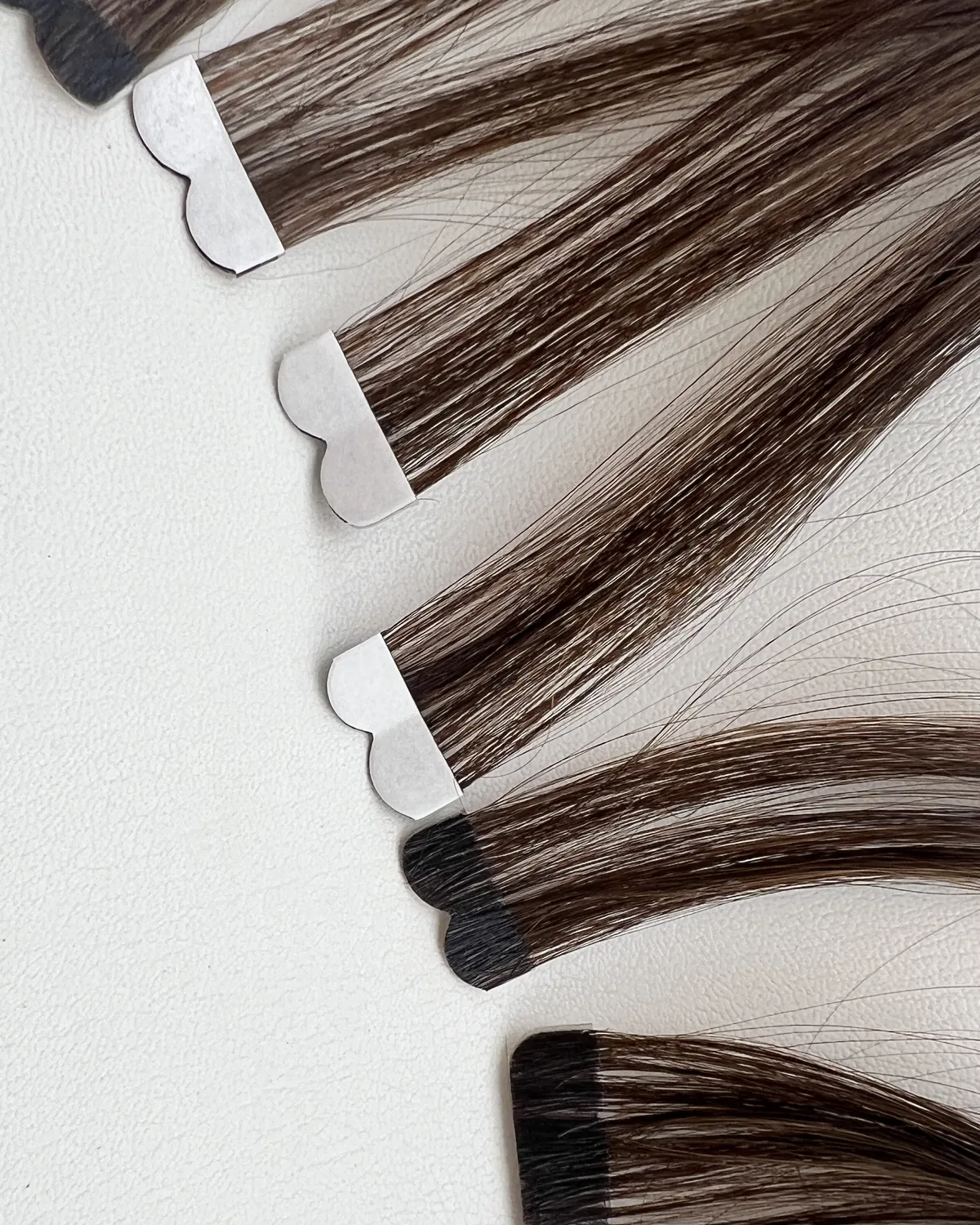
Four things belong in writing before you fly: which product you are wearing, and whether its adhesive face is the shaped Butterfly form or the rectangular Standard tab; which remover is specified for it; that a strip is spent at every cycle; and the shade codes with their catalogue. Ask whether your salon's figure includes strips or bills them separately, and check that it follows the correct release procedure.
Sun cream, hair oil and salt water against an adhesive face
Adhesion is a surface event, and a surface is easily occupied. Anything oily at the root gets in between the adhesive and the hair: leave-in conditioner, hair oil, dry shampoo — and here, sun cream and after-sun, which arrive on your own hands whenever you push your hair back.
Water behaves differently. In a sandwich your hair is captured between two adhesive faces, and sea or pool water saturates that space rather than running off. Repeated saturation, and the bulk drying that ends an afternoon at the sea, is what matts an attachment zone.
We have run no testing of our adhesive against sun cream, salt or chlorine; the above is mechanism, not measurement. Somebody swimming daily is often better served by a bonded set fitted here.
Drying a panel is a separate job from drying your hair
Hair dries quickly on this coast and a panel does not. Water held between two adhesive faces leaves from the edges inwards, so hair around a panel can feel dry while the joint is wet — which is where matting starts.
The routine is short. Rinse in fresh water before the salt dries. Blot the panels rather than dragging a towel across them, because that lifts the top edge, and an edge is where an adhesive joint gives way first. Dry the root area with the hair lifted, and never sleep on a damp panel.
One timing point belongs to this method alone. An adhesive joint is weakest immediately after closing, because the material needs time under pressure. A fitting on the morning you plan to swim is the wrong order: ask how long to wait before the first wash.
The free monthly check does not cover tape
Better written down than assumed. The free monthly check covers Micro applied by us in Fethiye, while the wearer carries hair supplied or applied by the company. It does not extend to tape, it is not a medical guarantee, and it is not automatic for buyers of our hair.
Follow-up belongs to whoever re-tapes the set. And somebody who cannot reliably get back for re-taping should not be given tape at all: left too long, the sandwich fills with shed hair and ends up being cut out. Clip-in hair, removable and fitted by the wearer, is the honest alternative there.
What the labour figures cover
Tape is quoted per pair, because a veil is sandwiched between two faces. Application, removal and renewal are published together; the second and third describe ownership. Colour work is quoted apart, alongside everything else on the Fethiye price list.
What still moves a final figure:
- natural hair density
- current haircut
- colour history
- target result
- hair length
- extension method
- amount of work required
- Tape-In Hair Extension Application
- €5 per pair
- Tape-In Removal
- €3 per pair
- Tape-In Renewal (removal + cleaning + new tape + re-application)
- €7 per pair
Hair is not included in labour-only prices. These figures cover application work alone.
What to send with a tape enquiry
Our address is Taşyaka Mah., Ölüdeniz Caddesi (TSK), No: 45/1, Fethiye / Muğla, Türkiye. Confirm arrangements with us rather than off a page.
A panel puts its shade down as a solid block at the root instead of scattering it, so a match is judged there in daylight — the hub page covers how. These four beat a gallery.
- How you wear your hair in a normal week: down, up, pushed back
- Whether you intend to swim daily
- Whether your cut is blunt or heavily layered
- Whether a salon at home will re-tape, and at what price
Frequently asked
Common questions
Can a tape-in set be fitted inside a short trip?
Usually — that is the family's genuine advantage: a head takes dozens of panels where a strand set takes hundreds of joints. Two things still need planning. An adhesive joint is weakest immediately after closing, so ask how long to wait before the first wash, and never book a fitting for the morning you intend to swim. Then judge it against your year at home.
Will my stylist at home be able to re-tape this?
Most salons work with tape, so usually yes — but give her specifics rather than a description. She needs the product name, whether the adhesive face is the shaped Butterfly form or the rectangular Standard tab, the remover specified for it, and the shade codes with their catalogue. Ask whether her figure includes fresh strips, since one is spent every cycle.
Can sun cream really affect a panel?
It occupies the surface, and adhesion is a surface event. Sun cream, after-sun, hair oil, leave-in conditioner and dry shampoo all park themselves between the adhesive and the hair, and here they reach the root on your own hands whenever you push your hair back. We have run no testing against any of them, so treat that as mechanism, not measurement.
Can the panels be used again after they are taken out?
The hair often can and the adhesive never can, which is the whole economics of the family. A strip is dissolved at removal and replaced at every reinstallation, so there is no version of a taped set in which the consumable stops recurring. The hair is released, the residue cleaned off and a fresh strip mounted. How many cycles a set survives we have not assessed.
Related pages
Continue reading
Tell us your dates, how you wear your hair in a normal week and whether a salon at home will re-tape — we will say whether tape suits that year.
Method, colour, length and grams are settled by consultation before anything is quoted.