Manufacturing in Fethiye
Hair Extension Manufacturer in Turkey
SACH & VOGUE HAIR is a manufacturer-led hair company in Fethiye, Muğla, Türkiye. We prepare human hair extensions from raw hair through sorting, drawing, colour processing, blending and method preparation, and we also work with extension systems professionally in Fethiye — so what we learn at the chair returns to the production table. Alongside our own systems we develop custom specifications with professional partners, including products that begin as somebody else’s idea rather than a catalogue entry.
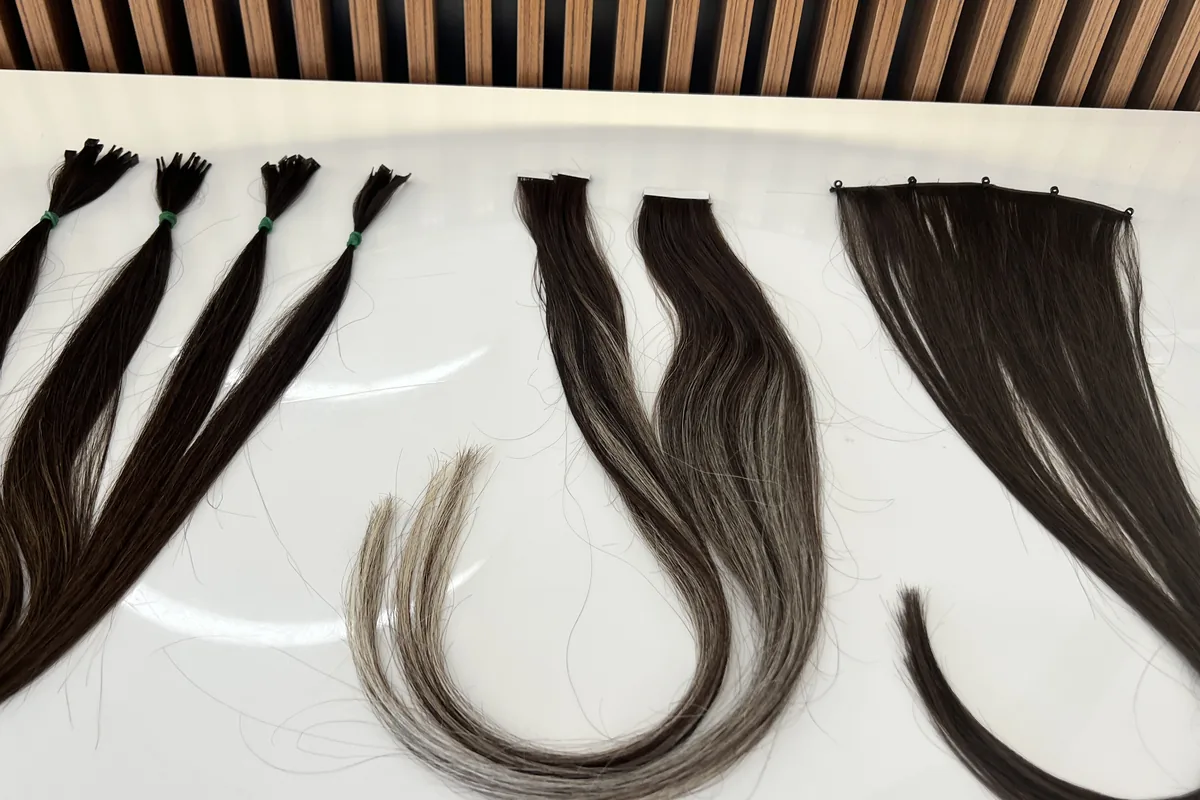
We make hair extensions in Fethiye, on the south-west coast of Türkiye. Raw hair arrives, and over a series of unhurried operations it becomes something a technician can fit and a client can live with: sorted for direction, drawn for density, processed or blended for colour, prepared into an attachment system, weighed and packed.
What follows is an account of that work — the decisions inside each step, the systems we prepare, what professional application teaches us, and how a specification that does not yet exist can be developed with us.
Made and developed in Fethiye
Our workshop is at Taşyaka Mah., Ölüdeniz Caddesi (TSK), No: 45/1, Fethiye / Muğla, 48300, Türkiye. Fethiye is a coastal town rather than an industrial estate, and the scale suits the work: batches are small enough that the person drawing a bundle is often the person who will see it again at colour, and again before it is packed. What that looks like for a visitor is on our Fethiye page.
Development happens in the same rooms as production. There is no separate department where ideas are handed over — a change to a tip, a new blend, a different weft edge is tried on the same bench, by the same hands, and judged against the last one.
Why we love working with hair
Human hair is an unusual material to manufacture with. It is not uniform, it is not synthetic, and it does not behave identically from one lot to the next. Two bundles of the same stated length and shade will take colour at slightly different rates, sit differently in the hand, and move differently once cut. Most industrial processes treat that kind of variability as a defect. Here it is simply the material, and the craft is in reading it.
That is what keeps the work interesting. A batch arrives and someone has to decide how far it will lift before condition suffers, whether the ends justify another drawing pass, whether a blend needs a third component to stop it reading flat. None of those decisions is settled by a chart. They are settled by having handled a great deal of hair and paying attention to what happened afterwards.
The questions we find ourselves returning to are small and specific. Can this attachment be less visible at the parting. Can this tip be formed more consistently. Can this colour hold its warmth once it is fitted and moving under daylight rather than a workshop lamp. Can the technician get through the head more comfortably. Each answer is incremental, and the accumulation of them is the product.
From raw hair to finished extension
The route through the workshop is consistent even though the decisions inside it are not. Raw hair is received and sorted. It is drawn to the density standard the order calls for. Colour is processed where the target shade is not the base the hair arrived on, and blended where the shade has more than one component. The hair is then prepared into its attachment system, weighed against its stated weight, and packed.
Some steps belong to other people, and it is worth naming them plainly. Raw hair is bought from suppliers and agents rather than collected by us. The keratin compound is bought to a specification from a specialist manufacturer — Italian keratin in the case of Micro — so we choose it rather than formulate it. Freight and customs are handled by carriers and brokers.
What the material terms mean mechanically, rather than commercially, is set out on the hair extensions page.
- Receiving and sorting for length and root direction
- Drawing to the density standard the order calls for
- Colour processing where the target shade is not the base the hair arrived on
- Blending where a shade has more than one component
- Method preparation into the attachment system
- Weighing against the stated weight, then packing
Sorting, direction and preparation
The first operation is the one nobody sees in the finished product and everybody notices when it has gone wrong. Hair has a direction: the cuticle lies one way from root to tip, and a bundle assembled with some fibres reversed will feel acceptable in the hand and then tangle at the joint after a few weeks of wear. No later step corrects it.
So hair is sorted for length and for root direction before anything else happens to it, and direction is checked again as the bundle moves on. It is slow, quiet work that rewards patience more than speed, and it is the foundation everything downstream is standing on.
Sorting for length at the same time is what makes the drawing standard achievable. A bundle is not one length; it is a distribution of lengths around a middle, which is why untreated hair is full at the top and tapers towards the ends.
Why we prefer Double Drawn
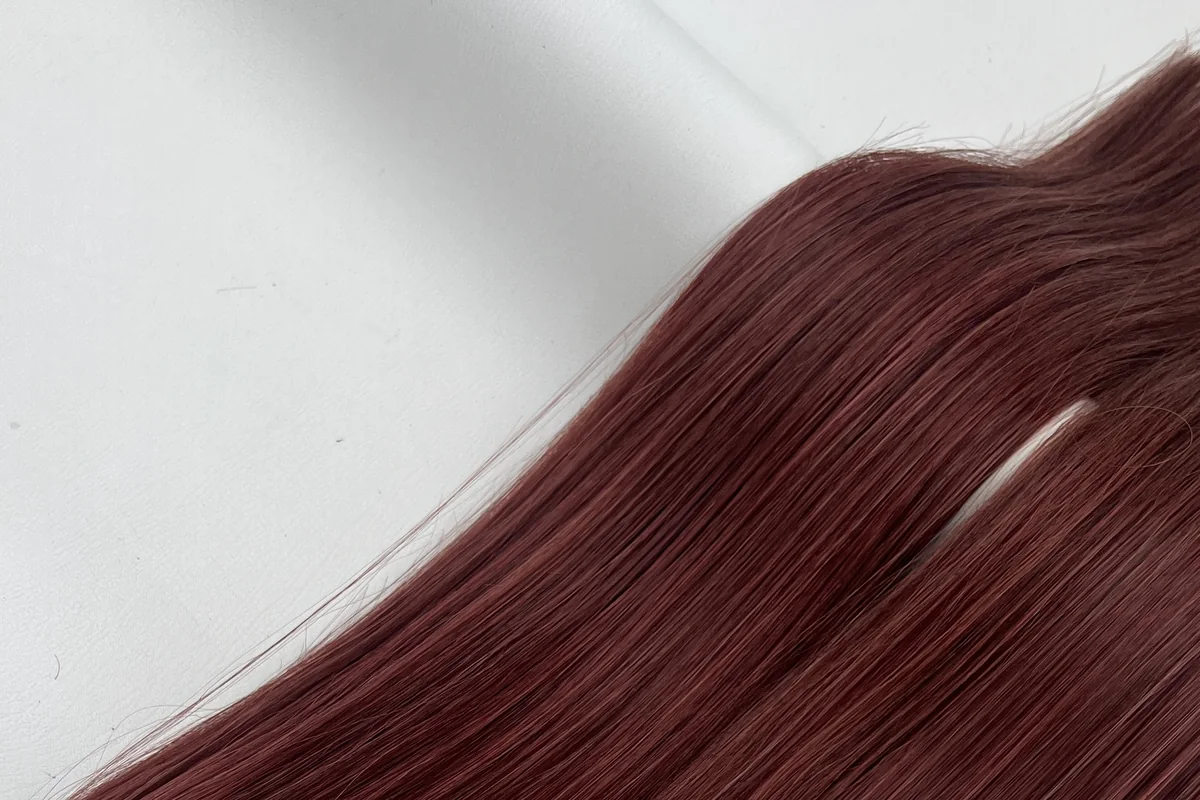
Drawing is the process of withdrawing the shorter fibres from a bundle by hand, in repeated passes, until what remains holds its density most of the way to the tip. Double Drawn is the standard we prefer, and it is an operation with a cost rather than a tier on a label.
Each pass returns less than the one before. The first removes a great deal. By the fourth, the operator is working through material that mostly qualifies already, removing a small residue for the same time spent. When to stop is a judgement against the target length and the lot in hand rather than a fixed number of passes, so we state it for the order in front of us instead of publishing a count.
The part rarely explained is the yield. Raw hair is bought by weight, so every fibre withdrawn during drawing was already paid for at full rate. It is not wasted — shorter fibres become shorter products — but it leaves that order, and the weight finally packed is a fraction of the weight that started. Both effects grow with length. Double Drawn from a given source therefore costs more per gram than single drawn, and that difference is real work rather than positioning.
What drawing changes is where mass sits along the length, not what one attachment unit weighs. A 0.3 g strand weighs 0.3 g whether the hair inside it was drawn once or several times. Single drawn remains a legitimate product and some clients specifically want the taper. Written into an order, the standard reads as a state rather than an adjective: shorter fibres removed by repeated drawing so the bundle holds density to the tip. There is more on density and how it reads once fitted on the Double Drawn page.
Colour processing
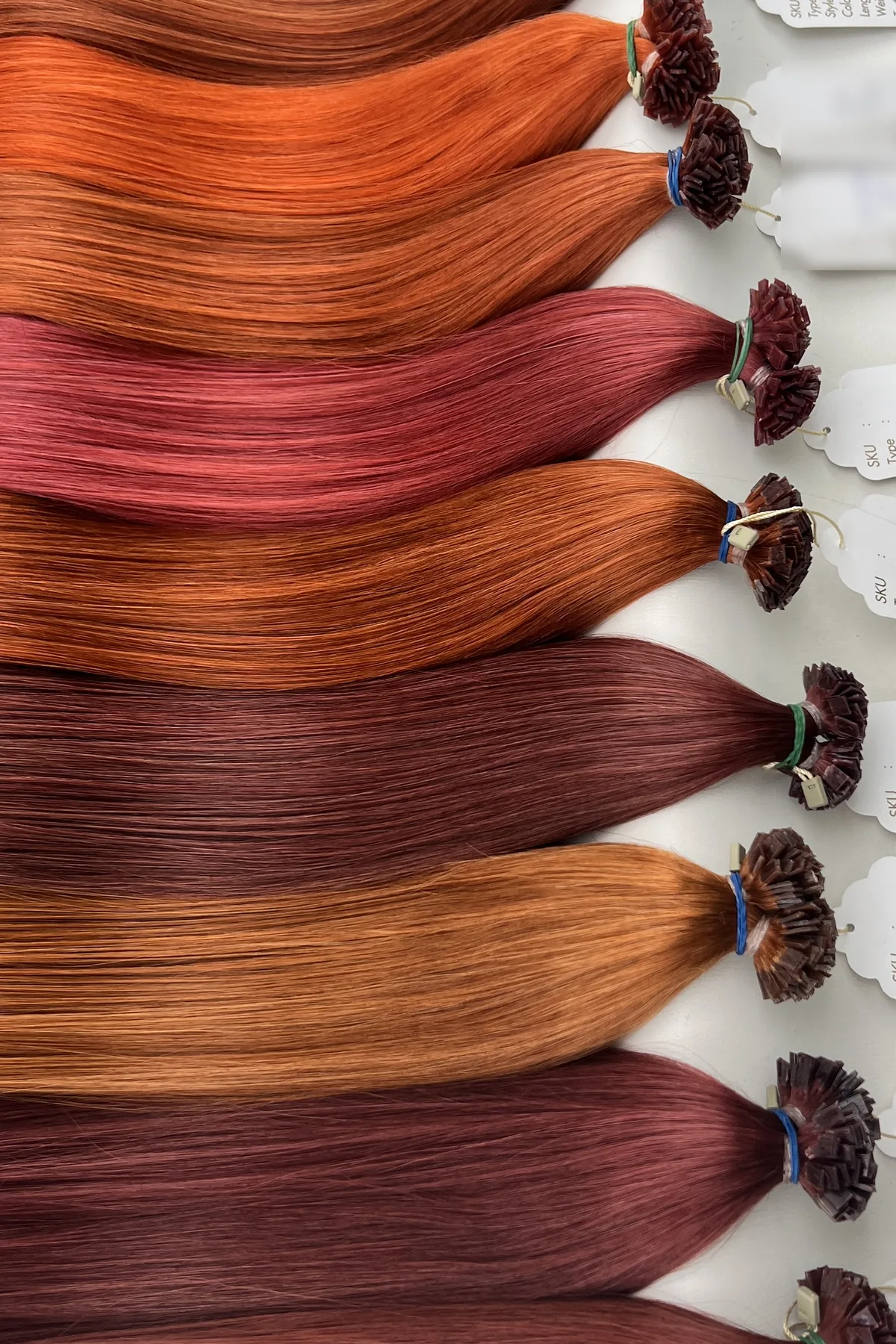
Raw hair reaches this trade on predominantly dark bases almost everywhere it is collected. Nearly every light shade in every catalogue, ours included, is therefore lifted hair rather than found hair — and lifting is the operation that most rewards restraint.
Colour work here covers lifting from those bases, depositing tone, multi-tone effects such as a shadowed root or a graduated end, and building a shade from two or three processed batches combined in proportion. Lifting is chemistry, time and loss together: pigment comes out over several passes, and some fibre does not survive the journey. Fibre that fails was bought by weight and cannot be sold.
That gives every lot a point past which lifting further costs more condition than the shade is worth. Where a target sits beyond it, the useful options are a different lot or a shade nearer the limit — and it is far better to say so at quotation than to let it be discovered after three washes. We would rather send a shade that holds together than one that matched a swatch on the day it left.
Multi-tone work is a sequencing problem more than a mixing one. A transition that looks correct laid flat on a bench can band once the bundle is cut, fitted and moving under changing light, so the judgement is always about how it will read installed rather than how it reads on the table.
Custom colour blending
Blending is taking two or more processed shades and combining them physically so that they read as one new colour. It is one of the most enjoyable parts of the work and one of the least mechanical, because the result is not the arithmetic mean of its components.
Proportion is only the beginning. How the components are distributed through the bundle changes the result as much as the ratio does — the same two shades evenly dispersed, lightly veiled or concentrated towards the ends give three different colours. Undertone decides whether a blend stays clean or turns muddy. Contrast decides whether it reads as depth or as two separate colours sitting next to each other. And movement matters, because a blend is judged in a head of hair that is being turned, lifted and lit from different angles.
This is the smallest batch size in the workshop, its yield poor by definition, and it is discussed per project. It is also where a professional partner’s eye is most valuable: a colourist who knows the client can often describe the target better in a sentence about how it should behave than in a shade code.
- Proportion of the components
- Distribution through the bundle — evenly dispersed, lightly veiled, or concentrated towards the ends
- Undertone, which decides whether the blend stays clean
- Depth and contrast, which decide whether it reads as dimension or as two separate colours
- Movement, because the blend is judged in hair that is turning and being lit from different angles
Colour matching
Matching against a physical reference works. Matching from a photograph has a physical limit that no amount of care removes: a camera sets its own white balance and the receiving screen applies its own profile, so an image carries relationships within its own frame and absolute colour not at all. Depth can often be estimated from a photograph. Undertone frequently cannot.
So we will get close from an image, often close enough, and we will say close rather than exact before an order is placed. The reliable method is physical — a shade ring posted out, or a cut sample posted in — and the approved reference is then retained here so a later batch is matched to the sample rather than to the original description.
Between batches, expect a tolerance rather than an identity. Hair is a natural fibre processed in lots, and a shade reproduced months later from different raw material is a matching exercise rather than a lookup. The retained physical reference is what makes that exercise reliable.
Nanofilament
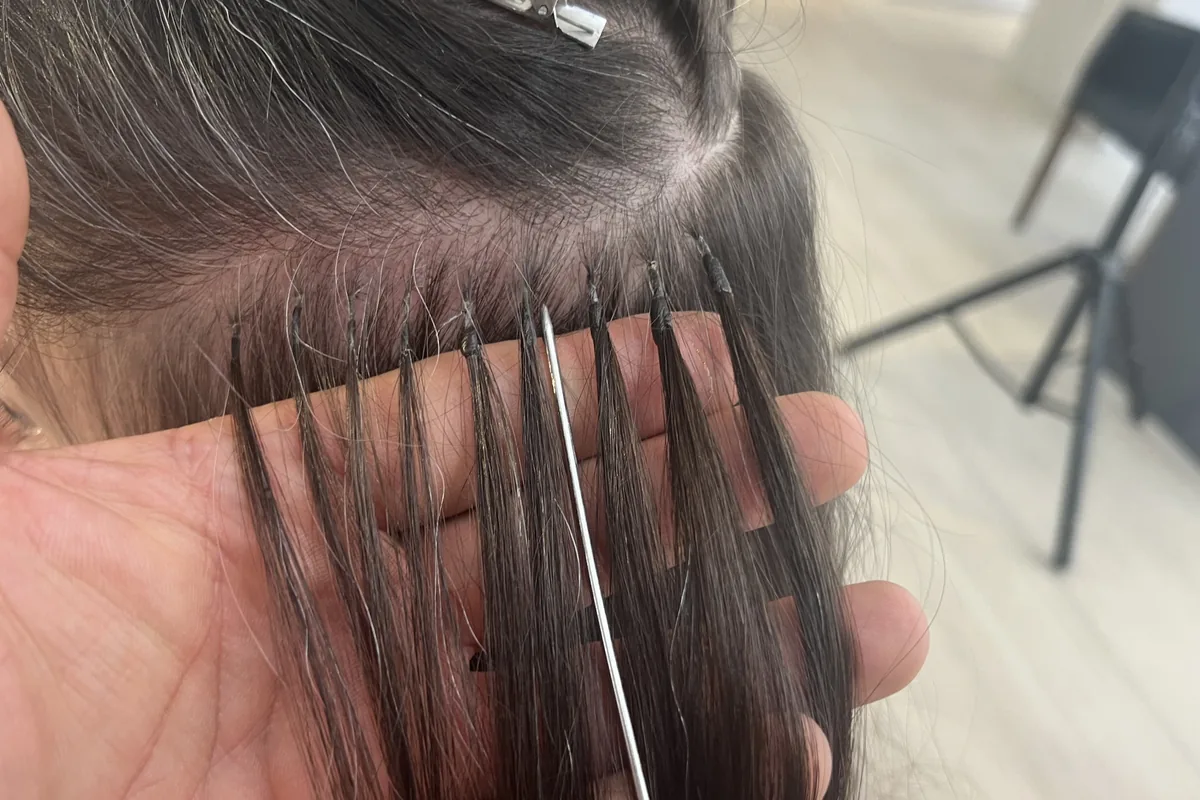
Nanofilament is our flagship system and the one we have spent the most development attention on. It is strand-based: the hair is divided into individually planned units and a tip is formed on each one, which is why the unit count rather than the total weight sets the labour. It is offered in 0.3 g and 0.6 g per-strand options. Despite the prefix it is not a nano-ring product and shares no mechanism with ring systems; the mechanism is described on the Nanofilament page.
The reason a smaller unit interests us is what happens at the parting. A smaller attachment can be placed more discreetly and distributed more finely through the head, which gives a technician more freedom in where weight sits. That freedom is the point — not a claim about what any other system does.
We have taken one measurement and it is worth stating precisely, because precision is the whole value of it. Ten Nanofilament strands of the 0.3 g option, weighed together, came to approximately 3 g. Ten Micro strands, weighed together, came to approximately 6 g. Dividing by ten gives approximately 0.3 g and approximately 0.6 g per strand. These are batch references divided out rather than individually weighed strands, so they are averages, and it is a workshop comparison rather than a laboratory test.
Micro
Micro is our individual bonded strand system, prepared with Italian keratin, in a supplied range of approximately 0.5–0.6 g per strand. Like Nanofilament it is prepared unit by unit. It is a bonded strand product and not a ring, bead or nano-ring system — a distinction worth keeping clear because the naming in this trade invites confusion. The mechanism is on the Micro page.
Preparing a bonded tip well is a repetition skill. The tip has to form cleanly, hold consistently, and present the same way to the technician on the two-hundredth unit as on the first. Consistency across a batch is the quality that matters most here, and it comes from the hand rather than from the specification sheet.
Tape-In systems
We prepare Butterfly Tape-In and Standard Tape-In. Tape systems are panel-based rather than strand-based, so the preparation problem changes shape: instead of forming a tip on each unit, the work is in hair alignment across the panel, even density from edge to edge, and a clean, consistent finish where the hair meets the adhesive. The mechanism of the tape family is on the Tape-In page.
Alignment is the quiet discipline in tape production. A panel with hair sitting at slightly different angles will look acceptable flat and behave inconsistently once fitted and brushed. As with sorting, it is the kind of step whose quality is invisible when done well.
Keratin preparation
Keratin bonded preparation is the broader family that Micro sits within, and the craft is the same in kind: dividing hair into units of a planned weight, forming a tip on each one, and holding that form consistent across a long batch.
We buy the keratin compound to a specification rather than formulating it. What we control is everything around it — how much hair goes into a unit, how the tip is shaped, how consistent the units are across a run, and how the finished bond presents to the technician who has to place several hundred of them in an afternoon.
Weft and sewing craftsmanship
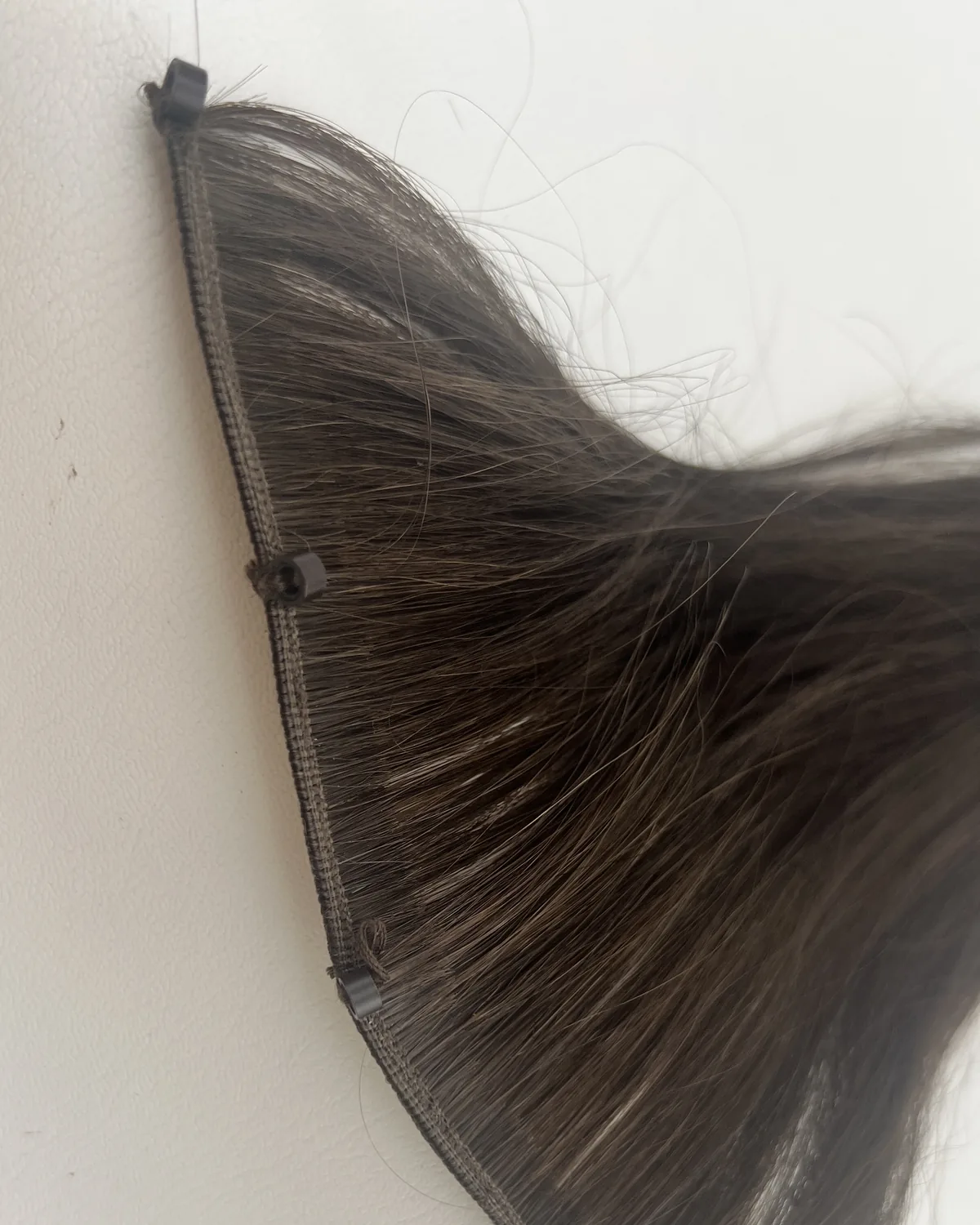
Weft work is sewing, and it is judged the way sewing is judged: by the edge. A weft has to hold consistent density along its length, run straight, and finish cleanly enough that it can be cut without unravelling and sit flat against the head without a ridge.
The seam is where skill shows. Density that drifts along the length, or an edge that thickens where the work was rushed, produces a weft that fits unevenly and reads as bulk in the wrong place. This is production sewing, and like tip forming it rewards a steady hand over a fast one.
Production and professional application inform each other
We manufacture hair extension products, and we also work with extension systems professionally in Fethiye. Those two activities happen close enough together that they feed one another, and that is one of the more useful things about how this company is arranged.
A product that is finished on the production table is not yet finished as a product. It becomes finished when someone has fitted it, lived with it, come back, and had it taken out again. Seeing that stage directly changes what we notice at the bench.
The observations that travel back are practical ones: how an attachment behaves once it is in place and being brushed, how a technician handles a particular unit through a long session, how a blend integrates with a client’s own colour in daylight rather than under a workshop lamp, how density reads at the ends once the hair has been cut into a shape, how a system comes out at removal, and what maintenance looks like some weeks later.
None of that is a clinical study and we do not present it as one. It is craft feedback — the ordinary accumulated noticing of people who both make the thing and use it — and it is the most direct route we have to the next improvement.
How that dual perspective shapes the way we answer technical questions is set out on the about page.
- How an attachment behaves once it is in place and being brushed
- How a technician handles a particular unit through a long session
- How a blend integrates with a client’s own colour in daylight
- How density reads at the ends once the hair has been cut into a shape
- How a system comes out at removal, and what maintenance looks like weeks later
Quality control before packing
Checks happen where a mistake is still cheap to fix. Direction is verified at sorting, because a reversed bundle cannot be rescued later. Colour is assessed against the retained reference rather than against the description. Bundles are weighed against their stated weight before packing, and the tolerance we work to belongs on the order rather than on a web page, since it depends on what is being made.
For strand systems the check is also one of consistency: units should present the same way across the run, because the technician’s rhythm through a head depends on the two-hundredth unit behaving like the first.
Some things we have not measured, and it is more useful to say so than to imply otherwise. We have not run instrumented fibre analysis, wear trials over months, or standardised colour-fastness protocols, and nothing here has been assessed by an independent laboratory. Where a figure would be an estimate, we would rather give you the reasoning than a number with false precision.
- Direction verified at sorting, before anything downstream depends on it
- Colour assessed against the retained physical reference rather than the description
- Bundles weighed against their stated weight before packing
- Strand systems checked for consistency across the run
Continuous refinement
Our attention is on refinement: how the next strand, colour, attachment and system can be made better than the last. That is a slower ambition than launching things, and it suits the material.
Refinement in practice looks unglamorous. A tip is formed slightly differently for a batch and the difference is assessed at fitting. A blend gains a third component and is looked at again in daylight. A weft edge is finished another way and someone checks how it sits after a week. Most changes are small, some are abandoned, and the ones that stay become the new normal quietly.
Bring us the product you wish existed
Not every professional buyer wants something from a catalogue. Salons, extension specialists, educators and distributors spend their working lives close to a problem, and after enough repetitions the problem starts to suggest a product: a construction that would suit a particular kind of hair, an attachment that would behave better in a specific workflow, a weight that nobody currently offers, a colour concept that does not exist as a code.
Those conversations are welcome. Some of the work we are most pleased with began as a sentence from somebody else — could we make this differently, or could this exist at all.
We cannot promise that every idea can be manufactured. Some are not feasible with hair as a material, some are feasible only at a quantity that would not suit the person asking, and some turn out on examination to be better solved by an existing product used differently. What we can promise is a real study of the question rather than a polite yes.
Bring us the idea and we will look at whether and how it can be made.
How a development project actually runs
A development conversation usually starts with use rather than with specification. What is this for, who is fitting it, on what kind of hair, and what is currently going wrong. The answer to that shapes every later decision, and starting from a drawing instead tends to produce something that is technically correct and practically awkward.
From there the work is iterative rather than linear. Material is selected. Construction alternatives are tried, because there is usually more than one way to build something and they behave differently in the hand. Colour work is developed alongside rather than afterwards, since colour and construction affect one another. Weight and dimensions are planned where the product has them. A prototype is prepared and then — this is the part that matters — it is put in front of a professional and used properly.
The feedback from that is what drives the revision, and there is usually more than one. Small development batches are practical where the concept warrants it, so the idea can be tested at a scale that reveals consistency problems a single prototype will not.
We would rather tell you at the second revision that something is not going to work than deliver a first version that technically satisfies the brief and disappoints in use.
- Understanding the intended use before any specification is drawn
- Material selection
- Construction alternatives, because more than one build usually works
- Colour developed alongside construction rather than after it
- Weight and dimension planning where the product has them
- A prototype put into real professional use
- Revision from that feedback — usually more than once
- A small development batch where the concept warrants it
Custom production for professional partners
Custom work is ordinary here rather than exceptional. A specification can vary in length, drawing standard, colour components, system, unit weight, panel or weft construction, and quantity, and most orders differ from the catalogue in at least one of those.
An honest answer to a custom request takes one of four shapes: yes, no, yes at a certain quantity, or yes with a lead time. Which one it is depends on the batch economics of the operations your order needs — a colour run, a drawing batch and a changeover cost roughly the same whether the batch is small or large, so those fixed elements have to spread across enough grams to make sense.
That is also why this page carries no minimum order, lead time or price list: each is an output of a specification rather than a property of a company, and a fixed number would misdescribe most cases. How a quotation is built up is set out on the pricing page. Send a specification and we will answer against it in writing, including where a simpler specification would serve you just as well.
- Length, drawing standard and target density
- Colour: single shade, blended components, or multi-tone effect
- System and unit weight, or panel and weft construction
- Quantity, and whether it is a first reference batch or a repeat
- Whether the specification needs to be reproducible later, and against what retained reference
Private label and bespoke projects
Private label means goods manufactured to a partner’s specification that reach the market under the partner’s name. It is a possibility here, discussed per project rather than offered as a programme with fixed terms, because in this kind of work the terms are the project.
A discussion has to settle a fairly consistent set of questions even though the answers differ every time. Which parts of the specification belong to you, and who owns a blend developed for you. What appears on the packaging. Who holds the retained physical reference the shade will be matched against next year. Whether the specification is exclusive, where, and for how long. And what documentation your market requires.
We do not publish client names or describe work done for other partners, which is a condition of doing this kind of work properly.
Working with salons, extension professionals and distributors
The people we work with most closely are the ones who fit hair for a living. A salon ordering for real clients gives us the most useful feedback loop there is, because the report comes back with context: this hair, this client, this technique, this outcome.
A relationship usually starts simply. A specification in units rather than adjectives. A quotation written against it with the variables visible. A first quantity small enough to be a test and large enough to be representative, assessed by your own technicians on real heads. Then a repeat in the same specification, which is the order that tells you whether a supplier is consistent.
What we can give a technician who did not buy from us directly is the practical information: the system name, what releases that particular joint, the shade codes with their catalogue, and what the goods were weighed to. What we will not do is advise on an individual client’s scalp from a distance — that judgement belongs to the professional in the room.
Documentation for your market
Documentation requirements differ by country and by product category. If your market requires specific documentation, tell us before ordering and we will confirm exactly what we can provide for that destination.
The people doing the work
The quality of the work ultimately depends on the people doing it — the hands that draw a bundle, form a tip, judge a blend or finish a weft edge. We are always interested in meeting experienced people whose craft aligns with this kind of production, and what we look for is described on our careers page.
Visit, or send us a specification
A visit settles in an afternoon what correspondence takes a month to cover, and we would rather show production hours than a showroom. What can be shown depends on what is running, since work in progress for one partner is not shown to another.
If a visit is impractical, send a specification — grams, length, drawing standard, colour and system — or send the idea you have not been able to buy anywhere. We will tell you what we can make, what we would have to source, and where a simpler specification would serve you just as well.
Frequently asked
Common questions
Do you manufacture, or do you resell finished goods?
We manufacture. Raw hair is received here in Fethiye and goes through sorting, drawing, colour processing, blending, method preparation, weighing and packing in our own workshop. Some inputs come from elsewhere and we name them plainly: raw hair is bought from suppliers and agents, and the keratin compound is bought to a specification from a specialist manufacturer.
Do you also fit hair extensions?
Yes. Alongside manufacturing we work with hair extension systems professionally in Fethiye. That is deliberate rather than incidental: seeing a product fitted, worn, maintained and removed tells us things the production table cannot, and those observations feed back into how we develop and prepare our systems.
Can you develop a product that does not exist yet?
Often, yes. Professional partners regularly arrive with a need rather than an order — a construction, an attachment behaviour, a weight or a colour concept that is not currently available. We will study whether and how it can be made, prepare prototypes, get them into professional use, and revise from that feedback. We cannot promise every idea is feasible with hair as a material, but we can promise a real study of the question.
What is your minimum order?
It depends on the specification, which is why no single figure appears here. A minimum is set by the batch economics of the operations your order needs: a colour run, a drawing batch and a changeover cost roughly the same whether the batch is small or large, so those fixed costs have to spread across enough grams. A catalogue shade in a stocked length therefore carries a different minimum from a blended shade at a non-catalogue length.
How do you match colour, and what should I expect between batches?
Against a physical reference rather than an image — a shade ring we send you, or a sample you send us — with the approved reference retained here so later batches are matched to the sample rather than to a description. A photograph fixes depth approximately and undertone poorly. Between batches, expect a tolerance rather than an identity: hair is a natural fibre processed in lots. Order a reference quantity first, approve it physically, and specify in writing that later lots are matched to that retained sample.
What weights does Nanofilament come in?
Nanofilament is offered in 0.3 g and 0.6 g per-strand options. Micro is supplied in a range of approximately 0.5–0.6 g per strand. Micro is a bonded strand system prepared with Italian keratin, and is not a ring, bead or nano-ring product despite similar-sounding names elsewhere in the trade.
Why is Double Drawn more expensive?
Because it is an operation with a yield rather than a grade on a label. The shorter fibres are withdrawn by hand in repeated passes, and every fibre removed was already bought by weight at full rate. The weight finally packed is a fraction of the weight that started, and both the labour and the loss increase with length. What it changes is where mass sits along the length — a 0.3 g strand still weighs 0.3 g whichever standard the hair inside it was drawn to.
Do you offer private label?
It is discussed per project rather than offered as a programme with fixed terms, because in this kind of work the terms are the project. A discussion settles which parts of the specification are yours, what appears on the packaging, who holds the retained physical reference for future colour matching, whether the specification is exclusive and for how long, and what documentation your market requires. We do not publish client names or describe work done for other partners.
What documentation can you provide for my market?
Requirements differ by country and by product category. Tell us the destination market and the product category before ordering, and we will confirm exactly what we can provide for it.
Can I visit the workshop?
Yes — ask for production hours rather than a showroom, so you see work actually running. What can be shown depends on what is on the bench that day, since work in progress for one partner is not shown to another. We are in Taşyaka Mah., Ölüdeniz Caddesi (TSK), No: 45/1, Fethiye / Muğla.
Send us a specification — grams, length, drawing standard, colour and system — or tell us about the product you wish existed. We will tell you what we can make, and what we would need to study first.
Method, colour, length and grams are settled by consultation before anything is quoted.