From the factory floor
Tape-In Hair Extensions: An Adhesive Surface, and Everything That Follows From It
A tape-in extension is a flat panel of hair mounted on an adhesive strip, joined to a fine veil of the wearer's own hair by sandwiching that veil between two strips or laying it against one. Everything else follows from that: load is carried by an area rather than a point, which keeps stress low across the contact and makes fitting quick, while producing a larger object to conceal and a stiff section that moves as one unit. The adhesive is the consumable — the hair is reusable, the strip is not, and every reinstallation spends a fresh one. In our own evaluation of seven attachment systems, a manufacturer's list containing its own products, Butterfly Tape-In sits third and Standard Tape-In fourth.
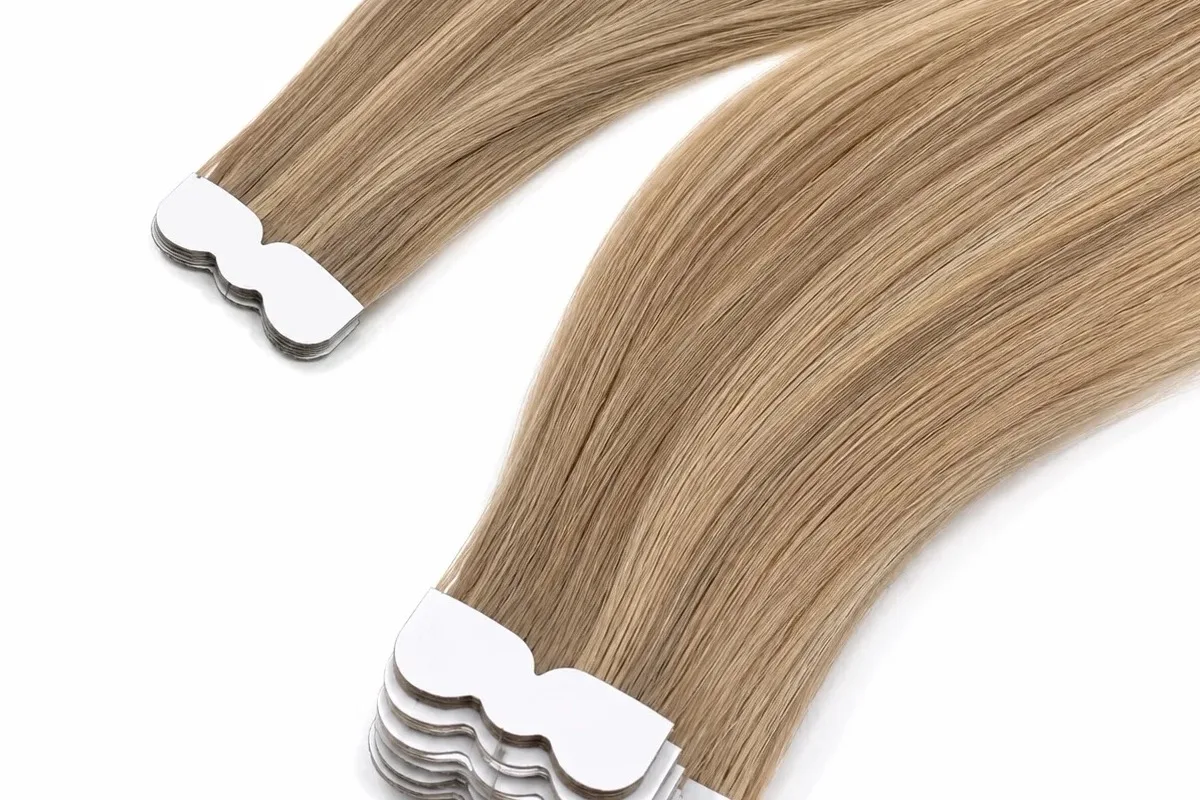
Tape is sold as the quick option, which is true and incomplete in a way that costs people money. Speed is a consequence rather than the property. The property is that grip is established across a surface, and a surface brings what a surface implies: a direction it is strong in and a direction it is weak in, a minimum amount of covering hair before it disappears, and a strip replaced every time the set goes back up.
We make taped panels, which sets the limits of what we can usefully say. We can describe how a panel is assembled and which decisions in that assembly govern shedding. We are not in the chair when one is closed on somebody's hair, and not there six months later.
What a tape-in panel physically is, and what happens when it is closed
A tape-in product is two manufactured objects joined into one. The first is a flat curtain of hair, anchored along one edge so the fibres hang in a single layer and stay in order. The second is a strip of adhesive on a thin backing, bonded to that anchored edge. What the salon receives is a panel: hair along three sides, a sticky face along the top.
The adhesive is of the pressure-sensitive class, which is a mechanical description rather than a formulation. It does not cure, is not mixed, and is not activated by heat or water. It grips because pressure brings it into intimate contact with a surface, into which it then flows slowly. So a technician presses along the whole length of a panel rather than pinching its ends, and the joint is weakest immediately after closing — which is why aftercare asks for a delay before the first wash.
There are two ways of using the panel, both in normal professional use. In the sandwich, a fine veil of the client's own hair is laid across one panel and a second closed over it, so the veil is captured between two adhesive faces that also meet where no hair passes. In the single-sided version one panel is laid against a veil and pressed, halving both the thickness of the object and the adhesive area holding it.
- Attachment family: adhesive surface, one panel per attachment point
- Grip: pressure-sensitive adhesion over an area, no heat and no chemical cure
- Consumable: the adhesive strip, replaced at every reinstallation
- Not published by us: adhesive composition, adhesive area, panel dimensions, per-panel weight, peel strength, retention
Surface load and point load: the defining property, with both of its costs
A bonded strand concentrates its work into a small volume of material gripping a small bundle of fibres. A taped panel does the opposite: the same grams are held across a contact area, so stress on any square millimetre stays low even though the panel holds several grams. Pressure spread thin is the family's argument, and it is a real one.
An adhesive joint is also directional: strong in shear, where force runs along the plane of the bond and the whole area resists together, and weak in peel, where force applied at an edge concentrates on a line that advances and unzips the joint. Gravity acts in shear, since a panel hangs in its own plane, and nothing on a head pulls one down hard enough to matter. A brush under an edge, a comb at a parting, a pillow, a ponytail — all apply peel. How each family releases is set out on the methods hub.
The area holding a panel is also not the area printed on the strip. It is the area genuinely in contact, and every fibre not touching adhesive is carried by the fibres that are. A section taken too thick, hair not completely dry, a film of conditioner or silicone, dry shampoo at the root — each reduces real contact while the panel looks identical to one that will hold for months.
Then the two costs of choosing an area. A surface is a larger object to conceal: it has thickness, an edge line, and it presents its colour as a solid block at the root rather than as scattered points. And it is stiff, because every fibre in the captured veil is locked into one plane. The trade against a strand system runs both ways: hundreds of small joints cost hours at every appointment, but one failure is minor, where a lost panel is a visible gap.
The tape family, correctly separated: Butterfly, Standard, and narrower formats
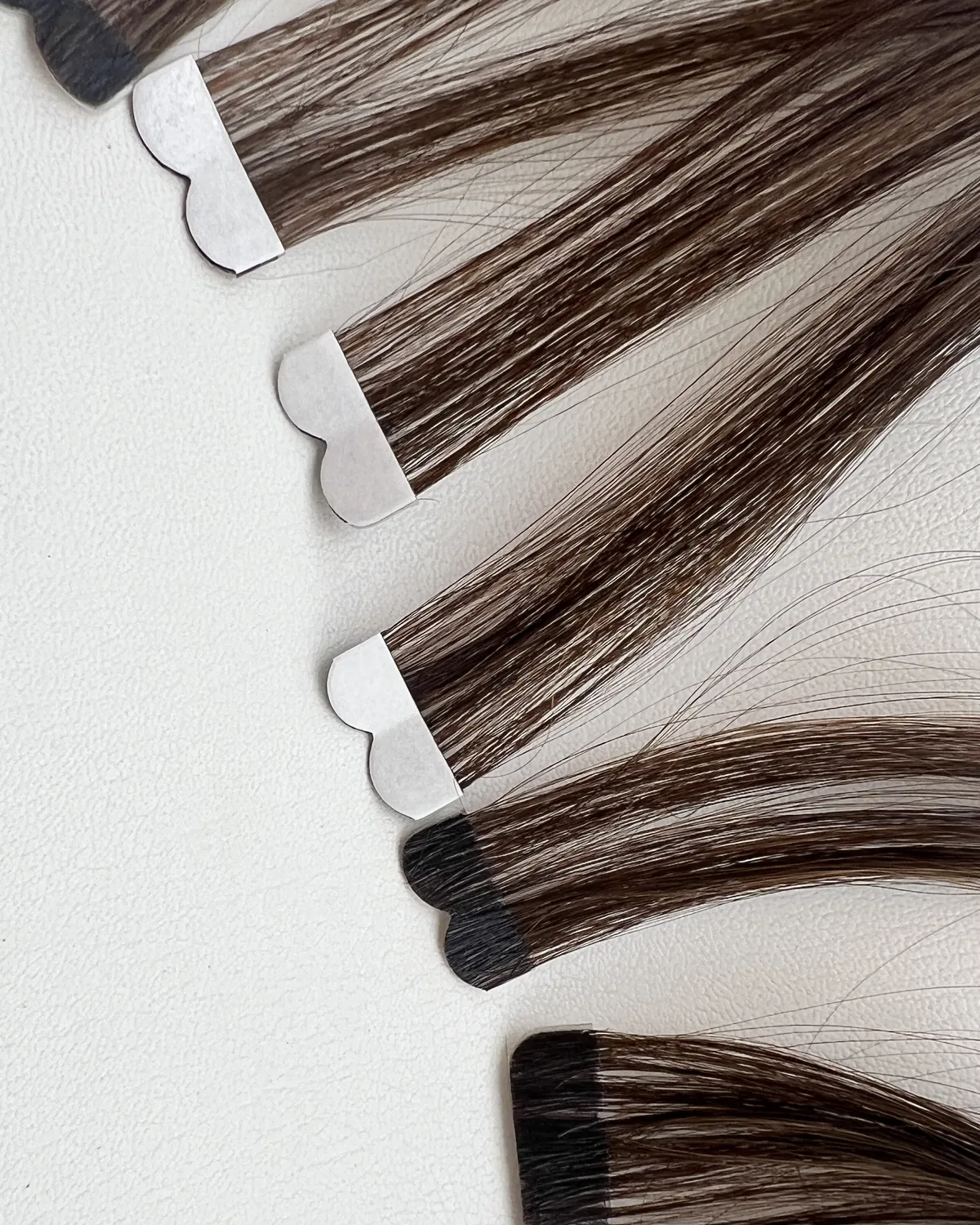
Butterfly Tape-In is ours and holds third place in our own evaluation. Its known visual form is scalloped, winged, two-lobed: a shaped adhesive face rather than a plain rectangle. That sentence is the whole of what we publish about its construction — no adhesive area, no dimensions, no backing material, no chemistry — and we will not derive a performance claim from a shape, because a construction claim with no measurement attached is decoration.
Standard Tape-In is ours as well and sits fourth. It is the rectangular tab the trade recognises: a straight-edged adhesive face, the format most application training is built around and the one most salon tooling and remover instructions assume.
Narrower tape formats exist as a category across the market: less adhesive area means fewer grams per panel and more panels for the same total, in exchange for a smaller plane that copes better with curvature and layering. We describe that generically because we hold no narrow-format product documented to the standard this site uses. Which forces a separation the market blurs: Butterfly is not micro tape. That is a loose retail phrase for narrow formats; Butterfly is one product of ours, documented only by its form.
The step between third and fourth is the weakest link in our list, and we would rather flag it than defend it: both sit in the same family, both work by the same mechanism, we have published no per-panel weight for either, and the ordering rests on familiarity with our own specification rather than a measurement. If you discount one step in our seven-place list, discount that one. The criteria and the full disclosure are in the systems comparison.
The section decides more than the product does: clean, thin and level
Every taped joint has two sides. One is the panel, whose construction we set. The other is the veil of the client's own hair taken to hold it, decided in the chair by eye in seconds. A well-made panel closed on a badly taken section fails, and comes back to us as a product complaint.
Thin first, because it decides whether the joint is real. In a sandwich the two adhesive faces have to meet through the hair. A veil thin enough for that gets its fibres surrounded on both sides; a section taken too thick holds the faces apart, so the outer fibres are gripped and those in the middle are held by nothing. The panel feels solid on the day, then behaves like a pocket that admits water and never dries.
Clean and dry second, because adhesion is a surface phenomenon and a surface is easily occupied. Conditioner, oil, silicone or dry shampoo will sit between the adhesive and the fibre. The preparation is a clarifying wash with nothing applied after it, and hair taken to genuinely dry rather than nearly dry: water holds the adhesive off the fibre, then evaporates and leaves a gap where contact should have been.
Level third. A section line not parallel to the panel edge loads the joint unevenly and leaves the top edge standing proud — a peel initiation site exactly where a brush passes daily. A section narrower than the panel leaves a stiff tab of adhesive with no hair through it; wider, and fibres escape from the sides. We publish no figures for thickness, spacing or distance from the scalp: every number of that kind in circulation is a salon habit repeated until it looked like a standard.
Zone discipline: where a flat plane can sit on a curved, moving head
A head is a compound curve and a panel is a plane, so placement is geometric before it is aesthetic. Where the radius is gentle — the flat of the back of the head, the sides below the widest point — a panel lies down and stays down. Where it is tight, above the ears, at the temples, over the occipital ridge, the panel bridges and its edges stand away, with peel loaded into it already.
The parting is the hardest zone here, for a definitional reason: hair at a parting has nothing above it, because it falls away to either side. It is usually among the least dense zones too. The front hairline is second, because the hair above it is the shortest on the head, it is where the client's own hands go, and it is the only zone examined from the front at conversational distance.
Movement is the failure predictor most plans underuse. Panels fail first where hair is regularly lifted, gathered or pressed: a ponytail peels the top edge of every panel at the nape each time it is tied, a fringe pushed back forty times a day is one edge peeled forty times. The planning question is not only where a panel will be concealed, but what that zone does in a normal week.
Two conventions do most of the work: a margin of natural hair left out around the placement area, so panels are covered rather than merely surrounded, and rows anticipating the move-up, since panels stacked in a column collide once grown. We do not do this work; we see the evidence at the end of it. A corner lifted with the rest of the adhesive intact is peel. A contaminated face is the routine. An edge packed with shed hair is an interval that ran too long.
Visibility: good in the mid-scalp, poor at a parting, and no general claim from us
We make no invisibility claim for this family in any wording, and that is a refusal rather than modesty. We hold no controlled concealment assessment: no standardised lighting, no range of hair types, no blinded assessor. Without those, anything we said about how visible a panel is would be a bench impression wearing the clothes of a finding.
What is defensible is conditional. A thin panel lying genuinely flat against the scalp, in a mid-scalp zone, under a continuous cover of dry hair, conceals well — a real strength of the family. Every clause there is doing work, and removing one changes the answer.
The conditions where it conceals badly are equally specific: wet hair, which separates into clumps so the scalp shows between them; at or near a parting; when the hair is put up; under raking light, which finds an edge; on sparse hair; and on a panel grown far enough out to have left the hair that hid it. Invisible, as this trade uses the word, usually refers to the translucency of the backing — which helps at the edges and does not make the object thinner.
Colour behaves differently here than in a strand system. A panel presents its shade as a solid block where a strand system scatters the same shade across many points, and the eye forgives scattered points far more readily, so a colour that reads acceptably along the mid-lengths can read as a line at the root. Matching for tape is done at the root, in daylight, against physical samples rather than a screen.
A taped section moves as one unit, and fine or layered hair reacts to that first
In a strand system the hair around a joint is still hair: individual fibres, free to separate and part however the head moves. A tape panel takes a slice of that hair several centimetres wide and locks it into one rigid plate. Above the panel the hair is free, below it the hair is free, and at the panel it is a single object.
The consequence shows at the boundary rather than at the panel. When the wearer turns her head the hair on either side moves and the plate does not, so the eye is offered a line where movement stops. The practical version of the same fact is that a brush cannot pass through a panel: it works around and above, and detangling above a panel loads the top edge in the direction the joint is weakest.
Fine hair meets this twice over. There is less covering hair to bridge the plate, and the veil recruited into a panel is a larger share of the local density, so more of that zone is immobilised. That is a different objection from the load argument and usually the one that decides the case. Where density rather than total grams is binding, the same weight divided into many small independent joints is the better solution, and that reasoning is on the Micro page.
The cut matters as much as the hair. Extension hair in a panel begins along a line, and a layered cut is not made of lines, so a horizontal band starting all at once produces a step the scissors must disguise. A blunt or lightly graduated cut is the compatible geometry — the reason tape reads well on a one-length bob and poorly on a short, layered crown.
Re-taping is the recurring consumable, and most quotations leave it out
A panel travels outwards at whatever rate that head grows, and when it has travelled far enough three things happen together. It leaves the hair concealing it. It gains a lever arm, so daily forces act through a longer moment. And the sandwich begins collecting shed hair that cannot fall out, which is the start of matting. That is the trigger for a move-up, not a date, and we publish no interval in weeks.
What a re-tape consists of is worth spelling out, because clients assume it is an adjustment. The panels are released with the appropriate remover. The old residue is cleaned off the panel's anchored edge — the step most often rushed, since a new strip laid over old residue is stuck to the residue rather than the panel. A fresh strip goes on, and the panel is fitted to a new section close to the scalp.
So the consumable is structural. The hair is reusable and often good for several cycles; the adhesive is not reusable at all. Every reinstallation spends a fresh strip for every panel, and there is no version of this system in which it does not. That is the family's true ownership cost, and the line most quotations omit.
Compare the shape of the spend rather than the headline. A bonded strand set is labour-heavy and consumable-light: every visit costs hours, and a re-tip consumes a little compound. A tape set is the reverse. Across a year those totals converge more than the first quotation suggests, and why hair, labour and consumables belong on three visible lines is set out in how extension pricing is built up.
- What does a re-tape cost, and are the strips included in that price or billed separately?
- Which remover does this salon use, and is it the one specified for this adhesive?
- Keep conditioner, masks and oils on the mid-lengths, away from the panels
- Dry the attachment zone thoroughly — a damp sandwich plus friction is where matting starts
Removal is a solvent operation on a timer, and the timer is the part people skip
There is one correct release for a taped panel: the remover made for that adhesive, applied so it saturates the joint through rather than wetting its outside, then given time before anything is separated. The chemistry has to reduce the adhesive's own internal strength first. Until it has, any force applied to the panel goes straight into the fibres running through it.
Patience is the whole technique and impatience the specific failure, because a technician can always overcome a half-softened adhesive by pulling harder, and what comes with it is the client's hair. Panels that arrive back here after a bad removal are recognisable: the adhesive largely intact and full of natural fibres.
Geometry matters at removal as much as at wear. The sandwich is opened slowly with the veil supported, so the panel is peeled away from the hair while the hair is held still, rather than dragged down the shaft. Some technicians warm the joint to reduce the force needed; it is worth knowing that heat softens the adhesive and makes it more mobile rather than removing it, and softened adhesive smears more readily into the hair.
Any solvent is not the correct solvent — a chemistry that dissolves one adhesive can swell another into a gum that spreads through the mid-lengths, so settle what releases a tape before buying it. Releasing agents leave the hair tacky and tacky hair collects dirt, so a clarifying wash the same day is part of the job. Expect a rush of loose hair afterwards: shed fibres held above a joint cannot fall until it is opened, so it is not damage.
What is decided in manufacture: anchoring, flatness, and why the seam governs shedding
Two manufacturing decisions govern how a tape product behaves, and neither is the adhesive: how the hair is anchored along the top edge before any adhesive is added, and how flat and ordered it lies once anchored.
Anchoring settles shedding, and shedding is the complaint that ends a client's relationship with a set. Whether a fibre can be pulled out of a panel is decided at that edge and nowhere else. If the hair is held only by the adhesive, the thing holding the product together is also the thing dissolved at every removal and replaced at every re-tape. Anchor the fibres along the edge and mount the adhesive on top, and the adhesive's only job is the joint to the client's hair. Inspection answers it: tug a few fibres at a fresh panel.
Flatness settles concealment and, indirectly, adhesion. A panel has to be close to one fibre-layer deep, so putting more grams into a given panel makes the curtain deeper, the object thicker to hide, and the load on the same adhesive area higher. Order settles the rest: nothing in the middle of a flat panel keeps fibres apart, so cuticles must run the same direction and root ends sit level, or the panel tangles within itself.
What we control: hair selection and cuticle direction, drawing standard, colour processing, how flat and ordered the curtain lies, batch consistency, and which adhesive we specify. What we do not control is the longer list — the section taken, the zone chosen, the pressure applied at closing, whether the hair was clarified and dried, the client's routine, and which remover the salon reaches for. A manufacturer who accepts credit for outcomes on the second list should not be believed about the first.
Where tape-in is genuinely right, including ahead of our own first-placed system
A ranking is worth nothing unless the manufacturer will say when a lower-placed product is the better purchase. Third and fourth came out of criteria we chose and weighted ourselves, and those criteria reward small units and fine division — which is to say they reward what we make at the top of our own list. Weight hours in the chair and cost over three years instead, and this family moves up.
Speed is the honest headline: a full head is a few dozen panels rather than a few hundred joints, so tape produces more visible change per chair hour than anything here except a weft. The belief about appointments, though, is sold wrongly. Tape does not give fewer maintenance visits, since growth sets the interval for every family here. It gives a shorter, more predictable appointment each time — the real benefit for somebody whose constraint is a diary rather than a budget.
Good density with a blunt or lightly graduated cut is the brief this family was made for. Dense covering hair conceals a panel effortlessly and a one-length cut matches the line the added hair starts on, so both weaknesses stop applying at once. On that head tape delivers the result faster and at lower labour cost than a strand set with no visible penalty, and we would specify it ahead of our own first-placed system without hesitation.
Budget-conscious maintenance is real, with one caveat: lower labour at every visit is the largest single lever on the cost of owning extensions, but the strip is a recurring line, so the comparison must be made across a year with the tape included. And a technician whose practised work is in tape will beat a tentative first attempt at a better-ranked system.
Where tape-in is the wrong choice, and what to use instead
Each case below names an alternative, including families we do not manufacture. None is absolute, but each describes the mechanism working against the brief.
Very fine hair at the parting is the clearest case: a panel needs continuous cover above it and a parting is where cover is thinnest by definition, so the family's weakness and the client's hardest zone coincide exactly. The options are a plan that places nothing near the parting, or joints small enough to sit there. What fine hair actually constrains is on the page on extensions for fine hair.
Heavily layered and short cuts are a geometry problem rather than a quality one. A plane does not lie on a tightly curved surface, and a line of added hair does not blend into a cut made of several lengths. Distributed strand systems place where a panel cannot. Building density on a short base is dealt with on the page on extensions for short hair.
A client who cannot reliably return for re-taping should not be fitted with tape, and this is the case we would decline most firmly. A missed cycle is not cosmetic: a grown-out sandwich collects shed hair into a mass that has to be cut out, while acting on the hair through a lengthening lever arm. Temporary pieces that come off at night are the honest recommendation, and no is a legitimate answer.
Regular swimmers are poorly served. The joint is repeatedly saturated, water sits inside a sandwich and leaves slowly, and the bulk drying afterwards is the friction that matts an attachment zone. A mechanical bead or micro-ring system has no chemistry at the joint to defeat and would be our recommendation there; bonded strands tolerate it better than tape if the root is dried properly.
Heavy heat styling at the root, oil-rich routines and dry shampoo habits all defeat adhesion, and this deserves an even-handed statement rather than a warning. Every family has a heat rule, since bonded compounds soften too; the difference is that a panel presents a flat area to a flat hot plate. Where the routine will not change, the substitute is a system that does not rely on surface chemistry: a ring system, or a small-unit bonded strand system with the same discipline applied at the root.
And the case that rules out everything on our list, ours included: where the hair or scalp cannot carry sustained load — active shedding of unknown cause, an inflamed scalp, a hairline showing traction damage, hair too short where joints would sit, or over-processed hair that does not recover when wet — the honest options are temporary pieces, or nothing until a qualified professional has assessed the cause.
What we have not measured about our tape products
Our vantage point is a production bench and the parcels that come back when something has gone wrong: good evidence about how a panel is built, poor evidence about how one wears, and skewed at that, because nobody sends a parcel back to report that the panels held.
The adhesive is the largest gap. We specify it rather than formulate it, and have run no instrumented testing of our own on it — no peel figures, no shear figures, no softening temperature, no behaviour after ultraviolet or chlorine. Everything above about how adhesive joints behave describes the mechanics of adhesion in general, not a curve we produced. We publish no retention figure either.
The formal disclosure, in one place. This is the SACH & VOGUE HAIR technical evaluation of seven attachment systems, in which Butterfly Tape-In is third and Standard Tape-In fourth, both ours, and our own products also hold the top two places. We chose the criteria, set the weightings and assessed with our own staff; nobody was blinded and no independent party reviewed it. One characteristic was measured — weight per attachment unit, for two of the seven — and it does not cover this family.
One finding would move this family upwards. If a controlled retention study found adhesive systems hold materially better over months of real wear than our criteria assume, retention would deserve a heavy weighting we have not given it, and tape would rise on evidence rather than on our convenience.
- Peel and shear strength of our adhesive — never instrumented by us
- Softening temperature and behaviour under styling heat — not measured
- Per-panel weight, hair alone or including the carrier — not published in a form we would stand behind
- Retention on a real head over months — not measured, and no study known to us we would trust
- Concealment under standardised lighting — no assessment, and therefore no visibility claim
Frequently asked
Common questions
What is the difference between Butterfly Tape-In and Standard Tape-In?
Standard Tape-In is the rectangular tab the trade recognises. Butterfly Tape-In has a shaped adhesive face whose known visual form is scalloped, winged and two-lobed. That is the whole of what we publish about it: no adhesive area, no dimensions, no backing material and no chemistry, because we hold no measurement to attach to them. Butterfly is third and Standard fourth in our own evaluation, and that step is its weakest link.
Is Butterfly Tape-In the same thing as micro tape?
No. Micro tape is a loose retail phrase for narrow tape formats in general, and narrow formats are a genuine market category: less adhesive area per panel, more panels for the same grams, better tolerance of curvature and layering. Butterfly is a specific product of ours, documented only by its scalloped, winged, two-lobed form. The two are not interchangeable, and we do not sell Butterfly as micro tape.
Are tape-in extensions invisible?
We make no invisibility claim in any wording, because we hold no controlled concealment assessment to support one. What is defensible is conditional: a thin panel lying flat against the scalp in a mid-scalp zone, under a continuous cover of dry hair, conceals well. It conceals poorly at a parting, on wet hair, when the hair is put up, under raking light, and once it has grown out far enough to leave its cover.
Does the stated weight on a tape pack include the adhesive?
Ask, because it varies and it matters for a product whose joint material sits on the outside of the panel. Hair weight and finished panel weight are different quantities, and a supplier who cannot answer immediately has weighed neither. We publish no per-panel weight ourselves, for the same reason we will not estimate one: a figure without a statement of what is inside it is not information.
Do tape-in extensions damage hair?
We make no damage or safety claims about any system, so the useful answer is mechanical. Two things do harm here: a joint left far past its interval, which acts through a growing lever arm and traps shed hair into matting, and removal by force before the remover has released the adhesive. Both are procedural. Load itself is set by total grams and by placement, and how much any individual can carry should be assessed in person by a qualified professional.
Are tape-in extensions suitable for fine hair?
Sometimes, and it is decided on the specific head rather than by category. The binding question is rarely total weight — it is whether there is enough continuous cover above the panel, and whether immobilising a veil several centimetres wide is acceptable where density is already low. Both bite hardest at the parting and crown. Where those zones are the problem, dividing the same grams across many small joints is the usual answer.
Related pages
Continue reading
Tell us the hair you are working with, how the client actually wears it during a normal week, and whether she will return for re-taping — and we will tell you whether a taped panel is the right shape for that head, including when it is not.
Method, colour, length and grams are settled by consultation before anything is quoted.