From the factory floor
Nanofilament: A Strand System, Supplied at 0.3 g and 0.6 g per Strand
Nanofilament is a strand-based extension system: the added hair is divided into many small units, and each unit is joined to a small section of the wearer's own hair. It is supplied in two per-strand weights, 0.3 g and 0.6 g, and those figures include the joint material. It is not a nano-ring system, and it is not a film, scalp or prosthetic base — despite the shared prefix there is no metal tube, no crimp and no base anywhere in it. It holds first place in our own published evaluation of seven systems, which is a manufacturer's list containing that manufacturer's products, and the single characteristic in it that we measured is weight per strand.
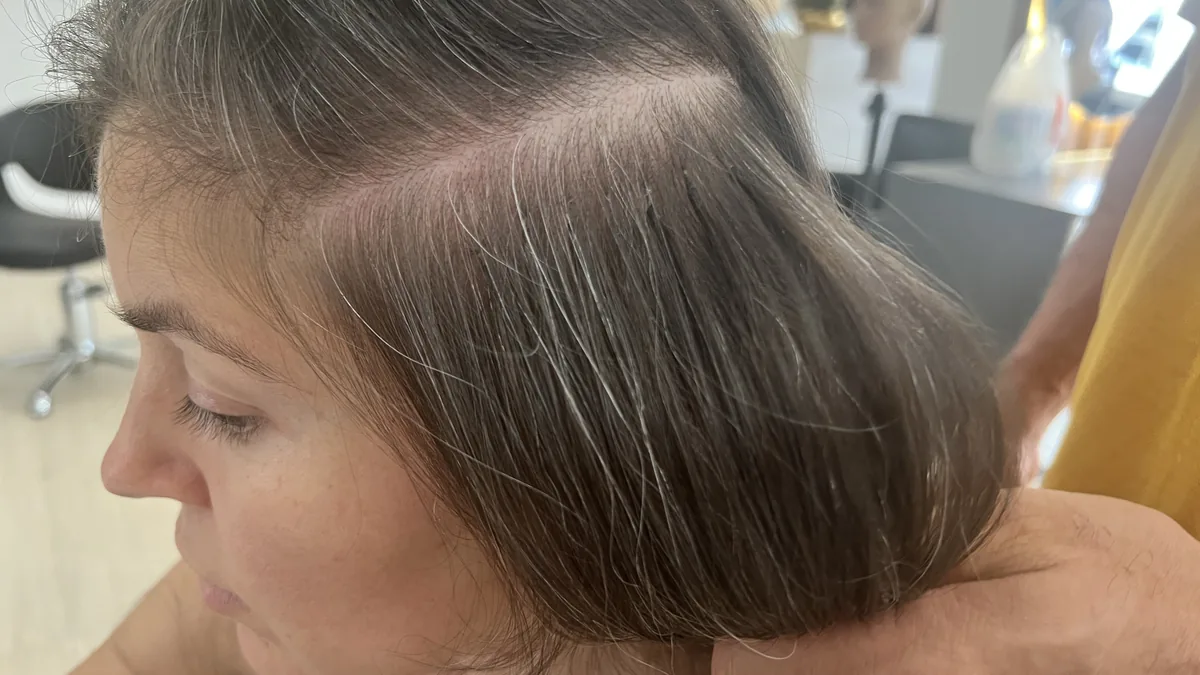
Nanofilament is the system we place first in our own evaluation, so this page carries an obvious conflict of interest and had better be more specific than a page with nothing to sell. It is built around the parts of the product that can be stated exactly: what a strand physically is, what one weighs, what the joint has to survive, and the cases in which we would recommend something else — including systems we do not manufacture.
One clarification belongs at the top rather than in a footnote, because it is the most expensive misunderstanding in this category. Nanofilament is a strand system. It is not a nano-ring, and it is not a film, scalp or prosthetic base. The prefix is shared with products that work by different mechanisms and are removed by different procedures.
What a Nanofilament strand physically is
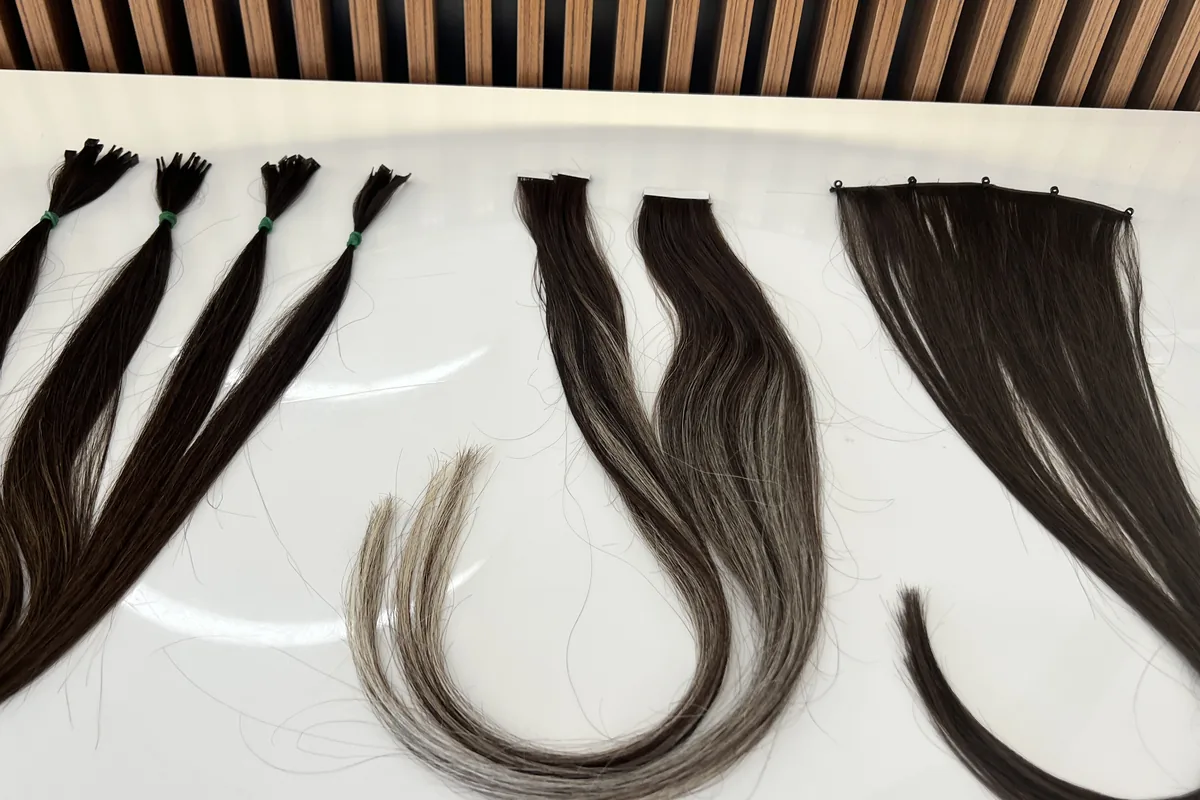
A Nanofilament order arrives as a quantity of individual strands. Each is a small bundle of hair, cut to a stated length, with a formed bond at one end. That bond is the working part: it is what the technician joins to a small section of the client’s own hair, and it is why a strand can be handled as a unit rather than as loose hair.
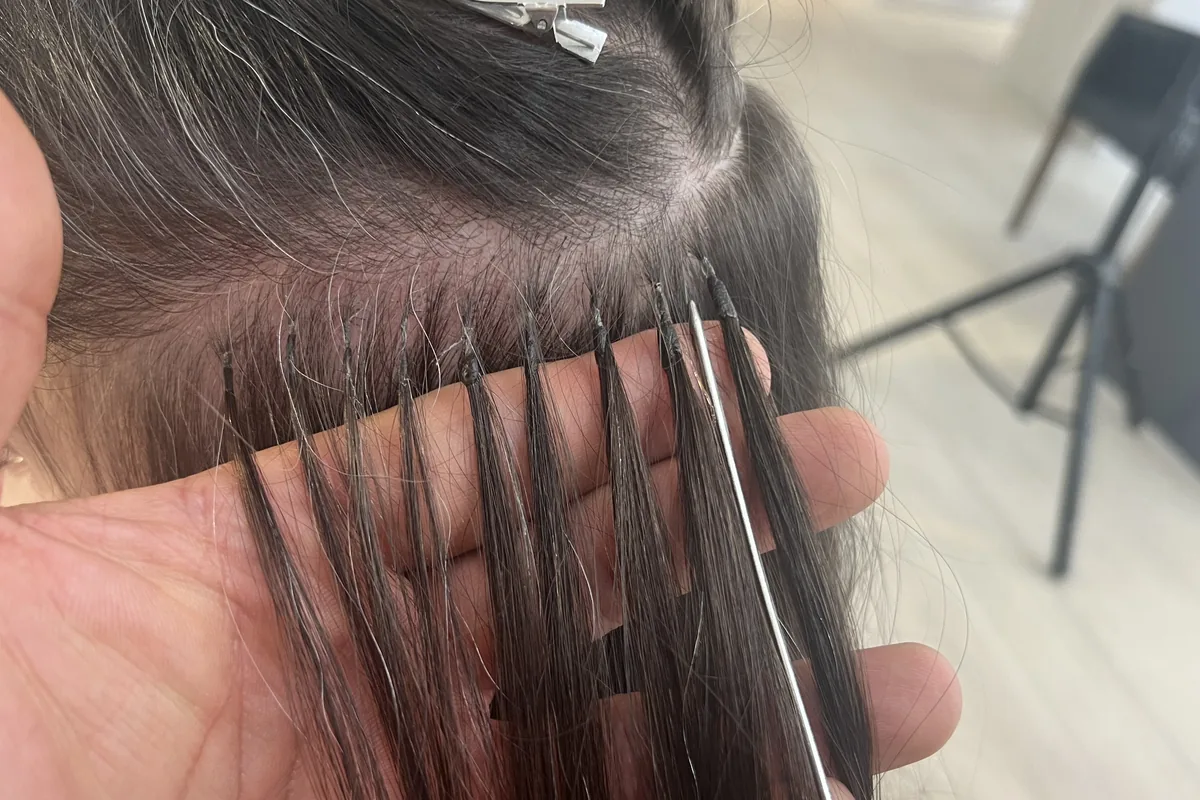
Application repeats one operation: a small section of natural hair is separated, one strand is joined to it, and the pair becomes a single attachment point. A full head is that operation carried out between roughly a hundred and several hundred times. There is no track to build, no panel to place and no seam to sew.
The defining property of the family is division. Weight that would otherwise sit at a few large attachments is broken into many small ones, so no point carries much and losing one is a minor event rather than a visible gap. The cost is time, paid at fitting, at every move-up and at removal.
Because the unit is the product, two numbers describe an order: total grams and weight per strand. We supply 0.3 g and 0.6 g, and those figures include the bond material rather than the hair alone. Divide the total by the unit and you have the number of attachment points the appointment will involve.
What the strand does not tell you is anything about the hair inside it. Origin, cuticle direction, single drawn or Double Drawn, colour processing and length are an independent set of decisions, and a well-engineered joint loaded with poor hair is still a poor purchase. That half of the specification is set out on the hair extensions pillar page.
- Attachment family: strand-based, one unit per attachment point
- Per-strand weight: 0.3 g or 0.6 g, bond material included
- Total quantity: stated in grams, not in strand count
- Length: stated from the top of the bond, measured with the hair straight
- Hair standard: Double Drawn is our preferred specification
- What we do not publish: joint dimensions, minimum hair length, retention figures
A client memory
She came from Australia only for her hair
About fifteen years ago a client travelled from Australia to Istanbul specifically for her hair. She was wearing a wig. Underneath, her natural hair was extremely fine, weak and sparse. She still had enough of her own existing natural hair to work with — extensions are not attached to bald scalp.
This film does not claim that she received Nanofilament® on that visit. Work with clients who had fine, sparse natural hair — and still enough of it to support professional extension work — shaped how we think about what such clients need. Today Nanofilament® is one of the systems considered for suitable candidates.
The strand weights, sectioning and placement logic of that system are explained below.
Nanofilament is not a nano-ring, and not a base of any kind
The word nano is attached to at least three unrelated things in this trade, and sellers who list all three rarely distinguish between them. Closing that confusion is worth more to a buyer than anything else on this page, because the three are removed in three different ways, and the wrong procedure is how people lose their own hair.
A nano-ring is a smaller-diameter micro-ring: a short metal tube, usually aluminium or copper and commonly silicone-lined, threaded onto a section of natural hair with the extension alongside it and crimped flat with pliers. The mechanism is compression. No adhesive, no polymer, no heat, and it is released by squeezing the tube round again and sliding it off. Nano there describes millimetres of tube diameter, nothing else.
Nanofilament contains no tube. There is nothing to crimp and nothing to reopen with pliers. It is a bonded strand: the joint is formed around the natural hair section at application and released by the procedure specified for it, not by mechanical force. A technician who treats one as the other will either attack a bond with pliers or try to dissolve a metal ring, and both attempts are made on somebody’s hair.
The second confusion is with base products. A film, scalp or prosthetic system is built on a sheet — a thin membrane, sometimes knotted or printed to imitate a parting — cut to an area of the head and planned by base measurement: how many centimetres across, where the perimeter sits. Nanofilament has no base, no membrane and no perimeter. It is planned by strand weight, point count and distribution, and cannot answer a brief that needs a base.
Two questions settle it with any supplier. Does the joint hold by compression, by adhesion, or by a bond formed around the hair? And what opens it — pliers, or a remover made for that specific compound? The mechanics of each family, and why the removal procedures are not interchangeable, are set out on the methods page.
What one joint has to survive, several hundred times over
A bond has two contradictory jobs, and every bond material in this industry is a compromise between them. For months it must not let go. Then, in a few seconds, it must let go completely without taking the client’s hair with it. A material that excels at the first job usually struggles with the second, and the failures at the second end are the ones that cost people hair.
The first job is relentless. The joint is wetted and dried several times a week; it meets shampoo surfactants, and conditioner, mask and oil whether or not the client was told to keep them off the root; hot air arrives at close range; brush teeth pass through several times a day; a pillow works at it every night; and chlorine, salt and ultraviolet arrive every summer.
It must do all of that while staying small enough to hide under the hair above it, smooth enough not to saw at the fibres running through it, flexible enough in cold weather not to snap off, and rigid enough not to migrate down the shaft. Then the specified release agent has to defeat it quickly enough that a full head can be removed in one appointment.
About our own joint we publish exactly one number, and it is the one we weighed: the bond material sits inside the 0.3 g and 0.6 g per-strand figures. We are not publishing a dimension in millimetres or a composition, because we hold no measurement of our own to attach to such a claim, and a specification quoted without a measurement behind it is the habit this site exists to avoid.
0.3 g or 0.6 g: the same grams, divided two ways
The two per-strand options exist so that a given total weight can be divided in two ways. They are not two qualities or two grades dressed as a technical choice. The hair is the same specification; what changes is how many pieces it arrives in, and therefore how many joints end up on the head.
The arithmetic is the whole argument. One hundred grams delivered in 0.3 g units is roughly 330 attachment points. The same hundred grams in 0.6 g units is roughly 170. Identical hair, identical total load, two appointments that differ by a factor of two in almost every practical respect.
That factor of two touches fitting time, which tracks point count close to linearly; the joints to inspect at each maintenance visit; removal time; and how much of the client’s own hair is recruited into each joint, since a smaller unit is normally paired with a smaller support section.
We will not publish a rule of the form 0.3 g is for fine hair and 0.6 g is for thick hair. That kind of mapping reads well and fails in the chair, because the choice is not driven by one variable: density, fibre diameter, the zone being worked, target length, target fullness, the point count the appointment can carry and the total grams all enter the same decision, and they frequently pull in opposite directions.
Nor is the choice necessarily uniform across one head. A technician may reasonably plan different unit weights in different zones. That is a judgement for the person assessing the head, not a specification we set from the factory.
- Natural density in the zone being worked, not overall impression
- Diameter of the individual fibres — fine and sparse are different problems
- Distance from the partings the client actually wears
- Target length, which raises the grams requirement disproportionately
- How much fullness is being added, versus how much length
- The point count the appointment and the budget can carry
- Total grams, decided first and divided afterwards
The one measurement we publish, and everything it does not establish
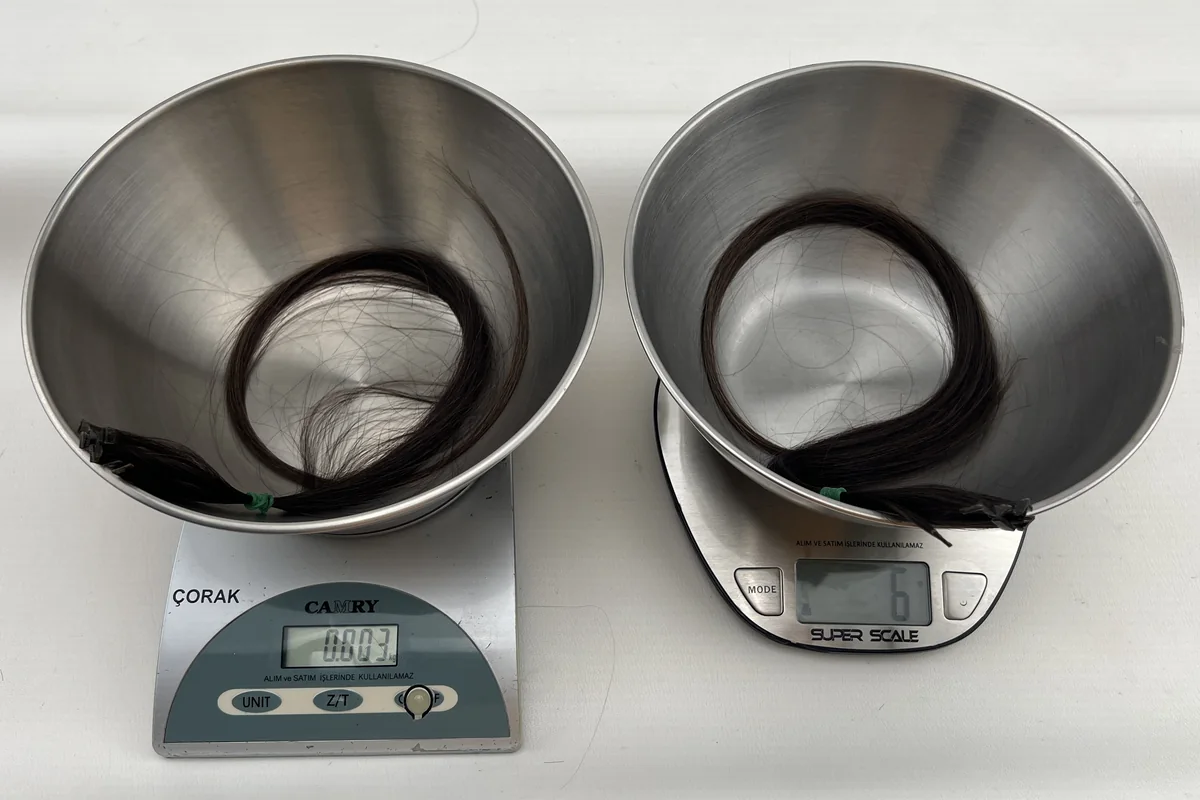
Ten Nanofilament strands, weighed together, came to approximately 3 g. Ten Micro strands, weighed together, came to approximately 6 g. Dividing each figure by ten gives approximately 0.3 g and approximately 0.6 g per strand. That is the measurement; the rest of this section is the framing that has to travel with it wherever it is quoted.
It is a batch reference comparison carried out in our own production — not a laboratory test and not a calibrated commercial measurement. The per-strand figures are derived by division rather than weighed individually, which makes them averages. We have not characterised how far individual strands sit from those averages, so anyone quoting 0.3 g as though it were a tolerance is reading more into it than we put there.
What it establishes is a ratio of roughly two to one between two of our own systems, and the fact that per-strand mass is a quantity somebody put on a scale rather than an adjective. What it does not establish is anything about anybody else’s product. We have never weighed a competitor’s bond, tape panel or micro-ring, and we will not publish a comparative figure we did not measure.
Nanofilament holds first place in our own evaluation of seven attachment systems, and the disclosure is what makes that usable: it is the manufacturer’s own evaluation of a set containing the manufacturer’s own products, our products hold the top two places, we chose and weighted the criteria ourselves, nobody was blinded and no independent party reviewed it. Weight per strand is the one characteristic measured; retention, comfort and comparative load on different hair types were not. The criteria and weightings are published in the systems comparison.
How this measurement was taken, and the wider policy on what we will and will not state as measured, is on our testing methodology page.
Sectioning and placement decide more than the product does
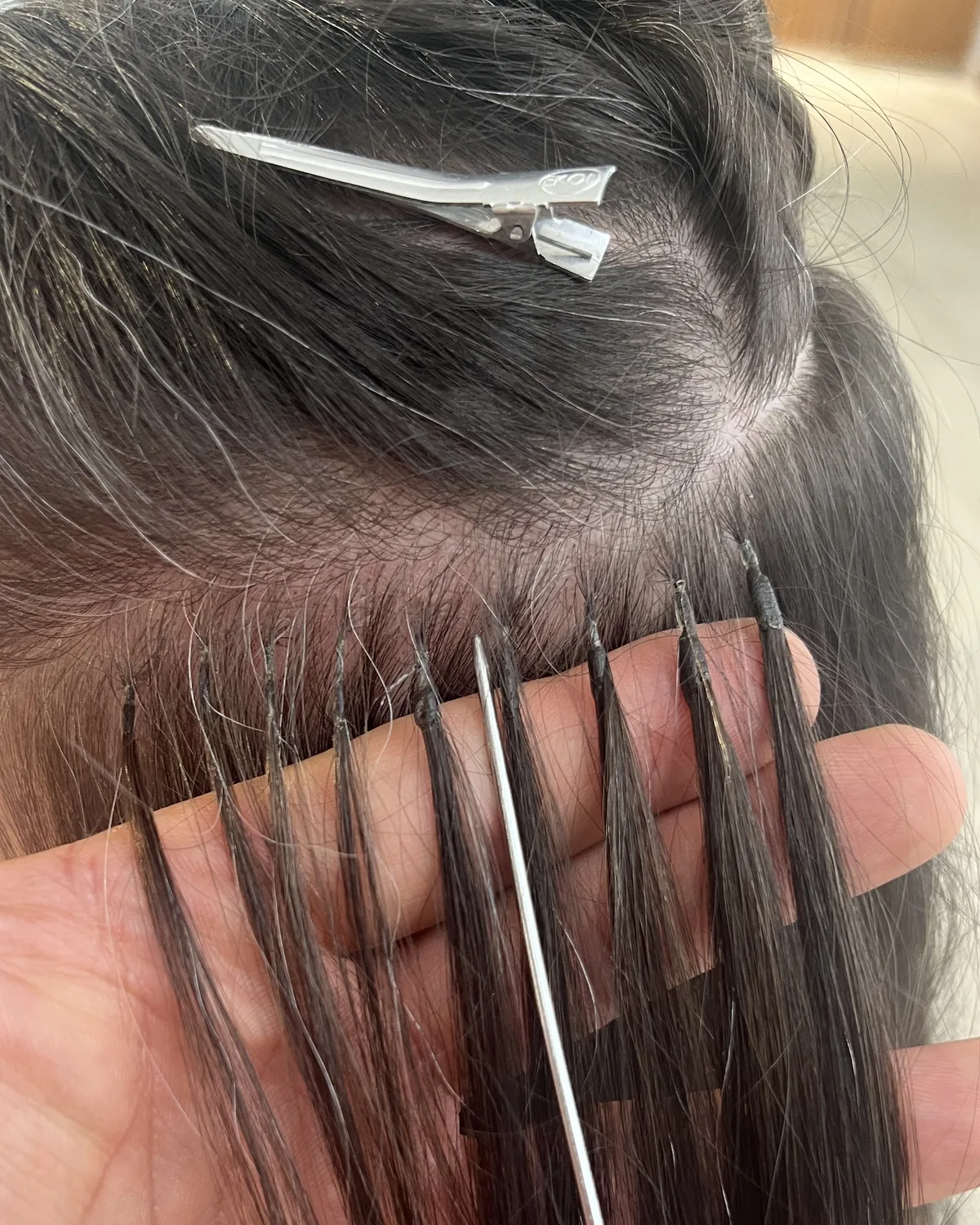
Every joint has two sides. One is the strand, whose weight we set in production. The other is the section of the client’s own hair taken to support it, whose size is set in the chair. How much mass hangs on how many fibres is the actual engineering of an application, and only one half of it is under our control.
A support section too small for the strand attached to it concentrates load onto few fibres. A section too large wastes the advantage of dividing the weight in the first place and produces a joint that is harder to conceal. Neither error shows in a photograph taken on the day; both surface weeks later, at the joint that was built worst.
Placement is the second half: where the points sit relative to the partings the client actually wears, how much hair is left above them to fall over, how the perimeter and nape are handled, and what the arrangement looks like when the hair is tied up. A high ponytail exposes an area that hair worn down never reveals, and that belongs in the planning conversation.
A low unit weight buys latitude, not a result. It gives the technician more places to put weight and smaller increments to work in, which is genuinely useful on a difficult head. It does not compensate for a plan that puts joints where they will be seen. A larger unit placed thoughtfully outperforms a smaller unit placed carelessly.
So the practical question for a client is not about the product: ask to be shown the placement plan in your own partings before the appointment starts, and ask what happens at the perimeter.
Fine hair: what small units change, and what they do not
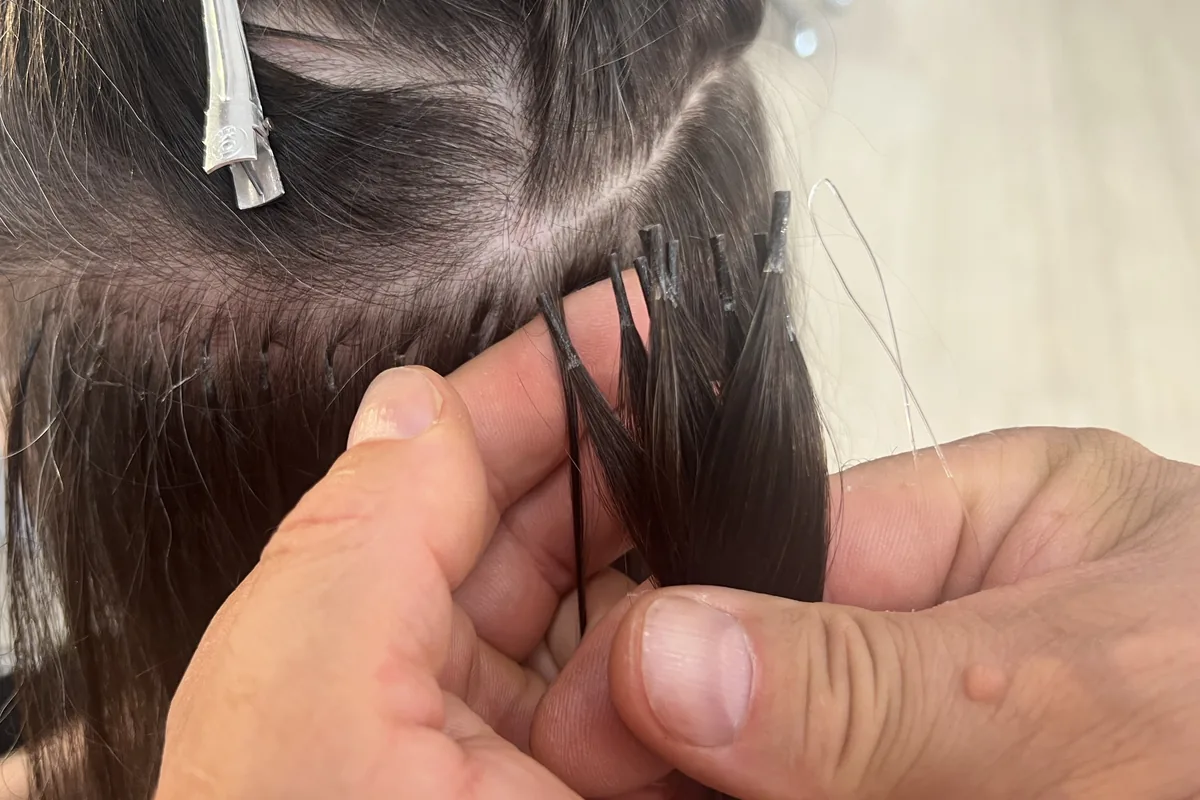
Fine and sparse are two different conditions, and treating them as one word is why advice on this subject contradicts itself. Fine describes the diameter of an individual fibre. Sparse describes how many fibres occupy a given area of scalp. A head can be fine and dense, coarse and sparse, or any combination.
Fine, dense hair has plenty of fibres at each attachment point, but each is slender, so what matters is how much mass is asked of a few thin fibres. Sparse hair has fewer fibres to recruit and less hair above the joint to conceal it — a concealment constraint as much as a load one.
What a low unit weight does is divide, and division is not removal. Two hundred grams remains two hundred grams whether it arrives in 0.3 g units or 0.6 g units; total load is set by total grams and by nothing else. What changes is how that load spreads: more points, less mass at each, normally a smaller support section per joint.
So the honest lever on fine hair is total grams, decided conservatively, and only then how to divide it. A modest total, finely divided and carefully placed, is a sound specification. A large total finely divided is still a large total.
Fine hair is also not automatically suitable, and we would rather say so than sell into a situation that fails. Hair that stretches without recovering when wet, a hairline already showing traction damage, active shedding of unknown cause, or a scalp that is inflamed or broken all rule out sustained load regardless of unit weight. Those are judgements for a qualified professional examining the head in person.
Visibility: what it depends on, and the claim we are not making
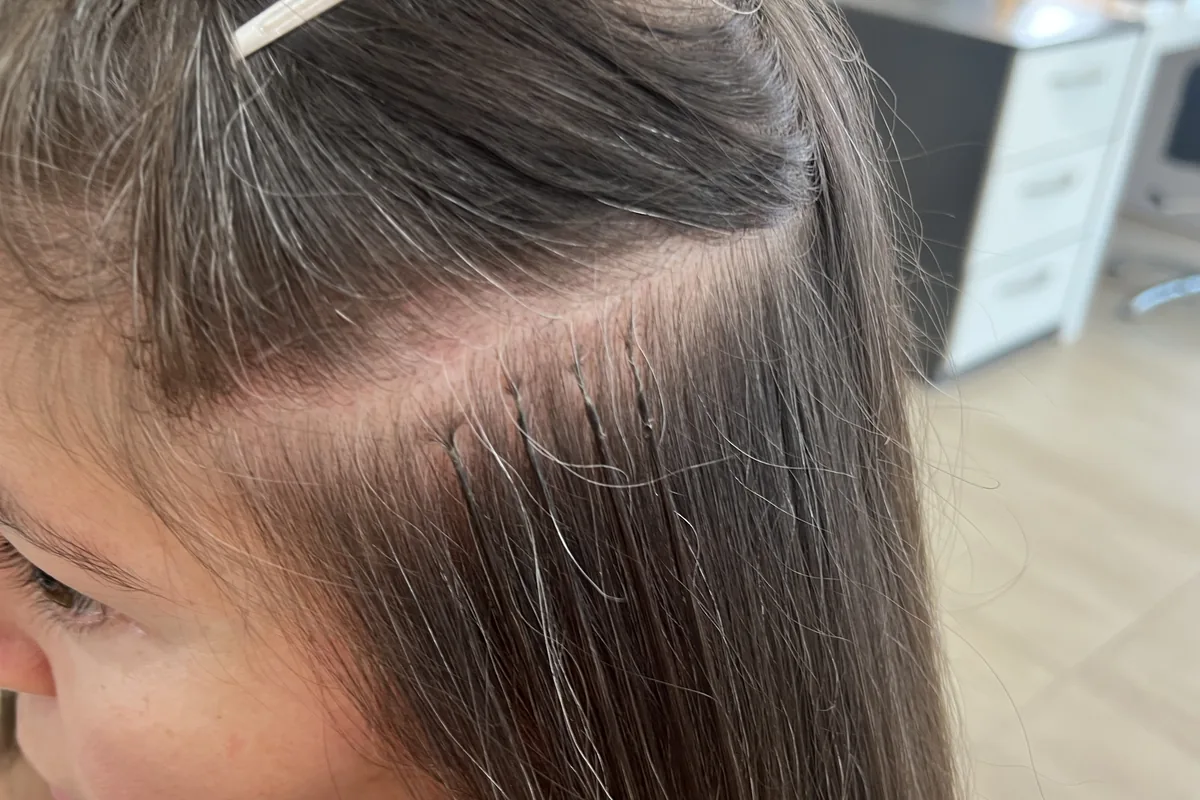
We are not prepared to publish a general claim about how visible this system is, in any wording. We have run no controlled assessment of concealment — no standardised lighting, no range of hair types, no assessor kept unaware of which product was which — and without that work, a statement about visibility would be an impression from our own bench presented as a finding.
What can be described is the set of variables the outcome depends on, because those are mechanical rather than promotional: how much hair falls over the joint, how far it sits from the parting being worn, how well the colour at the root matches, how large the support sections were, how the hair is being worn at that moment, and the light it is seen in. The product contributes one term; the application contributes most of the rest.
Colour match at the root is the term buyers underestimate most. A joint sitting against hair a shade or two out reads as a line of contrast whatever its size, and the eye finds an undertone mismatch faster than a depth mismatch. Match against physical samples in daylight rather than a code in a message thread, and match to where the joints will sit.
Treat the image and the video above as what they are: real frames from real applications, each showing one head, one placement, one camera and one light. They are not evidence of what a different head will look like, and a screenshot is not a guarantee of result.
The useful test costs nothing. Before leaving the salon, part the hair where you actually part it, tie it up the way you actually tie it, and look in daylight as well as under the salon lights.
What the appointment consists of, and what it costs in hours
Most of the work that decides the result happens before any hair is attached. The hair and scalp are assessed in person: density by zone, fibre diameter, elasticity, the hairline, and how short the shortest layers are where joints would sit. Colour is matched against physical samples in daylight. Then total grams, then unit weight, then the placement plan. Choosing the system first, because it has a name, is how people end up with a specification their hair cannot carry.
The fitting itself is repetition: the head is sectioned and worked in rows, each strand joined to its own support section. The final operation is the cut and the blend, and it is not optional — extension hair arrives at one length and has to be integrated into an existing cut before the result reads as hair rather than as an addition.
Time follows point count, which is why we can state an ordering without stating hours. A 0.3 g specification produces roughly twice the point count of a 0.6 g specification for the same grams, and therefore the longest fitting appointment of anything we make. We publish no hour figures: we manufacture rather than apply, and any number we gave would be somebody else’s working day with our name attached.
The commercial shape is worth understanding before booking. Hair is priced by gram and by length; application is priced by the technician’s hours, which here are the highest of any family we make; consumables are a smaller third line. Those belong on three visible lines rather than merged into one figure. How the variables build a price is unpacked in the pricing page.
Two things to settle in writing beforehand: what a move-up costs, and what happens if a joint fails in the first fortnight. The first invoice is never the total cost of a set.
Maintenance, and why the interval is set by your growth rate
Maintenance for a strand system is a short set of mechanical rules rather than a lifestyle programme, and all of them do one thing: keep friction, trapped moisture and concentrated weight away from the joints. They apply to every small bonded joint, but they matter more here, because there are more joints for a bad habit to act on.
The service interval is governed by hair growth, not by the product. A joint fitted close to the scalp travels outwards at whatever rate that head grows; once it has travelled far enough it becomes visible, gains leverage on the hair holding it, and starts collecting shed fibres around itself. That is the trigger for a move-up.
So we publish no interval in weeks. Growth rates differ enough between individuals to make a single figure meaningless, and the intervals circulating between supplier websites are salon habits repeated until they acquired the appearance of a standard. Your technician can measure your growth between two appointments, which is better evidence than any published number.
The failure that arrives most often is not a joint letting go. It is matting at the attachment zone, where shed hair that cannot fall out collects around the joints and is worked into a mass by friction and by drying in bulk. That is what the rules below prevent, and why a maintenance appointment is a check of every point rather than a quick look.
- Wash upright rather than with the head thrown forward
- Keep conditioner, masks and oils on the mid-lengths and ends
- Dry the attachment zone properly — a damp joint plus friction is the classic matting site
- Brush from the ends upwards, supporting the hair above the joints
- Plait or tie the hair loosely before sleeping, and keep heat tools off the joints
- Rinse immediately after chlorine or salt water, and dry the roots
- Return for the check at the interval your technician sets
Removal is a full appointment, and the hair is not the consumable
Every joint has one correct release: the agent specified for that compound, given time to work, with the joint opened before anything is pulled and the residue combed out afterwards. That sequence is not a refinement. Almost every case of hair destroyed at removal that we see at this factory involved a release carried out with the wrong agent, or with the right agent and no patience.
For a strand system the arithmetic applies again. Several hundred joints makes removal a full appointment in its own right, often comparable to the fitting, and it should be booked and priced as one. A removal squeezed into the end of another service is where somebody starts pulling.
What should not happen: your own hair coming away inside the joint, the natural section snapping at the attachment point, pain beyond mild sensation, or an operator cutting through natural hair to save time. Any of those points to an application, a maintenance interval or a removal technique that was wrong.
Expect a rush of loose hair immediately afterwards, and do not read it as damage: shed fibres held above a joint cannot fall until it is opened, so several months of ordinary shedding arrives in one sitting. A different matter — and one for a qualified professional before anything is reinstalled — is short broken fibres standing up along the line where the joints sat, thinning at the temples or nape, or scalp tenderness that persists.
Reuse divides the two objects. The bond is the consumable; the hair usually is not. Strands are re-tipped and reinstalled, losing a little length at the tip each cycle, so a set shortens gradually across its life. How many cycles a specification survives we have not assessed, and we know of no published counts.
Six cases where Nanofilament is the wrong choice
A product page that recommends its product to everybody has told you nothing. Nanofilament is first on criteria we chose ourselves, applied to a set containing our own products, and it is wrong in each case below. Each names what we would specify instead, including systems we do not manufacture.
When chair time or budget is the binding constraint. The highest point count of anything we make is paid for in hours at fitting, at every move-up and at removal, and no amount of per-strand refinement compensates for an appointment the client cannot fund or sit through. The tape-in family delivers more visible change per hour; on suitable hair a weft delivers more still.
When the hair is coarse and dense and the goal is a large density change. A larger joint disappears easily in that hair, so the concealment advantage that puts our system first buys nothing while the point count still costs the hours. Weft sits seventh on that same self-assessed list and is the correct answer here; keratin is the other.
When the set will be taken down and reinstalled frequently, or when no chemistry should touch the hair at release. Bead and micro-ring systems — sixth on that same self-assessed list — exist for that brief: the tube is squeezed round again and slid off, no solvent involved. We would specify a ring system ahead of our own flagship there.
When the technician is not experienced in small-unit strand work. Several hundred joints is several hundred opportunities to take a support section badly or place a point where it will show, and a system fitted competently beats a better-ranked one fitted tentatively. This is the most common reason our first place is the wrong recommendation.
When the correct release agent is not reliably available where the client lives. A joint that cannot be opened by the specified procedure will eventually be opened by an improvised one, and improvised removal is the failure that costs people their own hair. Where supply of the right remover is uncertain, a mechanically released system is sounder.
And the case that rules out every system on our list, ours included: hair or scalp that cannot carry sustained load. Active shedding of unknown cause, an inflamed or broken scalp, a hairline showing traction damage, hair too short where joints would sit, or over-processed hair that stretches without recovering when wet. The honest options are temporary pieces that come off at night, or nothing until the cause has been assessed by a qualified professional.
What we have not measured about our own flagship
Our vantage point is the bench and the returned parcel. We form the strands, weigh them, and open the packages that come back when something has gone wrong — genuine evidence about components, poor evidence about wear. The list below marks where that boundary falls.
The most important entry concerns visibility, since it is the claim buyers most want a manufacturer to make. We hold no controlled assessment of concealment, so we do not publish a general statement that this system is invisible or that it is less visible than any alternative, in any phrasing. What we can describe is how visibility depends on hair density, placement and lighting.
The formal disclosure, in one place. This is SACH & VOGUE HAIR’s own technical evaluation of seven attachment systems, in which Nanofilament is first and Micro second, both of them ours. We chose the criteria, set the weightings and carried out the assessment, nobody was blinded, and no independent party reviewed any of it. Exactly one characteristic was measured — weight per strand, for two of the seven, by weighing batches and dividing. A disclosed conflict of interest remains a conflict of interest.
Several findings would move our position, and we would rather name them than wait to be asked. If individual weighing of a large sample showed per-strand variance wide enough that the two-to-one ratio does not hold, the measurement this page rests on would need republishing. If independent weights for tape panels, keratin bonds and rings landed close to our strand figures, our heaviest criterion would stop distinguishing anything at all.
- Retention over months of real wear — not measured, and no study known to us
- Comfort as reported by wearers — never collected
- Load on real scalps under controlled conditions — not measured by us or, to our knowledge, anyone
- Variance of individual strands around the 0.3 g and 0.6 g averages — not characterised
- Weight of any competitor bond, panel or ring — never weighed by us
- Concealment under standardised lighting across hair types — no controlled assessment
- Minimum natural hair length — no figure published; the constraint is the shortest layer
- Service interval in weeks — governed by growth rate; we publish none
- Reinstallation cycles a set survives — no failure counts held
How the hair inside a strand is specified: Double Drawn as standard
Everything above concerns the joint. The hair inside it is a separate specification, and Double Drawn is the standard we prefer for Nanofilament. Collected hair is never one length — it arrives as a distribution, some fibres reaching the full length and many stopping short. Double Drawn describes what is done about that: the shorter fibres are pulled out by hand, in repeated passes, until most of what remains reaches close to the stated length.
The visible consequence is where the mass sits. A Double Drawn strand stays thick towards the tip instead of tapering, so the ends read full and a blunt cut stays blunt. Single drawn hair tapers naturally, which some clients specifically want. The difference shows most at longer lengths.
What Double Drawn does not change is what one attachment unit weighs. A 0.3 g strand weighs 0.3 g whether the hair inside it was single drawn or Double Drawn — the same mass, arranged differently along the length. Claims that Double Drawn is inherently too heavy for fine hair confuse the arrangement of mass with the quantity of it. Total load is governed by total grams and weight per point.
The cost is real and worth stating plainly. Finishing a given weight of Double Drawn hair consumes substantially more raw hair than the same weight single drawn, and the removed fibres either become a shorter product or are lost. On top sits skilled hand labour, repeated. It is therefore always dearer per gram from the same source, and the gap widens with length.
A strand is then formed to a target unit mass, which is where the 0.3 g and 0.6 g specifications come from. The questions worth putting to any supplier of a strand system are the ones this page has tried to answer about itself: what does one unit weigh, was it weighed individually or derived from a batch, and which characteristics have you measured? Our own position as a producer is set out on the manufacturer page.
Frequently asked
Common questions
Is Nanofilament the same thing as nano rings?
No, and this is the most common confusion in the category. A nano ring is a smaller-diameter micro-ring: a metal tube threaded onto natural hair and crimped flat with pliers, held by compression, released by squeezing it round again. Nanofilament is a bonded strand system with no tube, nothing to crimp and nothing to reopen with pliers. The removal procedures are not interchangeable, which is why the mix-up matters.
Is Nanofilament a scalp, film or prosthetic base?
It is not. Base products are built on a sheet or membrane cut to an area of the head and planned by base measurement — how many centimetres across, where the perimeter falls. Nanofilament has no base, no membrane and no perimeter. It is divided into individual strands, each joined to a small section of the wearer's own hair. If a brief genuinely needs a base, this system cannot answer it.
What does one Nanofilament strand weigh?
It is supplied at 0.3 g or 0.6 g per strand, and those figures include the bond material rather than the hair alone. The measurement behind them: ten strands weighed together came to approximately 3 g, and ten Micro strands to approximately 6 g. The per-strand figures are derived by dividing by ten, not weighed individually — a batch reference comparison, not a laboratory test or a calibrated commercial measurement.
Should I choose 0.3 g or 0.6 g?
There is no fixed mapping between hair type and unit weight, and we will not publish one. The same total divides two ways: 100 g in 0.3 g units is roughly 330 attachment points, in 0.6 g units roughly 170. That factor of two runs through fitting hours, joints to maintain, removal time and how much of your own hair sits in each joint. Density, fibre diameter, target length and total grams all enter a decision that belongs to whoever assesses the head.
Is Nanofilament invisible?
We are not prepared to publish a general claim about invisibility in any wording, because we have run no controlled assessment of concealment — no standardised lighting, no range of hair types, no blinded assessor. What we can describe is what the outcome depends on: how much hair falls over the joint, distance from the parting being worn, colour match at the root, section size, and the light it is seen in.
How many strands will I need?
Strand count is the wrong starting point, because it is not a quantity of hair: 150 units at 0.3 g and 150 at 0.6 g differ by a factor of two in the hair delivered. Decide total grams first, then divide by the unit weight to get the point count. We publish no grams-per-length table, because every one in circulation is somebody's internal habit applied to heads it was never derived from.
Is Nanofilament suitable for fine hair?
Sometimes, and it is assessed in person rather than inferred from a photograph. Fine describes fibre diameter and sparse describes density; they constrain an application differently. A low unit weight divides load across more points, but division is not removal — total load is set by total grams, so the real lever is a conservative total, finely divided and carefully placed. An inflamed scalp, unexplained shedding or a damaged hairline rule it out regardless.
How long does application take?
We publish no hour figures, because we manufacture rather than apply, and any number we quoted would be somebody else's working day with our name on it. What can be stated is the ordering: fitting time tracks attachment points close to linearly, so a 0.3 g specification takes roughly twice as long as a 0.6 g one for the same grams.
How often will it need moving up?
The interval is governed by your hair growth rate rather than by the product, so we publish no figure in weeks. A joint fitted close to the scalp travels outwards as the hair grows; once it has moved far enough it becomes visible, gains leverage on the hair holding it, and collects shed fibres around itself. Your technician can measure your growth between two appointments, which is better evidence than any published average.
Can the same hair be reused?
Usually. The bond is the consumable, not the hair. Strands are released with the agent specified for that joint, re-tipped and reinstalled close to the scalp, losing a little length at the tip each cycle. How many cycles a specification survives is not something we have assessed. A move-up is operator hours and consumables, not new hair, and should not be billed as a new set.
Why is Nanofilament first in your ranking?
Because we weighted mass per attachment unit, fine division of load and joint concealment above everything else, and it performs best of the seven on those three. It is equally true that we make it, that we chose those weightings, and that they select for what we manufacture. Weight application time and cost heavily instead and our first place drops several positions. It is a manufacturer's own evaluation of a set containing its own products.
Will Nanofilament damage my own hair?
Any semi-permanent system places continuous mechanical load on hair and follicles, and we make no claim beyond that. How a particular head tolerates that load depends on density, elasticity, the hairline and the standard of the work, none of which we have measured or can judge remotely. What is controllable: total grams, weight per point, support section size, the maintenance interval and correct removal. Broken fibres along the joint line or persistent tenderness mean stop and have it assessed by a qualified professional.
Related pages
Continue reading
Send us the hair you are working with and the result the client wants, and we will tell you whether Nanofilament is the right specification for it — including when it is not.
Method, colour, length and grams are settled by consultation before anything is quoted.