From the factory floor
Hair Extensions: The Hair, the Method and the Load
A hair extension is two things sold as one: a quantity of hair fibre, and a mechanism that holds it against your own hair. The two are independent — good hair can be attached badly, and a well-engineered attachment cannot rescue poor hair. Most disappointment in this category comes from confusing them, and from buying by strand count instead of by grams. This page separates them, in the order a first-time buyer needs.
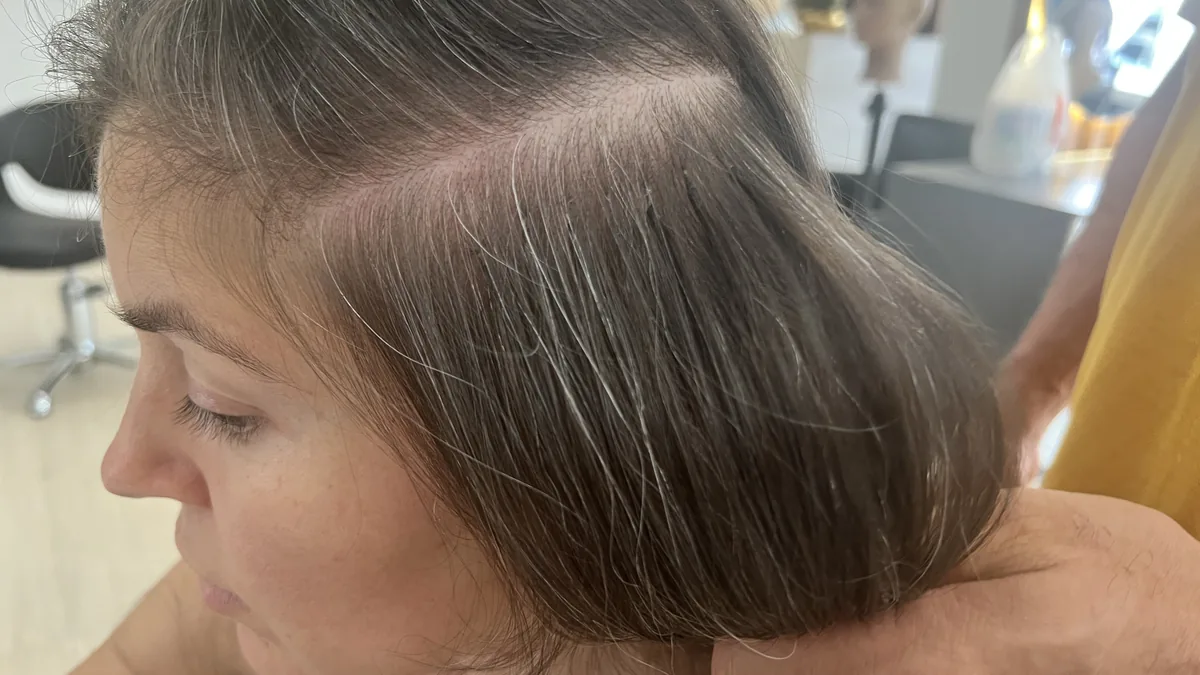
Two objects arrive in the same box and get sold under one word. One is hair: a keratin fibre that came off somebody's head, sorted, cleaned, processed and cut to a length. The other is a joint — a small piece of engineering whose only job is to hold that hair against your own without letting go too early or holding on too hard. Nearly every complaint we see traces back to a failure to separate those two objects.
We manufacture in Fethiye, Muğla. That gives us one vantage point and one blind spot. The vantage point is that we handle the raw material, weigh it, and see what comes back when something has gone wrong. The blind spot is that we are not in the salon chair for the six months afterwards, so there are things about wear we can describe but have not measured. This page marks both, and what having both positions changes about the advice is set out on <a href="/en/about">the about page</a>.
A hair extension is two purchases wearing one name
Variable one is the hair: where it came from, human or synthetic, cuticle intact or stripped, how its lengths are distributed inside the bundle, how it was coloured, and — the number that governs the result — how many grams of it you are buying.
Variable two is the attachment: what material forms the joint, how much of your own hair it recruits, what it weighs, how it sits against the scalp as the hair grows out, and how it is released at the end. Nothing about variable two tells you anything about variable one.
They combine freely, which is why the market is confusing. Excellent Double Drawn Remy hair on a weft sewn too tightly to a thin braid is a poor application of very good hair. A carefully made strand system loaded with cuticle-stripped, silicone-coated hair photographs beautifully and turns on the client at the fourth wash. Both say hair extensions and mean different failures.
The distinction earns its keep in a quotation. Hair is priced by gram and by length; application is priced by the operator's time and skill; consumables are a small third line. One number covering all three is unreadable — the client cannot see how much of the price is hair and how much is labour.
Clip-ins, halo pieces and ponytails also sit under this word and carry no sustained load, because they come off at night. The rest of this page concerns semi-permanent systems. If that commitment does not appeal, temporary pieces are the honest alternative.
- Origin of the hair, and how the supplier knows it
- Human fibre or synthetic filament
- Cuticle intact and aligned (Remy), or stripped and coated
- Single drawn or Double Drawn
- Length, in centimetres or inches
- Total weight in grams — not strands, pieces or packs
- Colour code, and whose catalogue it belongs to
- Attachment family, and the weight of one attachment unit
Human hair and synthetic fibre behave differently under heat, water and time
Human hair is a keratin fibre: cuticle outside, cortex carrying strength and pigment, sometimes a hollow medulla at the centre. Its diameter varies along its own length and between fibres, and that irregularity is why it blends — light lands on an uneven surface and scatters.
Synthetic hair is extruded polymer filament, leaving the die at a controlled diameter with a controlled surface. A whole head of it reflects light identically at the same moment, which is the origin of the plastic sheen people recognise across a room. That is not a quality failure; it is what a uniform cylinder does to light.
Heat is the sharpest divide. A straightening iron on a normal setting runs hot enough to soften, deform or fuse most standard synthetic fibre, and the damage is permanent, because you are reshaping a plastic rather than breaking the hydrogen bonds of a keratin fibre. Heat-tolerant synthetics are rated to a stated temperature by their maker; that rating is a limit, not a suggestion.
Colour is the second divide: synthetic pigment lives inside the polymer and cannot be shifted by salon colour. The third is lifespan — synthetic wear is usually measured in weeks of regular use before the ends fray and dull, while good human hair, properly maintained, is measured in months and survives being moved up and reinstalled.
The bounded part: we manufacture in human hair. We do not produce synthetic fibre and run no tests on it, so read the above as a description of a material class, not a measurement we performed. For a low-cost, occasional-wear piece, synthetic is a legitimate choice and we will say so.
Remy is a claim about direction, not a grade
Every human hair fibre is sheathed in overlapping cuticle scales pointing one way, root towards tip, like roof tiles. Run a finger from root to tip and the fibre feels smooth; run it back and it catches. That directional friction is the mechanism behind everything here.
Remy means the hair has been kept and assembled so that all fibres in a bundle have their root ends at the same end, cuticle intact and running one way. Every fibre then slides against its neighbours in the same direction.
Non-Remy hair loses that order — brushings, floor collection, sources combined after the fact — so a share of the fibres end up reversed, and scale edges meet head-on. Under ordinary movement the fibres ratchet against each other, tangles tighten instead of releasing, and the matting concentrates near the attachment point. By the time it is visible it is generally not brushable out.
The industry has a standard workaround worth understanding rather than fearing: strip the cuticle chemically, coat the bare fibre with silicone. The hair then feels superb, because a coated fibre has almost no directional friction. The coating survives a handful of washes. What remains is cuticle-free hair, which tangles differently but no less. That is the honest mechanism behind "it was beautiful for the first month".
Remy is not a grade, a certification or a number — no independent body issues it and nobody audits the claim. Virgin is a separate, narrower claim: never chemically processed, which says nothing about cuticle direction. To test either without a laboratory, wash a sample several times the way a client washes, then handle it.
Cuticle direction, the acid-bath and silicone workaround, the A-grade labels and how to specify any of it in an order are covered properly on <a href="/en/remy-hair-extensions">the Remy page</a>.
Double Drawn is about where the mass sits along the length
Collected hair is not one length. Like the head it came from, it is a distribution: some fibres reach the full length, many stop short, a few are much shorter. What a manufacturer does with that distribution is what single drawn and Double Drawn describe.
Single drawn hair keeps most of that distribution. The bundle measures its stated length at the longest fibres and thins towards the ends, because fewer fibres reach that far. Worn, it reads as hair with natural taper, and some clients want exactly that.
Double Drawn hair has had the shorter fibres pulled out by hand, in repeated passes, until the great majority of what remains reaches close to the stated length. The bundle stays thick down to the tips: the ends read full rather than wispy, and a blunt cut stays blunt.
The honest cost. Finishing a given weight of Double Drawn hair takes substantially more raw hair than the same weight single drawn, and the fibres removed either become a shorter product or are lost. On top sits skilled hand labour, repeated. Double Drawn is therefore always dearer per gram from the same source, and the gap widens with length. Double Drawn offered at single drawn prices means either a loose definition of the term or a label that does not match the contents.
Double Drawn is the preferred SACH & VOGUE HAIR standard, and here is plainly what it does and does not change. It changes where the mass sits along the length, so more weight is carried in the lower half and the tips look full. It does not change what one attachment unit weighs: a 0.3 g strand is 0.3 g whether the hair inside it is single drawn or Double Drawn, and only the arrangement of that same 0.3 g differs. Claims that Double Drawn is inherently too heavy confuse those two facts.
Length distribution, end fullness, and the difference between hair density and attachment load are worked through on <a href="/en/double-drawn-hair-extensions">the Double Drawn page</a>.
Four families of attachment, and one ranking with its limits declared
Strand-based systems divide the hair into many small units and join each to a small section of natural hair. The joint varies within the family: a filament-based connection, a polymer bond, or a metal element. Nanofilament and Micro are both strand-based systems of ours, and Micro is bonded with Italian keratin.
Tape-in systems present the hair pre-mounted on a thin adhesive strip, with a section of natural hair sandwiched between two strips or laid against one. Butterfly Tape-In is our product in that family. Weft systems supply hair on a horizontal seam, attached along a track by sewing, beads or adhesive — one long attachment instead of many small ones.
Bead and ring systems, micro-rings and nano-rings among them, thread natural hair and extension hair through a small metal tube and crimp it closed: no adhesive, no heat, and the tube can often be reused. Nano there means a smaller ring than a micro-ring. It has no connection to our Nanofilament system, which is a strand product and not a ring product at all; the two are regularly conflated by people reselling both.
Our published evaluation of seven systems runs: 1 Nanofilament, 2 Micro, 3 Butterfly Tape-In, 4 Standard Tape-In, 5 Keratin, 6 Bead / Micro-Ring, 7 Weft. The disclosure is the only thing that makes it useful. This is the manufacturer's own evaluation of a set that includes the manufacturer's own products, and our products hold the top two places. What we measured is per-strand weight, by weighing batches and dividing. What we did not measure is retention over months of wear, comfort as reported by wearers, comparative load on different hair and scalp types, or anything assessed by a party independent of us. A ranking that does not say which of its parts were measured is an opinion presented as data — ours included, unless we say so.
Choosing between families is a decision about your hair, your routine and your budget, not about which family is superior in the abstract. The mechanics of each are set out on <a href="/en/hair-extension-methods">the hair extension methods page</a>; for the same criteria applied side by side, read <a href="/en/hair-extension-systems-comparison">the systems comparison</a>.
Grams tell you what a strand count cannot
Strand count is the most quoted and least informative number in this industry. Two clients told they are getting 150 strands can receive quantities of hair differing by a factor of two, because nothing in that number says how much hair is in each strand. Grams survive translation between systems and suppliers.
There are two loads. Total load is hair plus attachment material sitting on the head. Point load is what one attachment unit weighs, spread across your own fibres recruited into it. Point load is what acts on the follicle, and it is the one nobody publishes.
Here is the only measurement we state as our own, with its limits attached. We weighed a batch of ten <a href="/en/nanofilament-hair-extensions">Nanofilament</a> strands together at approximately 3 g, and a batch of ten Micro strands together at approximately 6 g. Dividing gives approximately 0.3 g and approximately 0.6 g per strand.
Now the framing that must travel with those numbers. This is a batch reference comparison. The per-strand figures are derived by division, not weighed individually, so they are averages, and we have not characterised how much individual strands vary around them. It is not a laboratory test and not a calibrated scientific measurement. What it establishes is a ratio of roughly two to one between two of our own systems — a useful thing to know and a small thing to claim. Nanofilament is made in two per-strand weights, 0.3 g and 0.6 g; the batch we weighed was the 0.3 g option.
The arithmetic that follows changes how an appointment is planned. Delivering 100 g of hair in 0.3 g units means roughly 330 attachment points; the same 100 g in 0.6 g units means roughly 170. Identical hair on the head, different fitting and removal time, a different number of joints to maintain, and a different amount of your own hair recruited into each.
What we will not do is turn that into a rule about how many grams a head can carry. We have not measured retention or traction on real scalps under controlled conditions, and to our knowledge nobody in this industry has published such a study. A supplier quoting a hard maximum in grams is asserting something the field has not established.
Length changes the grams before it changes the price
Length is the variable buyers set first and understand last. The instinct is that a longer set is the same order with longer hair in it. It is not, because the hair must fill a larger surface: as length increases it fans wider as it falls, and holding the same apparent density over that area needs disproportionately more weight.
Price then moves twice with length, and buyers usually anticipate only one movement. Long hair costs more per gram at source, because long donor hair is scarcer and because a long Double Drawn bundle discards more short fibre to reach its weight. Then the longer set needs more grams. The two multiply, which is the mechanism behind the gap people notice between a 40 cm and a 65 cm order; it is unpacked in <a href="/en/hair-extension-prices-turkey">how hair extension pricing is built up</a>.
We will not publish a grams-per-length table and present it as fact. Every such table in circulation is somebody's internal habit written down as a standard, and applied to a head it was never derived from it produces either a set that does not show or one heavier than that hair should carry.
One practical note on measurement. Extensions are measured with the hair lying straight, and stated length runs from the top of the attachment, not from your scalp. A joint placed a centimetre down from the root makes the visible result that centimetre shorter than the packet says, and wavy or curly hair reads shorter still. Neither is a defect; both disappoint when nobody mentions them beforehand.
Extension colour codes are catalogue references, not a colour system
Salon colour numbering is a system: a depth level and a tone, with arithmetic behind it that lets a colourist predict a result. Extension codes are not that. #1, #1B, #2, #4, #613, #60 and every supplier-specific code beside them are catalogue entries pointing at a physical shade a factory produced. An extension #6 is not level 6.
The consequence is blunt: codes are not portable between suppliers. Two factories' #4 are two different browns, and a code that matched last year from one source can miss from another. Matching is done against physical samples in the hand, and a supplier who cannot send a ring of their own shades is asking you to buy blind.
Match to the mid-lengths and ends, not the root. The root is darker on almost everybody and will be darker again weeks after any colour service, whereas the extensions live where they have to disappear. Match undertone before depth: the eye tolerates a small error in depth and will not tolerate a warm extension against ash-toned hair, or the reverse. That error reads instantly, in every photograph.
Check in daylight as well as indoors, because warm artificial light hides a mismatch until the client walks outside. Where the natural hair carries several tones, blend two or three codes rather than one flat shade.
Toning and darkening afterwards are ordinarily achievable, with the caveat that processed hair takes deposit faster than expected and can grab. Lifting already-processed extension hair carries a real risk of destroying it.
Extensions are also never refreshed at the root appointment the way your own hair is. They oxidise under UV, lose deposited tone with washing, drift warmer in warm shades and can pull blue-grey in deep blacks. That is normal fading of hair no longer attached to a living follicle, and one reason a set needs replacing even when the fibre is sound.
Two clocks run at once: the hair, and the position of the joint
The hair has a lifespan and the attachment has a much shorter one. People plan for the first and are surprised by the second. Good human hair, properly maintained, stays wearable long after the joints holding it have travelled to the wrong place.
The attachment clock is set by your growth rate, not by the product. Hair grows roughly a centimetre a month for many people, and your own rate is what matters — a stylist can measure it between two appointments better than any average can. A joint fitted close to the scalp sits several centimetres away within a few months. At that distance it becomes visible, it swings, it acts on the natural hair with more leverage, and shed hair collects around it.
Reapplication, or a move-up, means releasing the extension hair from its old joint, cleaning and re-tipping it, and reinstalling it near the scalp. It is not new hair and should not be billed as such. Ask at the outset what a move-up costs: the first invoice is never the total cost of a set.
Maintenance is not a lifestyle list. It is a short set of mechanical rules, all of them about keeping friction, moisture and weight away from the joints.
- Wash with the head upright, not thrown forward, so the joints keep their orientation
- Keep conditioner, masks and oils on the mid-lengths and ends, away from the attachment area
- Dry the attachment area properly — a damp joint plus friction is the classic matting site
- Brush from the ends upwards, supporting the hair above the joints with the other hand
- Plait or tie the hair loosely before sleeping
- Keep heat tools off the joints themselves, whatever the joint is made of
- Rinse immediately after chlorine or salt water, and protect from prolonged UV
- Return for a check at the interval the technician sets, not when a problem appears
Removal is where you find out how the application was done
Every system has a defined release: a solvent that dissolves the bond, pliers that reopen a ring, or another specified method and tool. Removal done correctly uses the correct release agent for that exact system, opens the joint before anything is pulled, and finishes with residue combed out of the natural hair. It takes real time, often comparable to the application.
What should not happen: your own hair coming away inside the joint, the natural section snapping at the point of attachment, pain beyond mild sensation, or the operator cutting through natural hair to save time. Any of those points to an application, a maintenance interval or a removal technique that was wrong.
Expect a rush of loose hair immediately afterwards. Shed fibres held above a joint cannot fall until it is opened, so months of ordinary shedding is released in one sitting. That is hair already lost, not hair the extensions took.
A different matter, not to be dismissed as the same thing: short broken fibres standing up along the line where the joints sat, scalp tenderness that persists, visible thinning at the temples or nape. Extensions place a continuous mechanical load on hair and follicles, and how much load an individual can carry is not something a factory can determine from a distance. If those signs appear, stop, do not have the set reinstalled, and have the scalp assessed by a qualified professional first.
A test worth applying to any salon before booking: ask to watch a removal, not an application. Applications are what gets photographed; removals are where the standard of the work becomes visible.
The people extensions genuinely do not suit
We manufacture and sell this product, and we will still say that a meaningful number of the people who ask for it should not have it. A salon that has never turned anybody away is not a salon with unusually suitable clients. It is a salon that does not assess.
The pattern behind the list is constant: extensions add sustained load to hair that is already compromised, already shedding, or too short at the point of attachment to carry anything. The load does not care why the hair is weak.
- Anyone with an inflamed, flaking, sore or broken scalp — a matter for a medical professional, not a salon
- Hair loss with an unknown cause, or a recent change in shedding that has not been explained
- The post-partum shedding phase, or shedding after illness, surgery, severe stress or a change in medication
- A hairline already showing traction damage from previous extensions, tight braiding, weaves or tight ponytails
- Hair too short in the attachment zone to conceal a joint or to give it anything to hold
- Recently over-processed hair — hair that stretches without recovering when wet, or breaks mid-shaft, fails before the joint does
- Very fine, low-density hair combined with a demand for a dramatic transformation; the honest options are fewer grams, or no
- Anyone unable to fund the recurring cost — a set means move-ups every few months
- Anyone unwilling to change their washing and brushing routine, or unable to return for maintenance
- Daily swimmers, and people who work in a helmet or covering that rubs the attachment zone
- Children, whose hair and scalp should not carry this kind of sustained load
- Anyone who wants a permanent solution — no such product exists in this category, from us or from anyone else
Questions that separate a manufacturer from a reseller
Much of what presents itself as a hair extension brand is a trading operation buying finished goods, repackaging them and applying a name. That is legitimate as long as everybody knows which one they are dealing with. The difficulty is that a reseller cannot answer questions about production — so the questions that expose the difference are about how the goods were made.
The pattern to watch is not dishonesty, it is the absence of limits. A supplier whose every statement is an adjective — premium, finest, guaranteed non-shedding for two years — has given you nothing checkable, and the guarantee is usually the tell, because nobody can guarantee the behaviour of hair they will never see again.
Two commercial checks are worth as much as any technical one. Ask whether the same specification can be supplied again in six months, since a reseller is at the mercy of whatever the upstream shipped that quarter. Then apply price sanity: hair is a scarce raw material, and a long Double Drawn set cannot cost what a short single drawn one costs.
These questions apply to any source in any country. For the considerations specific to this region — sourcing, standards, communication, and what actually differs between a factory and a trading company here — see <a href="/en/hair-extensions-turkey">the page on buying hair extensions from Turkey</a>.
- Where is the hair collected, and how do you know? A real answer includes where the chain stops being traceable
- Is your Remy claim about cuticle direction, or is it a grade name you were given?
- Single drawn or Double Drawn — and what does your single drawn look like at the ends?
- What does one attachment unit weigh? Weighed individually, or derived from a batch?
- Which characteristics have you measured, and which have you not?
- Can you show a photograph of the connector with a scale reference in the frame?
- Can I have the same specification, from the same source, in six months?
- For salons: what does a move-up cost, and how many can this hair take?
- For salons: when did you last tell a client that extensions were not appropriate, and why?
What to settle before the first appointment
Decisions here are usually made in the wrong order. People choose a method first, because methods have names and names are searchable, then discover it does not suit their hair, their budget or their routine.
Settle the result first, in plain words rather than a reference photograph: added length, added density, or both, and how much of each. Have a professional assess the hair in person — density, texture, elasticity, the hairline, how short the shortest layers are. Only then does the method question have a real answer, because the assessment eliminates several families outright. Grams come next, decided by the assessor. Colour is matched against physical samples in daylight. Price is discussed last.
Ask for the maintenance schedule in writing before committing: the interval between checks, the expected move-up interval, what a move-up costs, and what happens if a joint fails in the first fortnight.
One last thing, which is why this page takes the form it does. If a supplier or a salon cannot tell you what they do not know, you have no way of judging anything else they say. We have not measured retention, traction or comfort under controlled conditions, and our one published measurement is a batch division rather than a laboratory result. That is not a weakness. It is the only way to say something a reader can use.
Frequently asked
Common questions
Will hair extensions damage my own hair?
Extensions place a continuous mechanical load on hair and follicles. How a particular head tolerates that load depends on density, elasticity, the hairline and the standard of the work — none of which we have measured under controlled conditions, and none of which can be judged remotely. What is controllable: weight per attachment point, keeping to the maintenance interval, and correct removal. Short broken fibres along the attachment line, or persistent tenderness, mean stop and have it assessed by a qualified professional.
How many grams do I need?
It depends on your natural density, the length you are going to, and the balance of length and density you want. Dense hair needs more weight before any change shows; fine hair needs less to change but carries less. Length raises the requirement disproportionately, because hair fans wider as it falls. We will not publish a grams-per-length table as a standard — every one in circulation is somebody's internal habit applied to heads it was never derived from.
What is the difference between Remy and virgin hair?
Two different claims. Remy is about direction: fibres assembled root end to root end with the cuticle intact and running one way, which is what stops a bundle ratcheting into knots. Virgin means never chemically processed. Hair can be Remy without being virgin, which is the normal case for coloured shades. Neither term is certified by an independent body, so both are supplier statements. Test them by washing a sample several times and handling it afterwards.
Is Double Drawn too heavy for fine hair?
No, and the claim confuses two things. Double Drawn describes where the mass sits along the length: shorter fibres have been removed so the bundle stays thick to the tips. It does not change what one attachment unit weighs — a 0.3 g strand is 0.3 g regardless of how the hair inside it was drawn. Load is governed by total grams and weight per point, set independently. The real consideration with fine hair is aesthetic: Double Drawn ends can read a little solid, which a stylist resolves by softening the tips.
How long do hair extensions last?
Two clocks run at once. Good hair, properly maintained, stays wearable for a considerable time and survives being reinstalled more than once. The attachment has a much shorter life, set by your growth rate rather than by the product: as the joint travels away from the scalp it becomes visible, gains leverage on the natural hair and collects shed hair around itself. That, not the condition of the hair, triggers a move-up.
What does reapplication actually involve?
The extension hair is released from its old joint, cleaned, re-tipped and reinstalled close to the scalp. You are paying for operator hours and consumables, not for new hair, and it should not be billed as a new set. A small amount of length is lost at the tip each time. Ask before your first appointment what a move-up costs and how many the hair should take.
Can I dye or bleach hair extensions?
Toning and going darker are usually achievable, with the warning that already-processed hair takes deposit faster than expected and can grab unevenly. Lifting extension hair that has already been processed carries a real risk of destroying it, and pre-lightened shades such as #613 and #60 have little integrity left to spend. Always test on a spare piece first. No manufacturer, ourselves included, can stand behind colour work carried out after the hair leaves us.
Why do the same colour codes look different from two suppliers?
Because extension codes are catalogue references, not a colour system. Salon numbering encodes a depth and a tone with arithmetic behind it. A #4 or #6 on an extension label points at a physical shade one factory produced, with no formula and no cross-supplier equivalence, so two factories' #4 are two different browns. Match against a physical sample in daylight rather than against a number in a message thread.
What do grades like 10A or 12A mean?
Nothing standardised. No body defines the A-scale, audits it or issues it, so 8A, 10A, 12A and whatever appears next season are supplier marketing. Two suppliers' 10A have no relationship to each other, and a higher number indicates nothing verifiable about cuticle direction, length distribution or processing. Ask the underlying questions instead: origin, cuticle intact and aligned, single drawn or Double Drawn, weight in grams, and weight per attachment unit.
Can I remove extensions myself?
We advise against it. Every system has a specific release — a particular solvent, tool and sequence — and the failure mode of getting it wrong is your own hair breaking at the attachment point or coming away inside the joint. It is also awkward to do on the back of your own head, which is where most of the damage happens. If you must stop wearing a set urgently, find a technician who works with that system rather than improvising.
Is it normal to lose a lot of hair when extensions come out?
A rush of loose hair immediately after removal is expected. Shed fibres sitting above a joint cannot fall out until that joint is opened, so months of ordinary shedding arrives at once. That is hair already lost. A different matter is short broken fibres standing up along the line where the joints sat, thinning at the temples or nape, or persistent scalp tenderness. Those warrant assessment by a qualified professional before anything is reinstalled.
How much of my own hair do I need before extensions are possible?
Enough for the joint to have something to hold, and enough hair above it to conceal the attachment. Very short hair in the attachment zone fails both tests: the joint has too little to grip, and it shows. Layers matter as much as overall length, since short layers around the crown and hairline are usually the limiting factor rather than the longest hair. This is a judgement made by looking at the specific head.
Related pages
Continue reading
Describe the hair you are working with and we will tell you what it needs — including when the answer is that it needs nothing.
Method, colour, length and grams are settled by consultation before anything is quoted.