From the factory floor
Keratin Bond Hair Extensions: What Is Actually Formed at the Joint
A keratin bond extension is a small bundle of hair carrying a thermoplastic tip, joined to a section of the wearer's own hair by softening that tip with heat and shaping it around the section until it cools solid. Nothing is glued and nothing cures: the hold is a solid formed around fibres, which is why it is opened with a solvent rather than pulled. Tip shape and attachment method are separate decisions — a flat or U-shaped tip is made to be fused, while an I-tip is normally clamped inside a metal ring instead, with no heat involved at all.
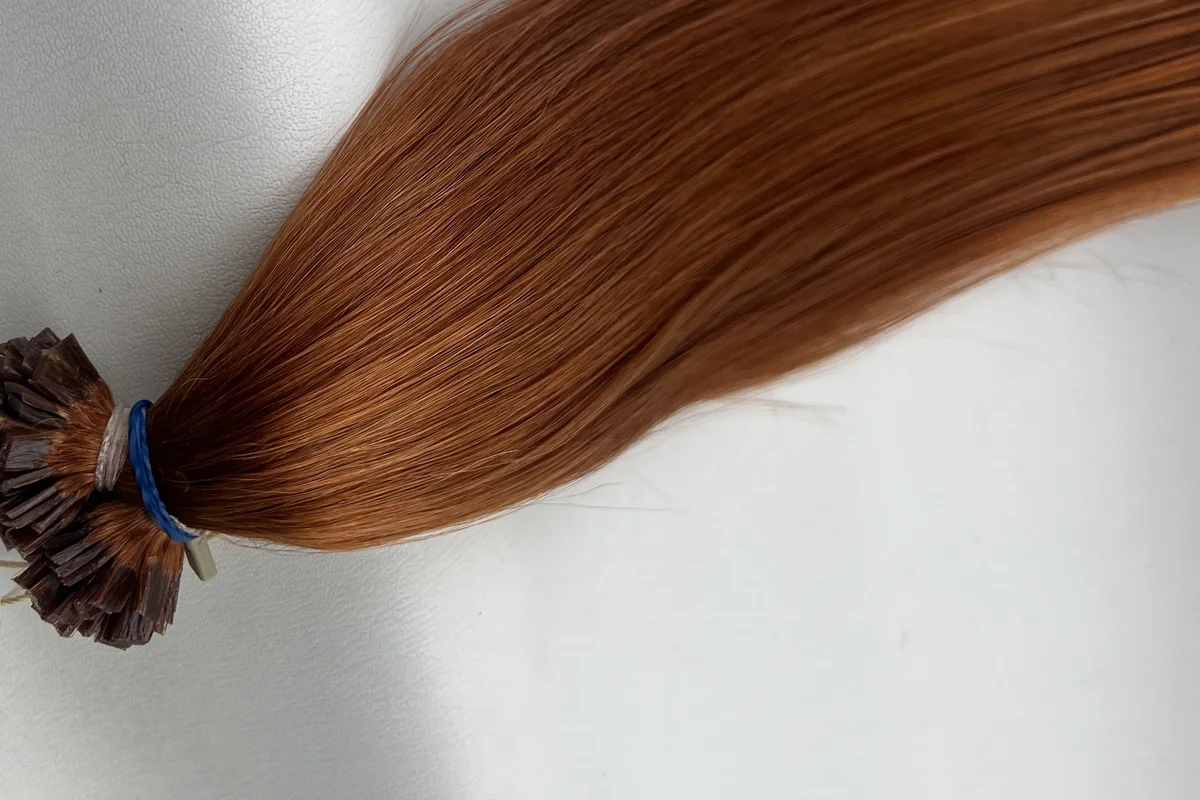
Keratin is the word this trade puts on a specification, and on its own it settles almost nothing. It names the material at the tip of a strand. It does not say what shape that tip is, whether heat will ever touch it, how much hair hangs beneath it, or what opens it months later. Those are four separate decisions, and treating the first as though it decided the other three is where most disappointment with this family begins.
We form tips onto strands, which sets the limits of what we can usefully say. We can describe how a joint is built and which decisions in it govern how it behaves. We are not in the chair when one is closed on somebody's hair, and where that distinction changes the answer, this page says so.
What a keratin bond physically is, and what the word does not tell you
A tip is formed in production, before a strand reaches anybody's hands. Hair is gathered into a small bundle and held in order, and a measured amount of compound is set onto one end so the fibres inside it are locked into a single solid. What arrives at the salon is therefore already a unit — countable, weighable, and attached one at a time.
The compound is thermoplastic, and that one property carries most of this page. It softens progressively as it warms and hardens again as it cools, with nothing mixed, nothing cured and no chemical reaction at any stage. That is why a tip can be re-formed, why styling heat has to be kept away from it, and why the correct release is chemical rather than mechanical.
Keratin as a word does no work by itself. It is trade vocabulary for a bonding compound of this class rather than a statement of composition, and origin only becomes meaningful when a behaviour is attached to it: how evenly the material softens, whether it stays workable long enough to be shaped, whether it sets clear against light hair, and whether it dissolves cleanly instead of going gummy. A supplier who cannot name the remover for their own tips has given you a word rather than a specification.
Flat tip, U-tip, I-tip: the tip shape and the attachment method are two different decisions
Three tip shapes carry most of this market, and confusing a shape with a mechanism is the most expensive misunderstanding in the family.
A flat tip is pressed into a thin, wide profile. Laid against the scalp it presents its narrowest dimension to the surface, so it sits closer and reads less as a solid object beneath the hair, and its flat face gives the fusing tool something even to work against.
A U-tip, also sold as a nail tip, is a rounded form with a hooked or pointed end. It is made to be softened and wrapped, so the finished joint is shaped in the chair rather than delivered in its final geometry — which puts more of the outcome in the technician's hands and less in the manufacturer's.
An I-tip is a straight stick, and it belongs in a different conversation. It is normally fitted by threading a section of natural hair through a small metal tube, sliding the tip in alongside it and crimping the tube flat. The tip is keratin; the joint is compression. No heat is applied, no solvent releases it, and it comes off when the tube is squeezed round again. An I-tip can be fused by a technician who works that way, but the ring is what it is made for.
So keratin on a packing list tells you what the tip is made of and nothing about the joint. Aftercare, tooling and above all the removal procedure follow the mechanism rather than the material, and a client who has worn ring-fitted I-tips arrives expecting a release that does not exist for a fused bond. The rest of the retail vocabulary — fusion, cold fusion, micro tip, stick tip — is untangled on the methods hub.
The bond is formed, not glued, and the working window is where the skill sits
Glue holds by adhesion: a film sticks to two surfaces and works across the contact between them. A fused joint does something else. The softened compound flows around the section of natural hair and then hardens through it, so the fibres end up inside the solid rather than stuck to its face. The grip is a mechanical interlock between two bundles of fibre held in one body of material, and that is why a well-formed bond survives conditions that defeat a film.
It also explains the aftercare. There is no adhesive layer to be contaminated by oil, conditioner or dry shampoo, so a fused joint is far less fussy about what is in the hair than an adhesive one. What it will not tolerate is heat, because heat is the mechanism — a straightener held against a bond is doing exactly what the fusing tool did, without anyone shaping the result.
The application window is narrow. Below it the compound never becomes properly workable, so it is either forced into an uneven shape or wrapped around only the outer fibres of the section: a joint that looks acceptable on the day and later slides or lets go. Above it the material thins, runs where it was not wanted, and the surplus heat has to go somewhere — into the client's own fibres in the middle of the joint.
We publish no temperature and no dwell time, and this is a refusal rather than an omission. The correct setting is a property of the compound, the tool and the technician's rhythm together, and tips carrying residue from earlier joints behave differently from clean ones. The variance between two pairs of hands is larger here than the difference between most products.
Bond size, and why a smaller bond is not automatically a better one
Small bonds are sold as the refined choice. The argument is real and it is conditional, and the condition is the part that gets dropped. A smaller joint is easier to conceal, sits closer to the scalp and hangs less mass on the fibres beneath it — provided the support section is reduced with it and the same total weight is divided across more attachment points.
Take the same grams, make the bonds smaller and change nothing else, and nothing has improved: each point is now thinner around the same amount of hair, which is a weaker joint rather than a lighter one. Reduce the support sections as well without raising the point count, and load per fibre goes up rather than down. Small is a consequence of a plan, not a substitute for one.
A smaller bond also asks more of whoever forms it. Less material means a narrower margin between under-softened and over-heated, and less compound around each fibre to hold it once it has set. Where hair is coarse or dense and a larger joint disappears effortlessly anyway, a smaller bond buys concealment nobody needed while its higher point count still costs the hours.
We publish no bond dimensions. We hold no measurement in millimetres we would stand behind, and a figure with nothing behind it is decoration. What we will say is that bond size is chosen against the hair it will sit in, zone by zone, not against a preference stated before the hair has been seen.
Strand weight decides the appointment; total grams decides the result
Total grams is settled before any system is chosen, because it describes the outcome: how much length and how much fullness are being added to a head that already carries hair. Only once that number exists does per-strand weight matter, and then it governs exactly one thing — how many attachment points the total divides into.
Two specifications carrying identical grams therefore produce entirely different appointments. Lighter strands mean more joints: a longer fitting, a longer removal, more tips to re-form at every reinstallation, and finer division of the same load. Heavier strands mean fewer of all four, each carrying more mass and needing more hair beneath it. Neither is better in the abstract, and the choice is made zone by zone on a specific head.
Our own bonded strand systems make that arithmetic concrete. SACH & VOGUE Micro is an individual bonded strand made with Italian keratin and supplied at approximately 0.5–0.6 g per strand. It is not a ring, bead or loop system of any kind, whatever the prefix has come to mean in retail listings — micro ring, micro link and micro bead name a separate attachment family that crimps a metal tube shut with pliers, uses no heat and no compound, and is opened mechanically. Nanofilament is our other bonded strand system and exists in 0.3 g and 0.6 g, and in no other weight.
Length raises the grams requirement disproportionately, because a few long strands read as stringy where the same weight in shorter strands reads as fullness. And the cut at the end is not optional: extension hair arrives at one length with its weight distributed one way, and it has to be worked into an existing shape at the end of an already long appointment.
Sectioning and placement: the half of the joint nobody manufactures
Every bonded joint has two halves and only one of them is made in a factory. The strand's weight is set at our bench. The section of the client's own hair taken to carry it is decided in the chair, by eye, in seconds, and it is where the real engineering of an application happens.
Too little hair under a bond concentrates the whole of its load onto a few fibres, which is the mechanism behind breakage at the joint line. Too much throws away the benefit of dividing the weight and produces a bulkier joint that is harder to hide and less comfortable against the scalp. The section has to be proportionate to the unit, which is why unit weight and section size are one decision rather than two.
Placement is a density map rather than a grid. Most heads are thinnest at the crown and along whichever parting is actually worn, so a plan that spaces points identically everywhere is right in some zones and wrong in others. Where a zone cannot carry a point at sensible spacing, the honest answers are a lighter unit there or nothing there — and the hairline is usually the second answer.
We publish no figures for section size, spacing or distance from the scalp. Every number of that kind we have seen describes one salon's working habit rather than a measured limit, and a technician holding a bond against the scalp and dropping the hair over it learns more in a minute than any table gives.
Load carried at a point, not along a track, and what that changes for fine hair
A bonded strand carries its share of the weight at a point. A weft carries many grams along a continuous track built across the head, and a taped panel carries its load across an adhesive area. That geometric difference predicts who each family suits far more reliably than any claim about gentleness.
Points can be moved and a track cannot. A track runs where it runs, and everything attached to it pulls along that line, so if the braid or bead row beneath is too fine for what it carries, the pull is continuous and cannot be redistributed. Individual joints can be omitted from a thin zone, spaced wider at the crown, specified lighter near a parting and left out of the hairline entirely.
That is why the bonded family is usually the first candidate on fine or unevenly dense hair, and the reason is placement freedom rather than any inherent kindness. The same freedom cuts the other way: a rushed plan can drop heavy points into precisely the zones least able to hold them, and a point load placed badly is less forgiving than a track load placed well. What fine hair genuinely constrains, and why total grams matters more than the drawing standard, is set out on the page on extensions for fine hair.
One more consequence of points rather than a plane: the hair around each joint stays hair. It separates, parts and moves as individual fibres, which is what makes a bonded set read as movement rather than as sections. A taped panel locks a slice of hair into one rigid plate, and the eye finds the boundary where that plate stops moving.
When a bond has travelled too far from the root, and what maintenance actually is
A joint fitted close to the scalp travels outwards at whatever rate that head grows, and three things arrive together once it has travelled far enough. It leaves the hair that concealed it. It gains a lever arm, so the same mass acts on the root through a longer moment every time the head turns. And it begins collecting shed fibres that can no longer fall out, because the joint sits above them.
The third one is the failure that actually turns up. Sets are rarely lost because a bond let go; they are lost to matting in the attachment zone, where trapped shedding is worked into a mass by friction and by drying in bulk. Once that has started it is worked out slowly by hand or cut out, and neither is a good afternoon.
So the move-up interval is set by growth rather than by the product, and we publish no figure in weeks. Growth rates differ between individuals by enough to make a single number meaningless, and the intervals circulating between supplier websites are habits rather than findings. Your own technician can measure yours across two appointments, which is worth more than anything published.
A move-up is not an adjustment, either. The joints are opened, residue is cleaned off, tips are re-formed with fresh compound and the strands are refitted close to the scalp — the same work as a fitting, with a removal in front of it. How that is planned in person, including the consultation, the colour work in daylight and the routine that follows a fitting on a coast where people swim, is on our Fethiye keratin page.
- Take the root area to genuinely dry before sleeping, not nearly dry
- Keep oils, masks and conditioner below the joints, on the mid-lengths and ends
- Separate the joints with your fingers before brushing, then brush upwards from the ends
- Straighteners and tongs stay off the bonds — the compound is built to soften with heat
- After the sea or a pool, rinse in fresh water first and dry the roots properly
Removal is a solvent operation, and pliers are not an alternative
There is one correct release for a fused bond and it is chemical. The agent specified for that compound is applied, given time to break the material down, and the softened bond is broken up and combed clear before anything is pulled. Almost every case of hair destroyed at removal that comes back to this factory involved the wrong agent, or the right agent used without patience.
Any solvent is not the correct solvent. A chemistry that dissolves one compound can swell another into a gum that smears through the mid-lengths, so what opens a tip is a question to settle before buying rather than on the day. If a supplier will not answer it, that is the answer.
The point that most needs stating: a fused bond cannot be opened the way a ring is opened. A crimped tube is squeezed round again and slides off in seconds with no chemistry involved. The same pliers applied to a keratin bond crush the bond, the extension hair and the client's own fibres running through it. Removal is a full appointment and should be booked and priced as one.
Expect a rush of loose hair afterwards and do not read it as damage: shedding held above a joint cannot fall until the joint is opened, so months of ordinary loss arrives at once. What does deserve a qualified professional's eye before anything is reinstalled is broken fibres standing along the joint line, thinning at the temples or nape, or scalp tenderness that persists. Reuse divides the product — the bond is the consumable, the hair usually is not, and a strand loses a little length at the tip with each re-tipping.
Honest comparison: keratin against tape and weft
Against tape, the trade is time for placement. A full head of panels is a fraction of the attachment points of a bonded set, so it fits faster and every subsequent appointment is shorter. It also spends a fresh adhesive strip at every reinstallation, where a bonded set spends a little compound, so the two have differently shaped costs rather than obviously different sizes. A panel needs continuous cover above it and locks a slice of hair into one plane; bonds go where panels cannot. The tape-in family is examined properly on its own page.
Against weft, the trade is grams for control. A weft delivers more weight per chair hour than anything in the bonded family and disappears effortlessly on dense, coarse or textured hair, where a seam has plenty of cover. What it gives up is the ability to place weight zone by zone, and it needs a track properly proportioned to what hangs from it.
In our own evaluation of seven attachment systems — a manufacturer's list containing its own products, in which exactly one characteristic was measured — keratin sits fifth, the tape family third and fourth, and weft seventh. That position is about joint scale against criteria we chose and weighted ourselves, not a verdict on the method. On coarse dense hair, or where a technician's practised work is in fusion, keratin is frequently the right specification and we would say so. The criteria, the weightings and the full disclosure are in the systems comparison.
And the case that rules out the whole bonded family, ours included: hair or scalp that cannot carry sustained load. Active shedding of unknown cause, an inflamed or broken scalp, a hairline already showing traction damage, hair too short where joints would sit, or over-processed hair that stretches when wet and does not recover. The honest options there are temporary pieces that come off at night, or nothing until a qualified professional has assessed the cause.
What we have not measured about bonded strands
Our vantage point is a production bench and the parcels that come back when something has gone wrong. That is good evidence about how a tip is formed and poor, skewed evidence about how one wears, because nobody returns a parcel to report that the bonds held.
The compound is the largest gap. We specify it against behavioural criteria rather than formulating it, and we have run no instrumented melt-range testing on ours or on anybody else's. Everything above about the working window describes how thermoplastics of this class behave, not a curve we produced.
We publish no retention figure and no concealment claim, in any wording. We hold no controlled assessment of either — no standardised lighting, no range of hair types, no blinded assessor — and without those, a statement about how long a bond holds or how visible it is would be a bench impression dressed as a finding.
- Softening range of the compounds we specify, in degrees — never instrumented by us
- Comparative testing against competing keratin compounds — never carried out
- Bond dimensions in millimetres — no measurement we would stand behind
- Retention over months of real wear — not measured, and no study known to us
- Concealment under standardised lighting — no assessment, and therefore no visibility claim
- How many re-tipping cycles a specification survives — no failure counts held
Frequently asked
Common questions
Is a keratin bond glued to my hair?
No, and the distinction is mechanical rather than semantic. Glue holds by sticking to two surfaces across the contact between them. A keratin tip is softened with heat, flows around the section of natural hair and hardens through it, so the fibres end up inside a solid rather than stuck to its face. That is why a fused joint tolerates oils and conditioners better than an adhesive one, and why it is opened with a solvent instead of being peeled.
Is an I-tip a keratin extension or a ring extension?
Both statements are true about different things, which is exactly why the term causes trouble. The tip is keratin, so it appears in the same catalogues as fused strands. The joint is normally compression: the natural hair is threaded through a small metal tube, the straight tip slides in alongside it and the tube is crimped flat with pliers. No heat is used and no solvent releases it. Buy the tip shape and the attachment method as two separate decisions.
Are smaller bonds always gentler on the hair?
Only when the rest of the plan changes with them. A smaller bond helps if the support section is reduced in proportion and the same total weight is divided across more attachment points. Make the bonds smaller and change nothing else and each joint is simply thinner around the same amount of hair — weaker rather than lighter. Small units also mean more joints, so every fitting, move-up and removal takes longer for the life of the set.
Is SACH & VOGUE Micro a micro ring system?
No. Micro in our range is an individual bonded strand made with Italian keratin, supplied at approximately 0.5–0.6 g per strand, and the joint is a bond formed around the hair with heat. Micro ring, micro link and micro bead name a completely different attachment family — a metal tube crimped shut with pliers, no heat and no compound, opened by squeezing the tube round again. The shared prefix is a coincidence of retail vocabulary, not a family resemblance.
Can keratin bonds be taken out at home?
It is the single most common way people lose their own hair, so the honest answer is that it should be booked as an appointment. The procedure is not a knack: the correct agent for that compound, enough time for it to break the bond down, the softened material broken up, and the joint combed clear before anything is pulled. A general-purpose solvent from a drawer may swell the compound into a gum instead of dissolving it, and pliers crush the fibres running through the bond.
How often does a keratin set need moving up?
Whenever growth has carried the joints far enough that they leave their cover, gain leverage on the hair holding them and start trapping shed fibres — which is a condition rather than a date. We publish no interval in weeks because growth rates differ between individuals by enough to make a single figure meaningless, and the numbers circulating between supplier websites are working habits. Your technician can measure your own rate across two appointments.
Related pages
Continue reading
Describe the hair you are working with, the grams you have in mind and who will maintain the set, and we will tell you whether a bonded joint is the right shape for that head — including when it is not.
Method, colour, length and grams are settled by consultation before anything is quoted.