From the factory floor
Hair Extension Methods: Sorted by How the Load Is Carried
Attachment methods differ in one respect that governs everything else: how the weight of the added hair is transferred into your own hair. Strand systems divide that weight across many small joints, tape systems spread it over an adhesive surface, rings hold it by mechanical compression, and wefts carry it along a single sewn or beaded track. Brand names and price tiers sit on top of those four mechanisms and rarely describe them. Decide which mechanism your hair, your routine and your budget can carry, then choose a product inside that family.
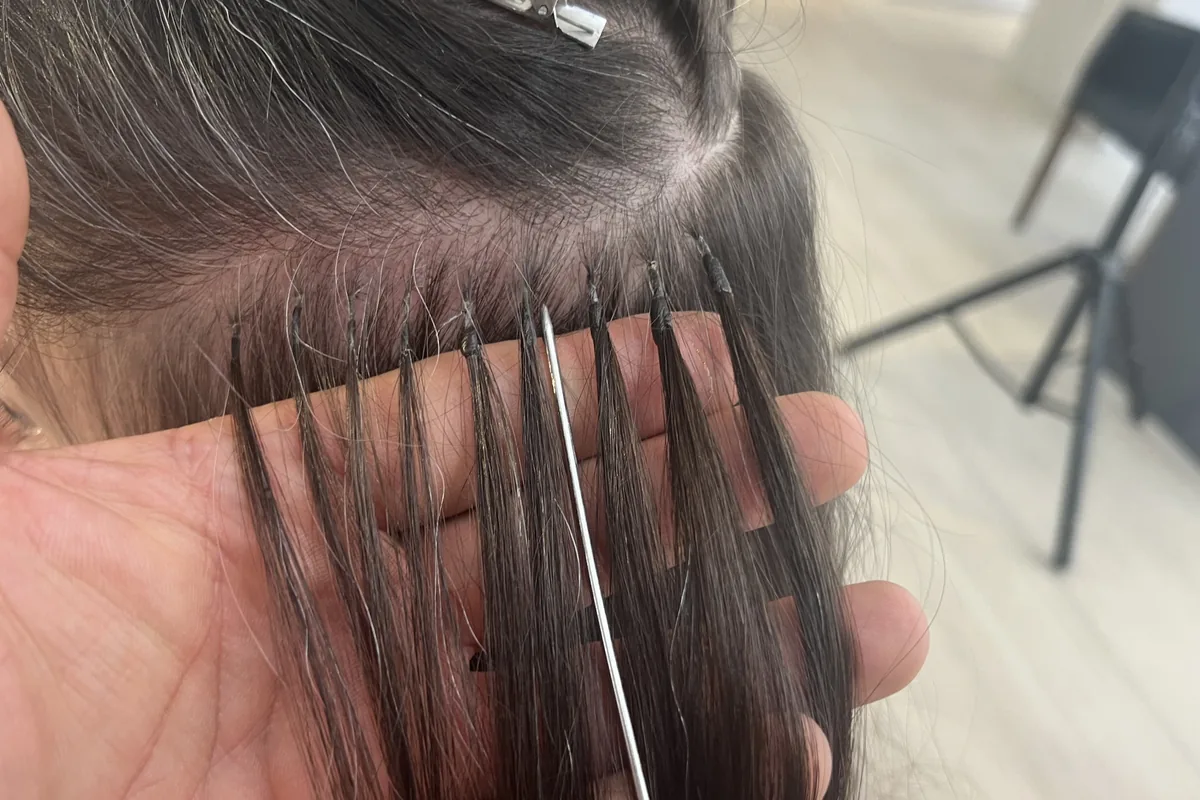
Methods in this industry are named after materials, tools or brands, almost never after what they do. Keratin is a material. Micro ring is a shape. Tape-in is a consumable. Weft is a manufacturing operation. A buyer comparing those four words is comparing four categories of noun, which is why the comparison never resolves. Sorted by mechanism instead, the category collapses into a few ways of moving weight from added hair into living hair.
Our vantage point and its limit: we manufacture the components — the hair, the moulded tips, the taped panels, the wefts. We can describe a joint precisely, because we make joints and we see what comes back when one has failed. We are not in the chair for the six months afterwards, so where a claim would need retention data from real heads, we say we do not have it.
Every method is an answer to one question: where does the weight go
Added hair has mass, and that mass must be carried by hair growing out of living follicles, because there is nowhere else for it to go. The shape of the joint, the material it is made from, how many there are and how they release are all decisions about how that mass is spread across your own fibres.
Three numbers describe any system, and only one is ever advertised: how many attachment points a full head uses, what one point carries counting extension hair plus joint material, and how much of your own hair is recruited into each. The third decides whether load is distributed or concentrated, and nobody publishes it, ourselves included, because the technician sets it during application.
There are four ways in commercial use to make a joint hold. Adhesion, where a sticky surface bonds to the hair shaft. Encapsulation, where a material is softened, wrapped around a section of natural hair and left to set. Compression, where a metal tube is crimped flat and friction does the work. And thread, where hair is sewn to a track built from the client's own hair.
Failure modes come out of the mechanism, which is why they are predictable. Adhesion is defeated by oil, silicone, heat and peel. Encapsulation fails when the material was applied too thin, too hot or around too many fibres. Compression slips when under-crimped and crushes fibres when over-crimped. A sewn track fails by tension.
The method tells you nothing about the hair inside it. A weft can carry excellent Double Drawn Remy hair; a strand system can carry cuticle-stripped hair with a silicone coat that survives four washes. The two variables combine freely, and the hair side is set out on the hair extensions pillar page.
Strand systems: many small joints, and what each one has to survive
A strand system divides the added hair into many small units and joins each to a small section of natural hair. The defining property is division: the weight is split across many independent points, so no point carries much and losing one is a minor event rather than a visible gap. It is also why strand work takes longest to fit — you build the attachment several hundred times.
A bond is a small volume of material holding two bundles of fibre together: the tip of the extension, and the section of your own hair recruited into it. It grips by hardening around both, so the hold is mechanical interlock rather than glue in the household sense. Small enough to hide, smooth enough not to saw at fibres, flexible enough when cold not to snap off, rigid enough not to slide down the shaft.
What it then survives, for months: repeated wetting and drying; shampoo surfactants, plus conditioner and oil reaching the root whether or not the client was warned; hot air at close range; brush teeth several times a day; pillow friction; chlorine, salt and ultraviolet. Then the same joint must be defeated in seconds by the correct release agent, without taking the client's hair with it. Every bond material is a compromise between those two demands.
Two strand systems are ours. Nanofilament is our flagship, strand-based, made in two per-strand weights: 0.3 g and 0.6 g. It is not a nano-ring product and shares no mechanism with ring systems despite the prefix, and it is not a film, scalp or prosthetic base. Micro is our individual bonded strand system, bonded with Italian keratin.
The one measurement we publish, with its framing. Ten Nanofilament strands weighed together came to approximately 3 g; ten Micro strands to approximately 6 g. Dividing gives approximately 0.3 g and 0.6 g per strand. This is a batch reference comparison: the per-strand figures are derived by division, not weighed individually, so they are averages. It is not a laboratory test and not a calibrated scientific measurement. It establishes a ratio of roughly two to one between two of our own systems.
Unit weight is what changes an appointment. The same 100 g in 0.3 g units is roughly 330 joints; in 0.6 g units, roughly 170 — double the fitting time, double the joints to maintain, and half as much of your own hair in each.
Our own two strand systems are treated in full elsewhere: the flagship on its own page, and the second-placed bonded system on the Micro page, which also separates it from the ring products that share its prefix.
Tape systems: load spread over a surface instead of concentrated at points
In a tape system the hair arrives already mounted on a thin adhesive strip, and a fine, wide veil of natural hair is either sandwiched between two strips or laid against one. Grip is adhesion over an area, so stress per square millimetre stays low even though the panel holds several grams. Pressure spread thin is the family's mechanical argument.
The constraint comes with it. A taped panel is a flat, rigid plane and a head is a curved, moving surface. Where a panel can sit, and how thick the sandwiched section can be, is the skill of the application. Sections taken too thick leave the adhesive gripping only the outer fibres; panels placed where the head curves sharply lift at the edge and show.
Speed is the honest advantage: a full head is a few dozen panels rather than a few hundred joints, so fitting and move-ups are the quickest of any semi-permanent family. The trade is granularity — a panel cannot be placed with the precision of one small bond — and the enemies are chemical: oils, silicone conditioners and dry shampoo at the root defeat the adhesive, and heat softens it.
Two of our products sit here. Butterfly Tape-In is placed third in our own evaluation and Standard Tape-In fourth: our list, our products in it, limits declared at the end of this page. We are deliberately not describing Butterfly geometry — publishing a construction claim with no measurement attached is the habit this site exists to avoid, so we state its family and its position and nothing more.
The family in depth — surface load, sectioning, re-taping economics and where a panel is the wrong answer — is on the tape-in page.
Keratin: a thermoplastic joint with a working window
Keratin bonding is the established individual-strand system and the technical ancestor of every small bonded joint, ours included. The extension arrives with a moulded tip already formed on it — U-shaped, flat, or a straight stick — or the compound is supplied in sticks and melted on. A heat tool softens the tip, the technician rolls it around a section of natural hair, and it hardens as it cools.
The material is a thermoplastic, and that word carries the behaviour that matters. It has no single melting point: it softens progressively over a range and re-hardens on cooling without a chemical change. Application is a timed operation inside a window. Below it the compound will not wrap; above it, it thins, discolours and loses grip, and the excess heat goes into natural fibres sitting inside the joint.
That narrow window is where formulations differ. Does the compound soften evenly rather than going liquid at the surface while stiff inside, stay workable long enough to roll the joint properly, set clear rather than clouding white against light hair, stay flexible when cold, and dissolve cleanly in the specified remover rather than turning gummy?
So Italian keratin is a real distinction rather than a nicer-sounding adjective. The compound comes from a small number of specialist chemical manufacturers, several of them in Italy, and their formulations differ measurably in the properties above. Naming the material and its source is a specification; using the phrase without saying which compound, and attaching no behaviour to it, is a label. We specify Italian keratin for Micro, and we have run no comparative melt-range testing across competing compounds — so this describes a property class, not our test result.
Keratin sits fifth in our own evaluation — our list, containing our own products, limits declared at the end of this page. The reason is joint scale, not poor chemistry: a classic keratin bond is larger than the strand joints above it, and our criteria weight per-point mass and concealment heavily. On coarse, dense hair, where a larger joint disappears easily, keratin remains a sound choice.
Bead and micro-ring: a mechanical clamp, with no chemistry involved
The bead system uses no adhesive, no polymer and no heat. A small metal tube — usually aluminium or copper, commonly silicone-lined — is threaded onto a section of natural hair, the extension strand is introduced alongside it, and the tube is crimped flat with pliers. Friction from compression holds everything. No solvent is needed to remove it and the joint reopens in seconds when squeezed round again, which is why bead systems suit hair that will be reinstalled repeatedly.
Crimp force decides everything and sits entirely with the operator: there is no indicator and no torque setting. Under-crimped, the ring slides down the shaft within days; over-crimped, the metal deforms far enough to crush fibres at the clamp line. The silicone lining raises friction so less force is needed, but it is a wear part — which is why rings that hold at first fit can slip after two move-ups.
The disambiguation that matters most on this page: a nano ring is not Nanofilament. A nano ring is a smaller-diameter micro-ring — same tube, same crimp, same mechanism, fewer millimetres. Our Nanofilament system is strand-based and contains no ring at all. The two are conflated constantly, usually by sellers listing both. When a supplier says nano, ask whether they mean a crimped tube or a bonded strand; the removal procedures are not the same.
Bead and ring systems are placed sixth in our own evaluation — our own list, containing our own products, limits declared at the end. That reflects joint size and operator-dependence, not a view that mechanical attachment is inferior in principle. For a brief of no heat, no chemistry and frequent reinstallation, it is the correct family and we will say so.
Weft: one long attachment, decided almost entirely in production
A weft is hair assembled onto a horizontal seam and supplied as a continuous strip: a few long attachments instead of many small ones. It is sewn onto a track built from the client's own hair — a braid, or a row of beads — or, in the cheapest version, glued directly. Load runs along a line rather than sitting at points, and this is the one family where what the wearer experiences is settled in the factory rather than the salon.
A machine weft is made by folding hair over a thread and running it through a sewing machine: a strong, sealed, consistent seam, cheap, durable, and shedding very little because the fibres are locked into stitching. The cost is bulk — the seam plus its folded return is thick, stands away from the head, shows in fine hair, and cannot usually be cut without sealing the end.
A hand-tied weft is made by a person tying small groups of fibres onto a fine thread, so the seam is a fraction of the thickness and lies flat — the entire point of it. The costs are real: slow skilled labour makes it the dearest construction per gram here, the seam cannot be cut without unravelling, and poor tying tension makes it shed within weeks. A badly made hand-tied weft is worse than a well-made machine weft, and costs more.
A middle category exists too: machine-made wefts with the return trimmed and the seam thinned to approximate a hand-tied profile. Seam shedding is a manufacturing defect no salon technique compensates for, so the useful questions here are about production — what the seam is made of, whether it can be cut, and whether the same specification will exist in six months. Our side of that is set out on the manufacturer page. SACH & VOGUE Butterfly Weft — our own foldable weft construction — is explained on the Butterfly Weft guide.
The weft's virtue and its risk are the same fact: many grams held by one continuous attachment. On a properly proportioned track it is quick to install, move up and remove; on a braid too thin for the weight it applies sustained pull along a line across the head, the least forgiving load geometry here.
Weft sits seventh in our own evaluation, and the disclosure at the end explains why that is not a verdict. Our criteria weight point-load distribution, concealment and per-unit mass, and a weft is at the far end of all three by design. On dense, coarse or textured hair, where the seam has plenty of hair to hide under, weft is frequently the right answer and often the only economic one.
Micro ring, micro loop, micro link, micro tip: mostly one mechanism, four words
Micro ring, micro loop, micro link and micro bead describe the same joint: a small metal tube crimped closed on natural hair. They are regional and retail synonyms, not separate technologies. Loop refers to the threading tool used to pull the hair through — a step in the process, not a different attachment.
Where those words do point at real differences: the internal diameter of the tube, whether it is lined or bare, the metal used, and how the extension enters — as a loose bonded tip, a pre-formed loop, or a weft threaded through a row of rings. Those change grip and reusability; the name on the packet usually does not.
Tip names describe the extension, not the attachment. An I-tip or stick tip is a straight bonded tip made to be inserted into a ring and clamped: the tip is keratin, but the joint is mechanical and no heat is used. A U-tip, nail tip or flat tip is shaped to be melted. Keratin on a specification does not tell you whether the joint will be melted or crimped.
Fusion means heat bonding, so fusion and keratin usually describe the same thing, while cold fusion is used inconsistently for both ring systems and heat-free adhesives. Invisible, seamless and injection specify no mechanism at all.
Our own catalogue collides with this vocabulary, so we would rather say it plainly: Micro in our range means individual bonded strands using Italian keratin. It is not a ring system, and neither is Nanofilament. Three questions settle any product name here, and they work on suppliers with no interest in being clear.
- What physically holds it — adhesive, an encapsulating polymer, metal compression, or thread?
- What releases it — which solvent or tool, and how long does a full-head removal take?
- What does one attachment unit weigh, and was that weighed individually or derived from a batch?
Fitting time, removal and reuse, family by family
Fitting time tracks the number of attachment points almost linearly, so the order is arithmetic rather than opinion. Tape panels are fewest and quickest; wefts are quick per gram once the track is built; ring and bonded strand systems are slowest, and a small-unit strand system slowest of all. We publish no hour figures: we manufacture rather than apply, and any number we gave would be someone else's data.
Removal is defined by the mechanism, and each has one correct procedure. Encapsulated bonds are broken down with the solvent specified for that compound, then crushed and combed clear. Tape is released with its own remover, given time to work rather than peeled. Rings are squeezed round again and slid off; sewn wefts are unpicked at the thread. In every family the joint is opened before anything is pulled, and removal takes real time.
Reuse divides into the hair and the joint, and the joint is always the consumable: bonded strands are re-tipped, taped panels re-taped, ring strands re-ringed — the least invasive of the four, because no chemistry touches the hair — and wefts refitted directly if the seam is intact. Re-tipping costs a little length at the tip each time.
The commercial consequence surprises buyers: the methods cheapest to fit are not automatically cheapest to own. Many small joints cost more chair time at every appointment, while a quick-to-fit family consumes more consumables per year. Hair, application labour and consumables belong on three visible lines rather than in one figure, and the reasoning is set out in how extension pricing is built up.
Minimum hair length: two constraints, and published numbers that disagree
Two separate constraints create a minimum, and conflating them is why the published figures make no sense. The first is grip: the joint needs enough natural hair to wrap around, thread through or sew onto. The second is concealment: enough hair must sit above and around it to hide it. On almost every head the second binds long before the first.
So the measurement that matters is not overall length. It is the shortest layer where joints would sit, usually around the crown, the parting and the hairline. Someone with hair to the shoulders and a short, heavily layered crown can be unsuitable for a method that someone with a shorter but uniform cut wears without difficulty. This cannot be judged from a photograph.
The part the industry does not say out loud: published minimums contradict each other, badly. The same method is quoted with figures that differ widely between suppliers, and almost none state whether the number refers to the shortest layer or the longest hair, which changes the answer completely. They are internal salon habits repeated between websites until they look like a standard.
We are not adding another number to that pile, because a figure invented in a factory would be no better. The geometry is not in dispute: the smaller the joint and the closer it sits to the scalp, the shorter the hair it can work with. That puts small strand joints and small rings at the permissive end, larger bonds in the middle, and wide tape panels and thick weft tracks at the demanding end.
The reliable procedure costs nothing. A technician lifts the sections where joints would actually sit, holds a joint of that size against the scalp and drops the hair over it. Either it disappears or it does not.
Where each method is the wrong choice, and what to use instead
A method page that recommends every method to everybody has said nothing. Below is where each family should be declined, ours included, with the alternative named. None of these are absolute — a skilled technician will have exceptions — but each describes a mechanism working against the brief.
Small-unit strand systems, ours included, are wrong when chair time or budget is the binding constraint: several hundred joints are paid for in time at fitting, at every move-up and at removal. If a client needs a visible result within a limited appointment and budget, the tape-in family or a weft delivers more change per hour, and saying so is more useful than selling our flagship.
Micro and keratin bonded strands are wrong where heat and polymer at the joint are specifically to be avoided — hair with a heavy chemical and thermal history, or a client who reacts to removal solvents. The bead and micro-ring family exists for that brief. Bonded strands also suit daily swimmers poorly, since the attachment zone is repeatedly saturated and then dried in bulk.
Tape systems are wrong for oil-rich scalps and routines: oil treatments, heavy leave-in silicones or dry shampoo near the root will defeat the adhesive whatever the product quality, and a strand or ring system that does not depend on chemistry at the joint is the substitute. Panels also struggle with heavy graduation and short crown layers, where small strand joints place more precisely.
Bead and micro-ring systems are wrong when the natural hair is very fine and low in density: a ring compresses a small number of fibres, so load concentrates rather than spreads, and the metal has less hair to hide under. They are also wrong when the operator's crimp consistency is unknown. The alternatives are smaller bonded joints spreading the same weight across more points, or a carefully placed tape panel.
Wefts are wrong for fine, low-density hair and for any hairline already showing traction damage: a track pulls along a line, and a braid built from thin hair cannot carry many grams. They are also wrong where placement must follow strong layering, since a weft is horizontal and layers are not; distributed strand systems are the alternative. On dense, coarse or textured hair the argument reverses.
And the case no method solves. Where the hair or scalp cannot carry sustained load — active shedding of unknown cause, an inflamed or broken scalp, a damaged hairline, hair too short in the attachment zone, or over-processed hair that stretches without recovering when wet — nothing here is right. The honest options are temporary pieces that come off at night, or nothing until the cause is assessed by a qualified professional.
Our seven-place ranking, and exactly what it is worth
We publish an ordering of seven systems: 1 Nanofilament, 2 Micro, 3 Butterfly Tape-In, 4 Standard Tape-In, 5 Keratin, 6 Bead / Micro-Ring, 7 Weft.
The disclosure is the only thing that makes that list usable. This is the manufacturer's own evaluation of a set that includes the manufacturer's own products, and our products hold the top two places. What we measured is per-strand weight, by weighing batches and dividing — a batch reference comparison, not a laboratory result. What we did not measure: retention over months of real wear, comfort as reported by wearers, comparative load on different hair and scalp types, shedding over time, or anything assessed by a party independent of us.
Our criteria weight per-unit mass, how finely the load divides and how well the joint conceals — priorities rather than a neutral standard, and ones that favour what we make. A ranking that does not declare which parts were measured is an opinion presented as data, ours included, which is why we say so every time it appears.
For an individual buyer, the section above is the more useful document, because the right method for a specific head is decided by that head, that routine and that budget. Weft is seventh here and still right for a great many people; Nanofilament is first and wrong for anyone who cannot fund the maintenance it needs. For the same seven systems set against the same criteria side by side, see the systems comparison.
Frequently asked
Common questions
Which hair extension method is best?
There is no answer in the abstract, only for a specific head. Our own evaluation places Nanofilament first and Micro second — the manufacturer's own list, including its own products, in which we measured per-strand weight by batch division and did not measure retention, comfort or long-term load. What decides it in practice is your density, your layers, and the chair time you can fund.
Is a nano ring the same thing as Nanofilament?
No, and it is the most common confusion in this category. A nano ring is a smaller-diameter micro-ring: a metal tube crimped closed with pliers, held by compression, with no adhesive and no heat. Nanofilament is our strand-based system and contains no ring at all. If a seller offers you nano anything, ask whether they mean a crimped tube or a bonded strand.
What is the difference between micro ring, micro loop and micro link?
Nothing mechanical. All three describe a small metal tube crimped onto natural hair; the words are regional or retail synonyms. Loop refers to the threading tool used to pull the hair through, which is a step rather than a different attachment. The real differences are internal diameter, whether the tube is lined or bare, and the metal.
Keratin and micro both use keratin — what actually differs?
Both are individual bonded strand systems using a keratin compound, so the mechanism is identical: soften the material, wrap it around a section of natural hair, let it set. The difference is joint scale and how finely the weight divides. Smaller units mean more attachment points for the same grams, less mass at each, and a joint that hides under less hair — at the cost of more fitting and removal time.
Should I choose a machine-sewn or a hand-tied weft?
Machine wefts are strong, consistent, cheap and shed very little, but the seam plus its folded return is thick and shows in fine hair. Hand-tied wefts have a much thinner seam that lies flat, at the cost of slow skilled labour, a far higher price per gram, and a seam that cannot be cut without unravelling. Execution matters more than category.
Which method is fastest to fit?
Fitting time follows the number of attachment points, so the tape-in family and wefts are quickest and small-unit strand systems slowest. The arithmetic is plain: 100 g in 0.3 g units is roughly 330 joints, the same 100 g in 0.6 g units roughly 170. We publish no hour figures, because we manufacture rather than apply; ask your technician for theirs.
Which method places the least load on my own hair?
No method is load-free, so the honest framing is distribution rather than absence. Total load is set by grams, chosen independently of method. The method controls how that total divides: many small joints spread the weight across more points and recruit less natural hair into each, while a weft concentrates many grams along one track. How much any individual can carry should be assessed in person by a qualified professional.
Can the same hair be reused when the joints are removed?
Usually. The joint is the consumable, not the hair. Bonded strands are re-tipped with fresh compound, losing a little length at the tip each time. Tape panels are stripped and re-taped. Ring strands are simply re-ringed, the least invasive because no chemistry touches the hair. Wefts can often be refitted directly if the seam is sound.
How long does my own hair need to be?
Long enough for the joint to grip, and — the constraint that actually binds — long enough to conceal it. The number that matters is the shortest layer where joints would sit, not overall length. Published minimums in this industry contradict each other, and rarely say which measurement they refer to. Have a technician hold a joint against the scalp and drop the hair over it.
What suits very fine, low-density hair?
Fine hair sets a hard limit on total grams and rewards distribution over concentration, because fewer fibres are available at each attachment point. That argues for many small joints rather than few large ones, and against wefts, whose track pulls along a line built from thin hair. Small bonded joints or carefully placed tape panels are the usual answers, with the grams kept modest.
I swim several times a week. Does that rule anything out?
It should change the choice rather than end it. Repeated saturation, chlorine or salt, and bulk drying are hardest on adhesive joints, so the tape-in family is the most exposed. Bonded joints tolerate it better but need the attachment zone dried properly every time, since a damp joint plus friction is the classic matting site. Mechanical ring systems have no chemistry to defeat.
Does the heat used for keratin bonds damage the hair?
The applicator delivers heat to a joint containing your own fibres, so temperature control and dwell time are doing real work. A correctly applied bond is softened only until workable; excess heat degrades the compound and puts thermal load into the natural hair inside it. That is one reason removal should use the solvent made for that compound rather than force.
Related pages
Continue reading
Tell us the hair you are working with and the result the client wants, and we will tell you which family fits — including when the answer is a system we do not make.
Method, colour, length and grams are settled by consultation before anything is quoted.