Cutting and distribution
How to Blend Hair Extensions With Your Own Hair
Blending is a cutting problem before it is a colour problem, and the practical answer runs in one order. Cut the extensions into the existing haircut rather than leaving them at factory length. Build the set from more than one length, so density fades across a distance instead of stopping on a line. Keep weight out of the hairline, the parting and the crown. Taper the outline so the ends thin rather than sit blunt. Then check it with the head moving, not standing still at a mirror.
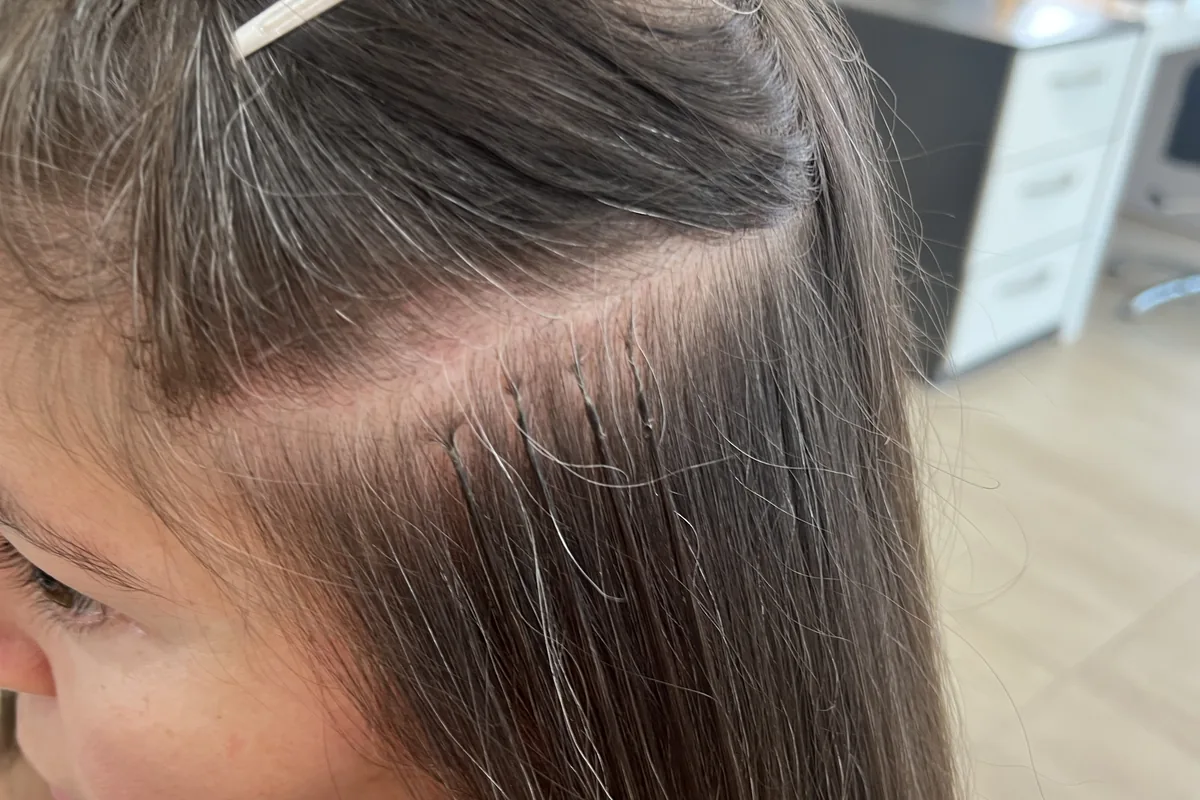
The question is usually asked in front of a mirror, about a set correct in every respect but one: it reads as hair placed on a head, not hair growing out of it.
Nearly always the cause is a hard line where the wearer's own ends stop, and nearly always it is read as a colour fault. It is a step in density.
The practical answer, in the order it happens
None of this is a product decision, which is why it rarely comes up in a sales conversation. It is labour, and it happens after the last attachment is in: a fitting that ends when the final joint is placed has not ended. Where we fit a set in Fethiye, the cut belongs to that appointment.
- Cut the extension hair into the existing haircut, never leaving it at factory length
- Build the set from several lengths so density fades across a distance
- Let the hairline, parting and crown carry the smallest share, or none
- Taper the outline, and connect the two layers through the perimeter
- Match texture on behaviour dry and unstyled, not on a word like wavy
- Check it with the head turning and bending, in daylight
Why the line appears, and why it is not a colour fault
The complaint describes one image: at a certain level the hair suddenly thickens and a line appears. That level is where the wearer's own ends finish — added hair carries on below, natural hair does not. The eye catches a boundary in mass, not in tone.
Colour and blending are separate disciplines and fail differently. A colour fault reads as separation, a strand breaking away from what surrounds it. A blending fault reads as shape: the tone can be exact and the hair still sit like a layer hung on a head. Matching has its own rules, on the colour matching page.
Extensions arrive at one length; hair never ends on one line
Hair out of the packet is a single length with untouched ends. No head of hair finishes on one line: it has a cut, internal layers, its own distribution of ends. Laid over one another, the two structures disagree.
So the set is cut into the client's own cut, with one object: a single haircut, not one layer laid over another. There is a price, and it belongs in the conversation before a length is chosen — hair in the upper sections is fitted shorter than ordered. Cutting fitted extension hair is its own discipline: none of it grows back.
Graduation and internal layers: turning a step into a ramp
A step is not concealed; it is removed, by building a gradient with nowhere to break. Built from one length, density starts and stops at the same level; finished at several levels, it falls away across a distance.
Internal layering is invisible from outside, and should be: the upper hair rests on the mass beneath it and the weight carries through uninterrupted. No number of layers is published here — that is decided in the chair, against your length, your density and your target.
Your own length decides what is achievable
Blending manages the difference between two lengths. As that difference grows, the distance available to spread the transition shrinks — past a point it has nowhere left to go, however well it is cut.
No threshold is published here; what decides it is where your shortest layer finishes. On a short base it becomes a problem in its own right, dealt with on the short hair page. Often the honest answer is not no but staged: a more modest length now, closer to the target next time as your own hair grows.
Weight gathered into too small an area reads artificial whatever the colour
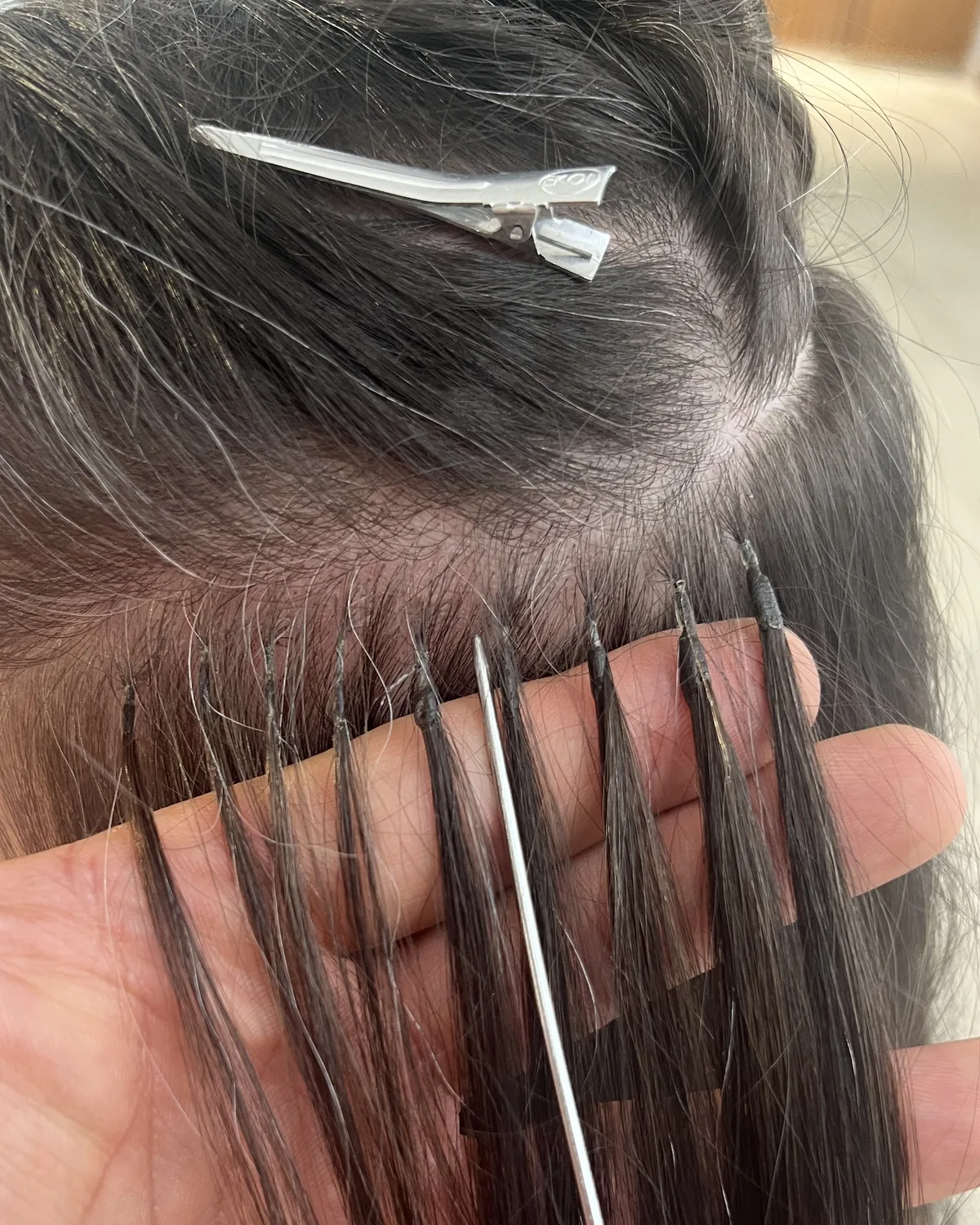
The same total weight, spread properly, disappears; gathered into a narrow area it announces itself. Natural density is not uniform across a head, and a compressed placement inverts that curve, so fullness begins where it has no reason to. Tone cannot rescue that.
Three zones decide the visible part. The hairline is a boundary with nothing behind it to hide anything, and a plan usually leaves it empty. The parting opens and closes daily. The crown takes light most directly. Their carrying the smallest share, or none, is the plan rather than a shortfall — which family goes where is set out on the methods page.
The outline: tapering the ends and connecting the layers
The place a set most often gives itself away is the ends. A factory end is blunt and evenly weighted; a natural end thins out. Left unopened, the hair forms a straight line along its lower edge — the curtain effect.
The second fault is disconnection: two layers sitting side by side without touching. Drawing a little of the upper layer down into the lower ties the masses together. Face-framing sections and the back perimeter are handled separately.
Texture is matched on behaviour, and checked in movement
Straight, wavy and curly are not descriptions of texture. What has to match is behaviour: how the hair sits when left alone, whether it carries volume at the base, whether it keeps a shape until evening, what damp weather does to it. The commonest error is matching to styled hair: a texture chosen against a blow-dry is a judgement about the blow-dry. The same goes where one side is heat-styled daily and the other is not.
A blend checked standing still almost always looks right: the layers stack and the boundaries close. Check it moving: the head turned, bent forward, the hair combed against its direction and lifted at the base. Light moves too — salon lighting comes from above and washes the crown, daylight arrives from the side and finds the edge of a layer.
A continuous panel and dispersed strands need different cutting logic
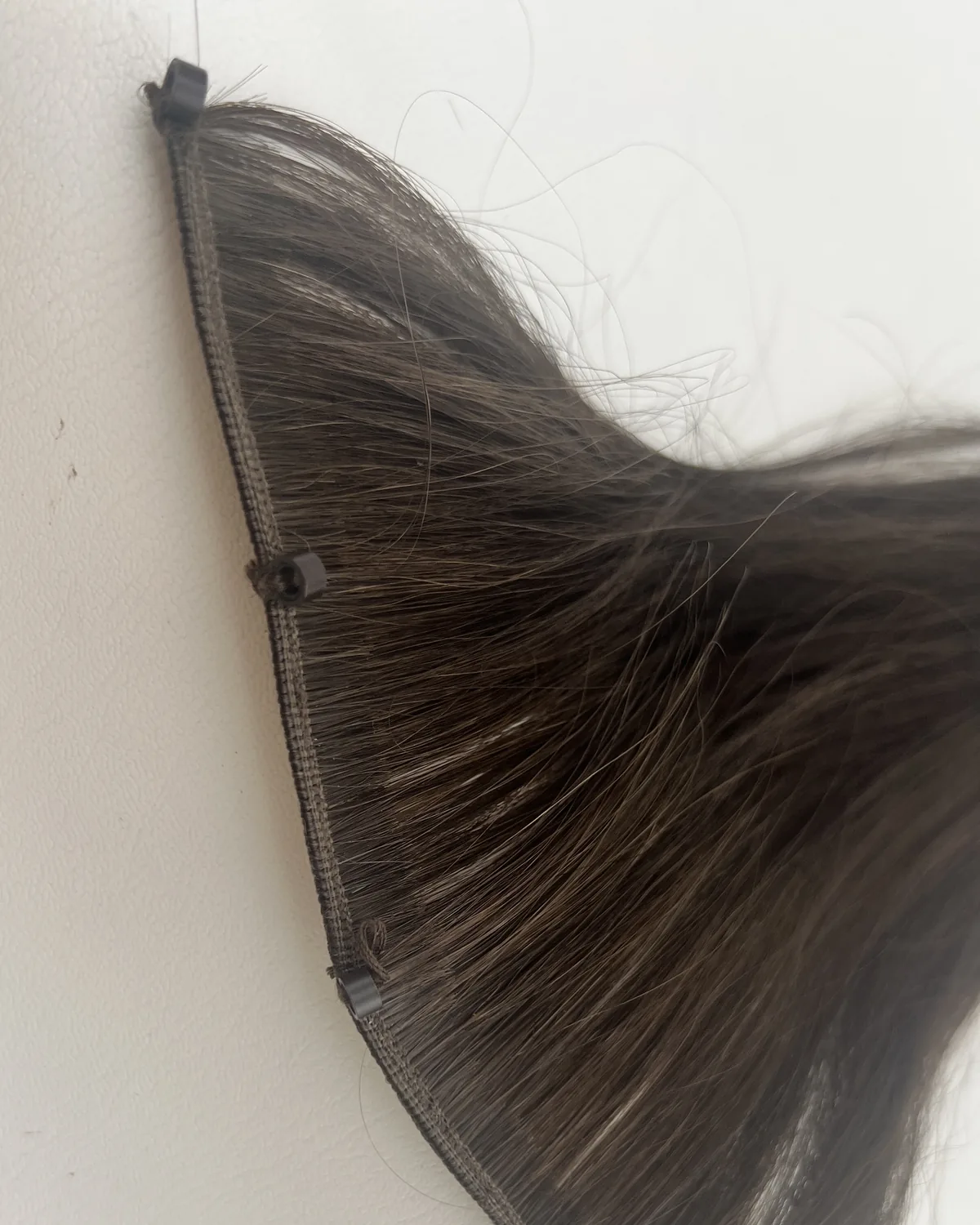
A continuous panel behaves as one piece. With a sewn weft or a tape set, the cut is built not in the panel's own length but in its relationship to the hair around it: how much is left over it, where its lower edge lands, at what level it ends.
Dispersed strands behave differently. With Micro or other keratin bonded strands the cut is made across the whole rather than strand by strand, and because points in different zones can be finished at different levels, internal layering is easier to build. Not a ranking — two routes to the same result.
Keeping a blend as your own hair grows
A blend is not a fixed state. Your hair grows and the added hair does not, so as your own ends travel down, the transition travels with them and the gradient built on day one slackens.
A maintenance appointment is therefore not only where joints are renewed: the transition is re-cut, the ends reopened, the bands adjusted, as covered on the maintenance page. Whoever cuts your hair in between has to work with the set on it, and when it comes off, the removal appointment is where your own cut finally becomes visible again.
Frequently asked
Common questions
My extensions look obvious. Is it the colour?
Usually not. A colour fault reads as separation: a strand breaks away from everything around it, and your eye picks it out one strand at a time. Looking obvious is more often a complaint about shape — density drops where your own ends finish, the added hair carries on below, and a step forms. The test: is the problem in single strands, or at one level? At a level, the answer is in the cut.
Do hair extensions have to be cut after they are fitted?
Yes, and it is part of the work rather than an extra. Hair out of the packet is one length with untouched ends, while your own hair finishes on no single line. Unless the two are cut into one structure, one layer simply lies over another. The cut usually takes in your own hair as well, and it belongs in the appointment plan.
Why was my extension hair cut shorter than the length I ordered?
Because a single uniform length produces a hard shelf. If the strands in the upper sections are not shortened, density begins and ends at the same level and no transition can be built. The shortening is not waste; it is the cost of the gradient. Settle it before choosing a length: what you ordered shows in the lowest band, and the bands above carry the transition.
Will the blend hold as my hair grows?
It changes gradually. Your own hair grows and the added hair does not, so as your ends travel down the transition travels with them and the gradient loosens. That is the normal course of a set, not a fault, and it is why a maintenance appointment is not only about renewing joints: the transition is re-cut, the ends reopened, the bands adjusted.
Send your own length, your current cut and the length you are aiming at, and we will talk through how the transition gets built.
Method, colour, length and grams are settled by consultation before anything is quoted.