From the factory floor
Clip-In Hair Extensions: A Set You Put In, Take Out and Wear Again
A clip-in set is hair stitched into a weft, with sprung clips sewn along that band, and it is put in and taken out by the person wearing it. Nothing stays on the hair between wears: the load exists only while the set is on, it never follows growth, and no appointment is needed to take it off. What decides whether a set works is unglamorous — whether each panel matches the row it sits on, how much weight hangs under each base, whether the colour reads as one surface, and whether anybody has cut it.
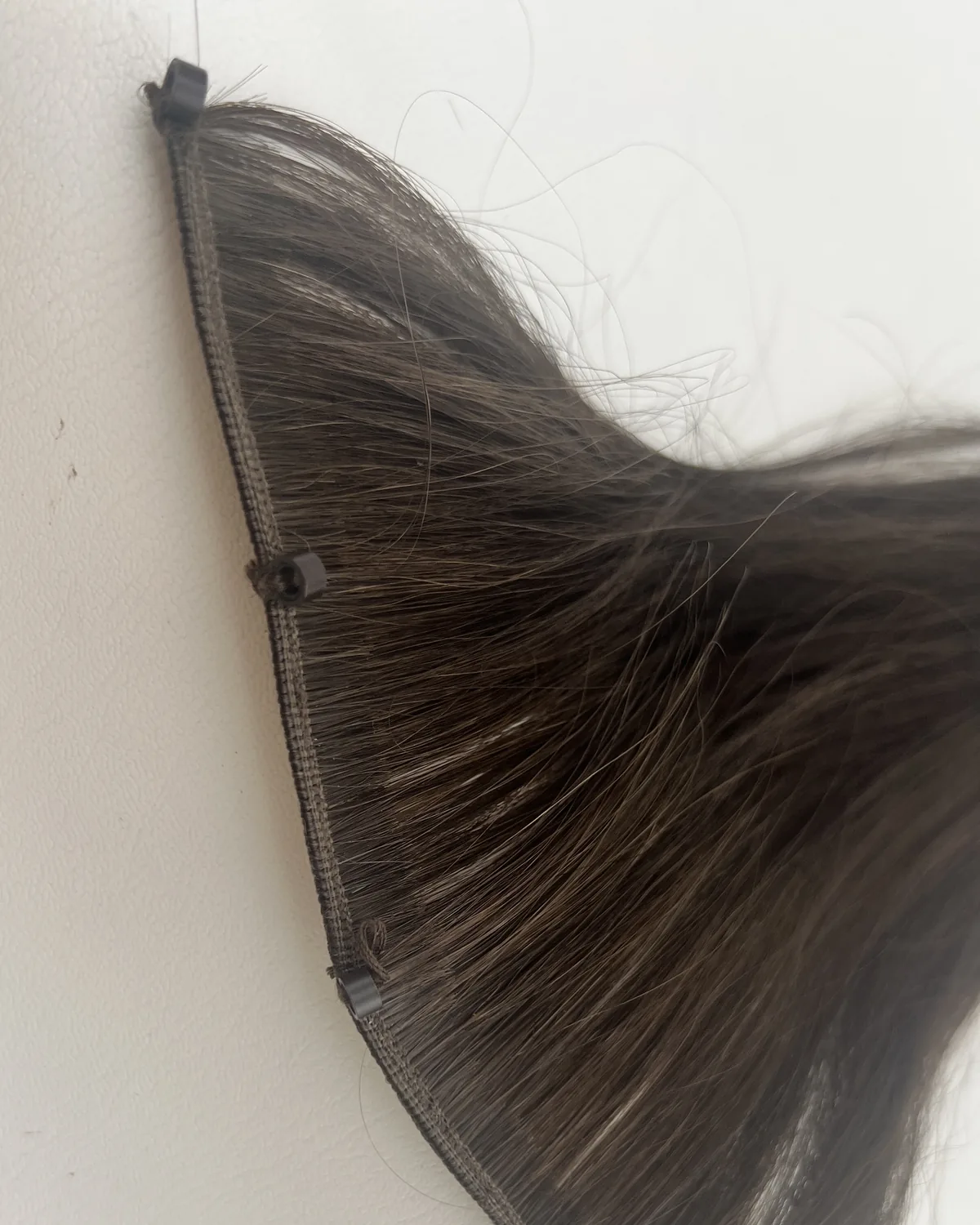
We make wefts, so this page begins at the band rather than at the mirror. The object is unremarkable to look at, and nearly everything that goes right or wrong with a set is decided inside it.
What follows is the piece: how it is built, why the widths differ, and what it cannot do.
What a clip-in piece physically is
Strip the product back and one component carries it: a weft. Hair is stitched along a single edge so the fibres lock into a narrow band, and the rest of the length hangs free — the same band a sew-in set is built on.
Clip bases are sewn onto that band at intervals, so two crafts sit in one piece: the stitching that holds the hair, and the fixture holding it to a head.
Base width is the specification that matters
A clip is a curved metal base with a sprung bar, fixed to the weft through holes along its spine. That stitching decides whether the base lies flat; one lifting at an edge shows, and gathers the hair it holds into a line.
Width is load distribution rather than comfort: a wide base spreads the same weight across more fibres, a narrow one concentrates it, so panel and base width are settled together. A clip that slides is usually gripping too small a section, and the answer is a wider base rather than a tighter one.
A set is a graded family of widths
Pieces in a set are not copies of each other. A head narrows in circumference from the nape upwards, so every row asks for its own width — geometry rather than styling. Put the wrong width on a row and the panel either runs past the section or buckles over itself.
- Back of the head: the widest panels, carrying most of the volume
- Above the ears: narrower panels, hidden by the hair above
- Near the face: small pieces for the edge that shows
- Crown and parting: least cover, so the most limited area
Weight is read at set level, never per strand
Bonded systems are planned by multiplication: unit weight against the number of units. A clip-in has no such arithmetic — weight belongs to the whole piece, divided among the panels by width. How the unit-based families count is on the systems comparison.
The useful question is how much weight hangs beneath each base. Spread over wide panels it settles nowhere in particular; gathered into a narrow area it pulls one section for as long as the set is on. We publish no set weights: the figure means nothing without your own density and length.
Fitting and removal belong to the wearer
No appointment, no solvent, no tool: what has to be learned is an order rather than a skill.
The order runs upwards, into dry combed hair: a horizontal parting clear of the hairline, the matching panel clipped near the roots, the hair above dropped over it, then the same move in narrower rows towards the crown. A set disappears because of that arrangement, not because of the clips. Move the rows slightly between wears rather than repeating one spot.
Coming out is the reverse, with one rule: every base is opened before the panel moves. Bonded joints are a different procedure, on the removal page.
Intermittent load is a different thing from continuous load
In the bonded families a keratin bond or a Micro strand grips a section of your own hair and survives washing, sleeping and months of growth, so the load is continuous and the joint travels away from the root.
A clip-in attaches nothing to the hair shaft for any length of time. The base holds a section while the set is worn, opens at the end of the day and leaves the hair as it was: load for those hours only, no joint collecting shed fibres.
That is not the same as no risk. A base returned to the same spot daily, or a panel heavier than the section beneath it, still works one area repeatedly. Intermittent load is smaller load, not absent load.
Who a set actually suits
The clearest case is the occasion: length and density on particular days, with your own hair back the next morning. A bonded system is a decision about the months ahead.
The second is anyone unwilling to take on a system at all. A third is fine hair, where continuous load is the usual concern — though fine hair also shows a base most easily, so benefit and constraint come from one property.
Short hair is answered with scissors rather than weight — there must be enough length above a panel to cover it — as the short hair page sets out.
What a set cannot be asked to do
A set is not worn asleep and not worn in water. A head turning on a pillow rotates the panel on its own axis and twists the section under the base, and a soaked band grows heavier as its stitching and metal stay damp.
The second limit is placement: too high, or over a section too sparse to cover it, and the base shows — a question of cover rather than weight. The third is that an uncut set announces itself the moment the hair moves.
Colour has to work across the set and against your own hair
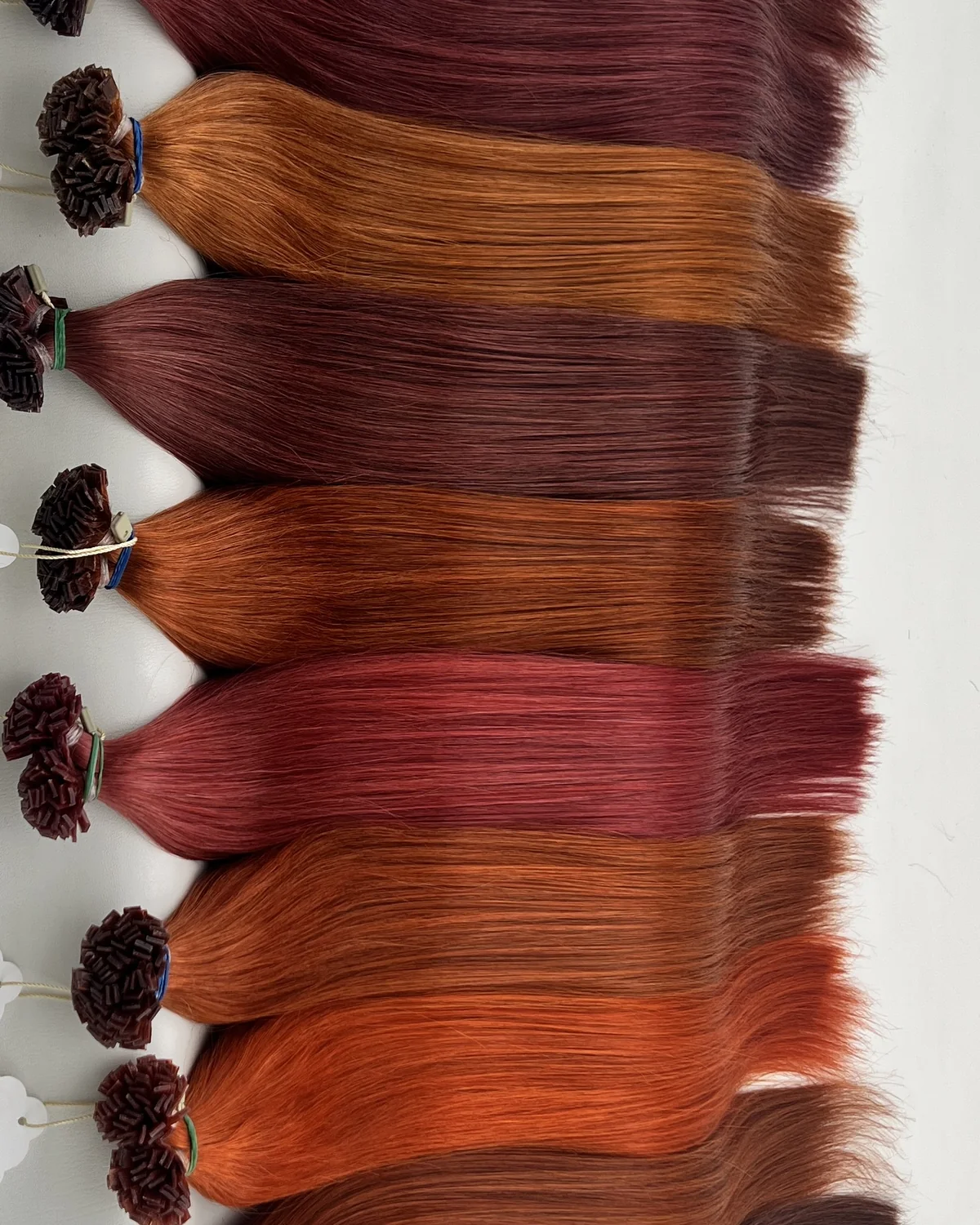
Panels are worn stacked rather than side by side and in movement all of them show at once, so a set is judged as one surface. The comparison stays physical — a ring in daylight, or a cut sample — because photographs carry depth well and undertone badly. Matching is set out on the colour matching page.
Your own hair is not one colour either: root, mid-lengths and ends behave differently, so a set matched to the mid-lengths can separate at the crown. The honest target is often a blend rather than one code.
A set is not finished until it has been cut
Sets leave production blunt and level, because nobody yet knows whose head they are going to. Your own hair has layers, a shape around the face and its own end density.
The two meet only when somebody cuts them together: dry, with the set clipped in, because what is judged is how they move. The end line is broken up, panels shortened to their rows, joins thinned. None of it reverses.
Washing, storage and keeping a set alive
A set is washed far less often than your own hair, because it receives nothing from a scalp; build-up is what makes washing necessary. Protect the band: no rubbing at the stitching, no soaking of the bases, and dry it first. The rest is on the maintenance page.
Storage is the step most people skip: clips closed, panel flat or hanging, dry and out of light. Folded at the band in a bag, a set deteriorates on days it is never worn.
What ends a set is usually the carrier rather than the hair — a loosened base stitch, a tired spring, a worn band — and caught early those are repairs. We publish no lifespan: wear, heat and storage decide it. District questions are on a separate page: clip-ins in Fethiye.
Frequently asked
Common questions
Are clip-in extensions a permanent attachment method?
No. A permanent method leaves a joint on your hair that survives washing, sleeping and months of growth, and needs a solvent to come off. A clip-in leaves nothing behind: the base holds a section while the set is worn and releases it the same day — no move-up, no residue, no removal procedure.
Can I sleep or swim in a clip-in set?
Both sit outside what the product is built for. Turning on a pillow rotates a panel on its own axis and twists the section under the base, tangling hair and concentrating load. In water the band takes on weight, and its stitching and metal stay damp long after the length feels dry.
Do clip-in extensions damage hair?
The load is intermittent: it exists only while the set is worn and leaves no joint travelling away from the root. That is not the same as no risk — a base returned to the same spot daily, or a panel heavier than the section holding it, works one area repeatedly. Pain, tenderness or visible thinning belongs to a qualified professional.
How many grams should a clip-in set be?
We publish no figure, because weight here is not a per-strand number to be multiplied up. It belongs to the set as a whole, divided among the panels by width, so what matters is the share under each base rather than a total on a label. Length changes the reading too: the same weight looks thinner over a longer target.
Does a clip-in set have to be cut?
Cutting is the step that stops a set announcing itself: production sends it out blunt and level, and that line does not agree with layered hair. The work is done dry with the set clipped in, because the point is how both structures behave together. Nothing reverses.
Tell us the length and density you are working with and the days you would actually wear a set, and we will talk through panel widths, colour and the cut it will need.
Method, colour, length and grams are settled by consultation before anything is quoted.