Before the product question
Fine Hair: The Variable Is Load per Attachment Point, Not Drawing Standard
Fine hair can often carry extensions, and the decision belongs to a specific head rather than to a product name. Fine describes the diameter of one fibre; sparse describes how many fibres occupy an area of scalp, and the two constrain an application differently. What decides suitability is the mass on each attachment point, how many of the wearer's own fibres hold it, how many points there are, where they sit and the total grams installed — not the drawing standard, which is why the common rule that fine hair means single drawn answers the wrong question. Some observable conditions make the honest answer not yet, and those belong with a qualified professional rather than a supplier.
This is the most searched question in the category and the one answered with the fewest numbers. The standard reply is a list of adjectives — lightweight, flat, invisible — attached to a product name, and adjectives are the one thing a person with fine hair cannot use, because the failure she fears is mechanical. Something will hang on her hair for months, and she wants to know how much, on how many fibres, in which places.
We manufacture the hair and the joints rather than fit them, which limits what we may claim and clarifies what we can explain: the arithmetic of an attachment point, which half of it is decided in the chair rather than in the factory, and the cases where the right answer is a system we do not make.
Fine describes a fibre. Sparse describes a scalp
One word does three jobs here, and separating them is worth more than any recommendation that follows. Fine is a statement about the diameter of a single hair — why it feels soft, tangles readily and reads as less hair than the same count of coarse fibres would.
Sparse, or low density, is a statement about the scalp: how many fibres occupy a given area. It is an independent quantity, so a head can be fine and dense, coarse and sparse, or any combination. A third condition hides inside the same word: fragile hair describes the condition of the fibre rather than its diameter, and a bleached coarse fibre can be weaker than a virgin fine one.
The two that matter mechanically constrain different things. Fibre diameter limits what each recruited fibre carries before it gives way. Density limits how many fibres a joint can recruit and how much hair is left above it to hide it — a concealment constraint, which is why a fine, dense head and a fine, sparse head need different plans while giving identical answers to the question what is your hair like.
It is also why advice here contradicts itself so reliably. An article reasoning about load and one reasoning about concealment reach opposite recommendations, both defensible, because their authors had different heads in mind and one word for both. Establish which you have, zone by zone: density on most heads is not uniform.
- Fine — fibre diameter. Governs what each fibre in a joint can carry.
- Sparse — fibres per area of scalp. Governs how many fibres a joint can recruit, and how much hair is left to conceal it.
- Fragile — the condition of the fibre after processing. Independent of diameter.
The variables that actually decide it, and where each one is settled
No single term makes an application suitable for fine hair. There is a list, and the useful way to hold it is by who controls each entry: what is negotiable at consultation, and what is fixed before the client sits down.
Three are set in the factory. Strand unit weight is what one attachment unit weighs, and it is the largest term in the arithmetic below. Attachment profile and footprint is the shape of the joint and the area it occupies — a panel spreads load across an adhesive area, a bond concentrates it at a point, a ring compresses a small group of fibres — which decides both how load reaches the fibres and how much hair is needed to hide the joint. Third is the hair specification, which changes how a set looks without changing what any joint carries.
Five are set in the chair. Support section size is how much of the wearer’s own hair goes into each joint. Placement and zone is where each point sits relative to the partings worn, the hairline and the crown. Number of attachment points follows from total grams divided by unit weight. Distribution decides whether a low-density region carries a concentration or a share. Total installed grams is the whole mass, decided first and constraining the rest.
Three belong to the head and are not negotiable: natural density in each zone, fibre diameter, and the condition of the hair after whatever has been done to it. One belongs to the client’s life. Maintenance capacity — how often she can return, how far she travels, what she can fund per visit — has the same standing as density, because a specification the client cannot maintain is an unsuitable one.
The arithmetic of one attachment point, and why only half of it is ours
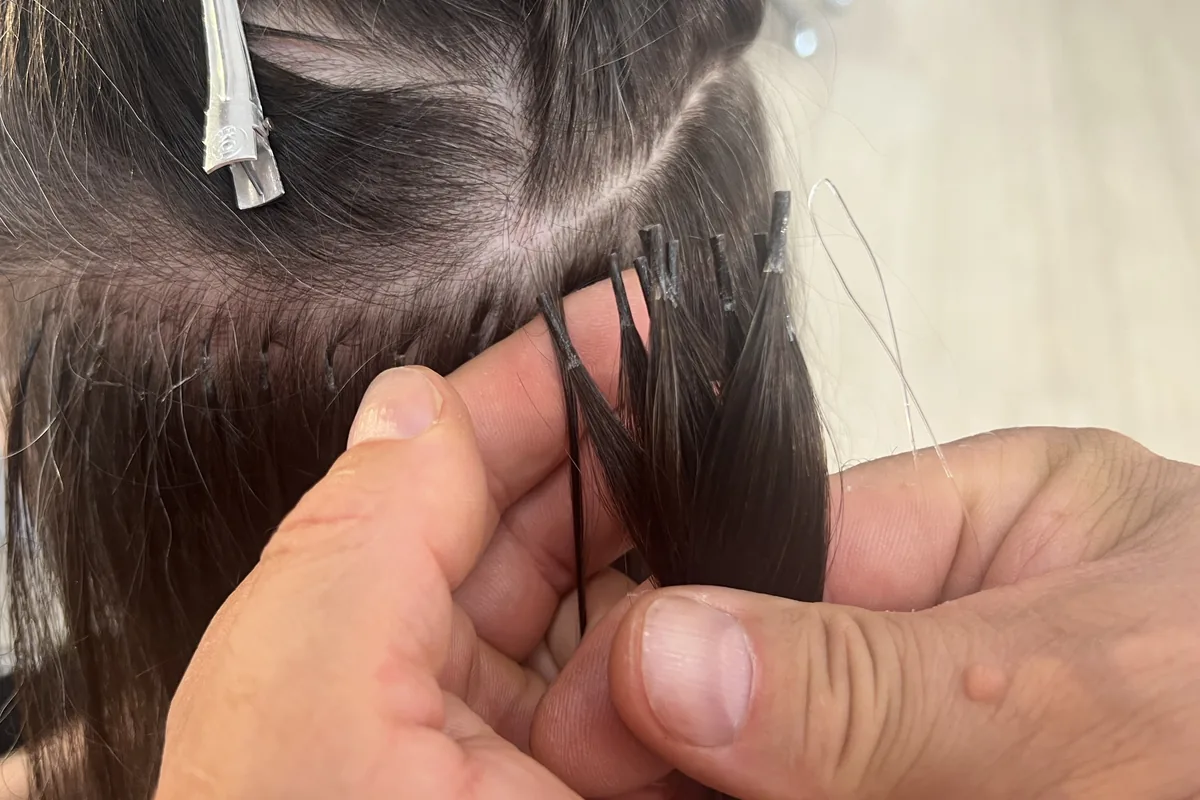
A joint is two quantities: the mass hanging on it, and the number of the wearer’s own fibres holding that mass. The first is set in production and printed on the specification. The second is taken by hand in the chair, and nobody publishes it, ourselves included.
The first division gets quoted often. One hundred grams supplied in 0.3 g units is roughly 330 attachment points; the same hundred grams in 0.6 g units is roughly 170. Identical hair, identical total, half the points, twice the mass at each.
The second half is where the reasoning usually stops. Whether a smaller unit reduces stress on any individual fibre depends on what happens to the support section. Halve the mass per point and keep the section the same size, and each fibre carries half what it did. Halve the section along with it — the natural instinct, because a small unit sits neatly on a small section — and each fibre carries exactly what it carried before. Dividing a total into more units does not automatically lighten anything; it creates the opportunity to, and whether that is taken is a judgement made by hand.
On fine hair the section goes wrong in both directions, and both surface weeks later. Too small, and a handful of slender fibres carries a unit continuously. Too large, and the joint is bulky, harder to hide under a thin canopy, and has consumed scarce hair. How many fibres a correct section contains is not something we have measured.
Load is also not constant. Wet hair is heavier, and the joints are wet several times a week; tying the hair up shifts the pull onto the hairline in a way that wearing it down never does. How each family delivers that load is set out on the methods page.
Total grams is the only decision that removes load rather than moving it
Division rearranges; it does not subtract. One hundred and twenty grams is one hundred and twenty grams whether it arrives in four hundred units or two hundred. Only one decision changes the total, and it is the one most often made last.
The pressure on fine hair runs the wrong way. Fine hair looks like it needs more added hair to reach a given fullness, so the gram figure creeps upwards precisely on the heads least able to carry it — and it creeps up inside a conversation about how the result should look rather than about load.
There is also an aesthetic ceiling, and on fine hair it arrives before the mechanical one. Once the added hair substantially outnumbers the natural hair in a zone it stops reading as her hair: it moves independently, and the boundary where it begins becomes easier to see. Grams past that point make a set more visible, not fuller.
So the most useful thing a fine-haired client can ask for is a staged first set — a conservative total, worn through a full maintenance cycle, with more added later if the head has tolerated it. Adding is a short appointment; recovering from a set that was too heavy is months. We publish no grams-per-head table: every figure in circulation is somebody’s habit applied to heads it was never derived from.
The rule that fine hair means single drawn answers the wrong question
The rule is repeated everywhere, including in good faith, and it is a category error rather than a difference of opinion. Drawing standard governs where a fixed mass sits along the length. It is not the variable that governs what one attachment point holds.
The distinction has one hinge. Where a product is specified by weight — a strand at 0.3 g, a set at 100 g — drawing standard cannot change the load, because the weight is the thing that was bought. Where it is specified by dimension — a weft sold by width, a tab described only as a tab — it absolutely does, because more fibre reaching full length means more mass on the same dimension. The derivation, including why hair density at the ends and attachment load at the joint are two different quantities, is on the Double Drawn page.
So the rule survives in a narrower form than the one being sold. Quoted a weft by width, or any product described without a gram figure, a fine-haired client should ask for the weight. Quoted a strand system at a stated unit weight and total, she should not accept single drawn as the answer to a load concern: it is reassurance that does no work.
A second version of the rule is true, and it is aesthetic rather than mechanical. A blunt, fully drawn end can read as a shelf against fine natural hair that tapers to a point. That is a real problem, and it is solved with scissors: the tips are softened, point cut or notched into the natural taper. Some fine-haired clients are genuinely better served by hair whose distribution tapers as theirs does — a blending reason, and it should be given as one.
The parting, the hairline and the crown are three different problems
The mid-scalp is forgiving: a joint there sits under a canopy of hair falling over it from every side. A parting is the opposite by definition — the line where hair is separated so the scalp shows, with nothing above a joint near it to fall over it. On a low-density head the canopy is thinner everywhere, so the buffer a technician must keep from a parting is larger.
Most people also wear more than one parting across a year and photograph themselves in the one they wear least, which makes the exclusion zone wider than a plan drawn on the day allows.
The hairline carries the most consequence and the least margin. Perimeter fibres on almost any head are the finest and shortest it has, and it is where sustained traction shows first and recovers worst. It is also where a client most wants density, so placement there should be argued for out loud.
The crown behaves differently again. Hair grows there in a whorl, lying in several directions at once, so there is no reliable direction of fall to hide a joint under; density is often lower there on heads dense elsewhere; and a hanging weight pulls against the direction of growth. Crowns are where a set photographs best on the day and reads worst at week eight.
Taken together, the usable placement area on a low-density head is smaller than most plans assume, and the answer is not a different product but fewer points, further from the exposed zones. Ask to see the plan drawn in your own parting, and tie your hair up before you leave: a ponytail displays what hair worn down conceals.
Where our own small-unit system is genuinely relevant, and what it costs for the life of the set
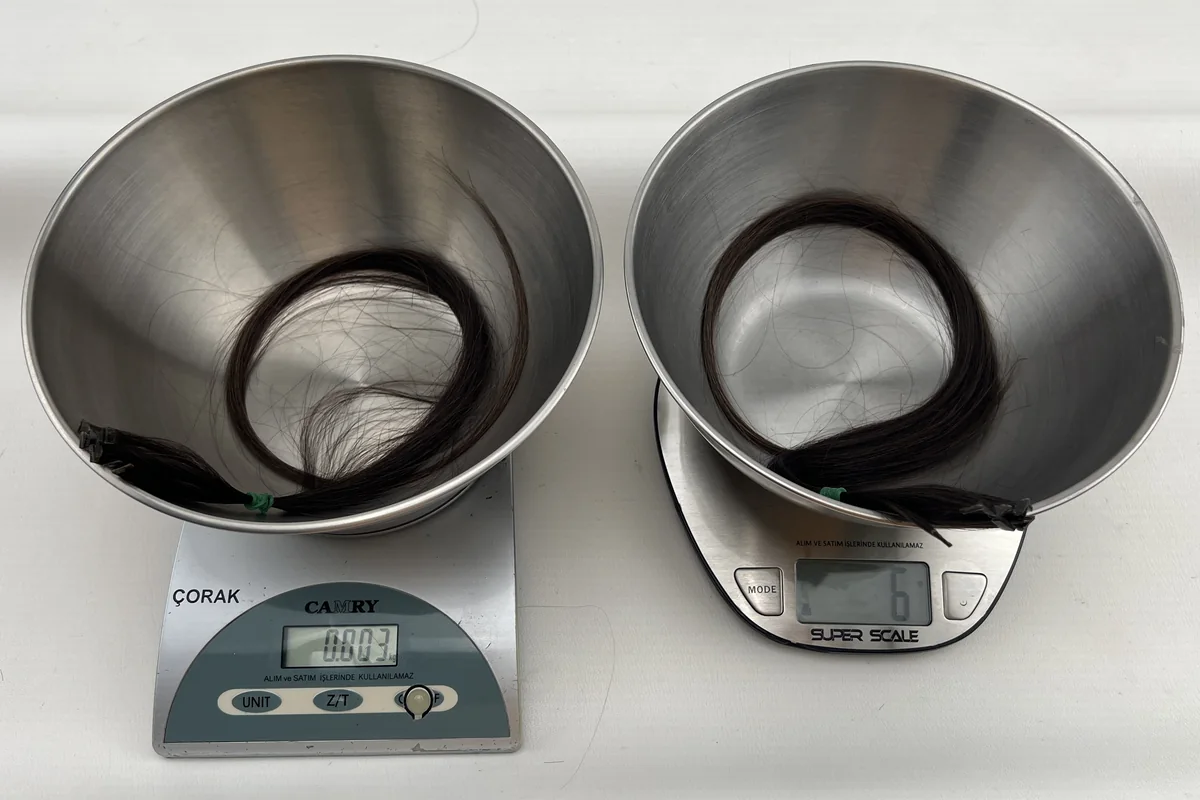
A disclosure before the argument, because the argument is about our own goods. Nanofilament holds first place in our own evaluation of seven attachment systems — a manufacturer’s evaluation of a set containing its own products, criteria chosen and weighted by us, nobody blinded, no independent review. Exactly one characteristic was measured: weight per strand.
Ten Nanofilament strands weighed together came to approximately 3 g. Ten Micro strands weighed together came to approximately 6 g. Dividing each by ten gives approximately 0.3 g and approximately 0.6 g per strand — derived by division rather than by weighing individual strands. It is a batch reference comparison from our own production: not a laboratory test, not calibrated, not legal-for-trade, not a direct single-strand measurement. It establishes a ratio of roughly two to one between two of our own systems.
What a small unit buys on fine hair is three things, and none of them is lightness. A smaller joint to conceal under a thinner canopy. Increments — a few grams added to a zone rather than a fixed larger step. And distribution, so no low-density region carries a concentration.
The cost belongs in the same breath. More points means a longer appointment — not once, but every time, for the life of the set: at fitting, at every move-up, at removal. A client who cannot fund or sit through that will stretch the interval, and stretched intervals are how matting at the attachment zone and travelled joints begin. Our best-ranked system is the wrong specification for a client whose life will not support it.
A second cost falls on the technician: three hundred points is three hundred chances to take a support section badly, and on fine hair the section is where the risk concentrates. Which is where Micro belongs, positively rather than as a fallback — an individual small-strand bonded system using Italian keratin with heat-controlled application, second on our own list, at roughly twice the per-strand weight in the batch compared. Halving the point count for the same total is a real advantage for a client with limited chair time, not a compromise.
Six cases where our first-placed system is the wrong answer for a fine-haired client
Each case names what we would specify instead, including systems we do not make.
When chair time or budget over the life of the set is binding. The tape-in family delivers more visible change per hour at fitting and at maintenance, and a system a client will actually return for beats a better-ranked one she will not. The caveat runs both ways: a panel needs enough hair above it to be concealed, so on sparse hair it trades one problem for another.
When no chemistry should touch the hair at release, or the set will come down and go back up often. Bead and micro-ring systems sit sixth on our own list and exist for that brief — the tube is squeezed round again and slid off, no solvent involved. The caveat cuts the other way: a ring compresses few fibres, so on very fine hair it concentrates load rather than spreading it.
When the specified remover is not reliably available where the client lives. A joint that cannot be opened by its correct procedure will eventually be opened by an improvised one, and improvised removal is the failure that costs people their own hair.
When the natural hair is too short where the joints would sit. The constraint is the shortest layer rather than the longest hair, and a fringe or a heavily graduated crown can rule out placement in exactly the zone a client wants filled — problems treated on the short hair page.
When the brief is occasional. Someone who wants length for an event or a fortnight in the summer should not carry a semi-permanent set for months; clip-in pieces are the correct answer.
And when the ranking is used as a recommendation at all. Our list is ordered by criteria rewarding small per-unit mass, fine division of load and small joint scale — weightings that select for what we manufacture. Re-weight for chair time and cost and our first place drops; the criteria are published in the systems comparison.
Observable conditions where the honest answer is not now
We are a manufacturer. We do not examine heads and we diagnose nothing; none of what follows is a diagnosis or an assessment of any individual. It is a list of things visible in a mirror and in the chair, where the response is to stop and refer.
A hairline that has moved from where it sits in photographs a year or two ago. Short broken fibres standing up along a line where previous attachments sat, or thinning at the temples or nape after a previous set — an observation that a specification, an interval or a removal procedure was not tolerated by that head.
Shedding that has increased and that the client cannot account for. A scalp that is sore, itching, flaking, red or broken at the time of consultation: an attachment sits against the scalp and is hard to keep dry at the root. Hair that stretches when wet and does not spring back — a hand test, and it should be described as one: a judgement made by feel, not a measurement. Lifting carried out in the same week is a poor moment to add months of continuous load.
Hair loss following an identifiable event: illness, medication, childbirth, surgery, sustained stress. The situation is changing week by week, so a specification fitted into it will be wrong within two months even if it was right on the day.
In each case the honest options are short: wait and reassess, or see a doctor or a trichologist first, because a hair professional is not a medical professional and neither are we. Meanwhile a temporary piece that comes off at night places no sustained load on anything.
One sentence has to be said plainly because the industry avoids it. We cannot tell you that extensions will be safe on your hair, and nobody selling you hair can. Any semi-permanent system places continuous mechanical load on hair and follicles; there is no version that does not, ours included. What can be managed is how much load, across how many points, placed where, checked how often, and released by which procedure.
What fine hair can and cannot be made to look like
Length is the easiest brief on fine hair, because it asks for hair where there is none rather than for more hair where there already is some. Body and hold are the underrated result: fine fibres struggle to keep a curl because each has little structure to it, and added hair with more substance can carry a shape the natural hair cannot. Colour placement is a third use — lightness or contrast placed with added hair rather than lifted into the client’s own fibres.
What cannot be delivered is the density seen in reference photographs of coarse, dense hair. The natural hair sets a ceiling on how much can be added before the addition stops blending and starts reading as a separate object, and that ceiling is lower on fine hair. The gap is not a matter of trying harder or paying more.
The blend boundary is the disappointment clients report most and predict least. There is a transition where the added hair begins, and on fine hair it is harder to conceal, because there is less natural hair above the joints to feather into it. Softening the tips helps; so does installing two or three lengths in bands.
And the limit that catches the largest number of people: extensions add length and mass below the attachment point. They do not add hair at the root. A client whose main complaint is a widening parting or a visible scalp at the crown is describing a problem this product does not solve.
What to bring, and the questions that have content in them
A consultation for fine hair is an assessment rather than a sales appointment, and a client makes it better by arriving with evidence about her own hair instead of a photograph of somebody else’s.
The photographs worth bringing are of your own head: the parting you actually wear, from above, in daylight; the back; the hair tied up; the hairline dry and pushed back. Photographs from one and two years ago are the most useful item, because they are the only evidence anyone will have about whether something is changing.
Bring your colour history with dates, because recent lifting changes the answer, and an honest account of your week: how often you wash, whether you sleep on wet hair, whether you swim, whether the hair is tied up for work. Bring your diary too — maintenance capacity is a technical variable, not an administrative one. The questions below are answerable in nouns and units, and a salon answering them in adjectives usually does not hold the information.
- What is the total in grams, and why that figure for my hair?
- What does one attachment unit weigh, and is that figure measured or estimated?
- How many attachment points, and where will they sit relative to the partings I wear?
- How large will the support sections be, and how does that change at the hairline?
- Can I start with a conservative total and add at the first maintenance visit?
- What is the maintenance interval, and what does each visit cost?
- What is the removal procedure, and is the agent it needs available here?
What we have not measured about fine hair, and what we cannot see
Our vantage point is the bench and the returned parcel. We form strands, weigh batches and open packages that come back when something has gone wrong — genuine evidence about components, poor evidence about wear. The boundary matters most here, because fine hair is where overstating costs most.
The gap worth naming first works against our own argument. We do not know whether support sections in practice scale down with unit weight. If they do — a plausible instinct in the chair — the per-fibre benefit of a small unit is smaller than the arithmetic suggests, and its real advantage on fine hair would be concealment and distribution rather than reduced stress on any individual fibre. We would rather publish that question than wait to be asked it.
We are also not in the chair for the six months after a set leaves here. Sets that go well are never sent back to a factory, so returned goods are a sample skewed towards failure, and any pattern we report from them carries that bias.
Nothing here should be read as a claim that any system is safe for fine hair, gentle on fine hair or free of consequences. We publish no such claim in any wording, we have run no controlled assessment that would support one, and we make no statement about concealment on low-density hair. Where the line falls between what we measure and what we observe is set out on our testing methodology page.
- Load a fine fibre carries before failure — not measured, and no figure we could cite
- Retention on fine hair over months of wear — not measured, no study known to us
- Fibres per support section — not characterised; set by hand and varying by zone
- Traction risk by unit weight, section size or placement — not measured by us or, to our knowledge, anyone
- Concealment on low-density hair under standardised lighting — no controlled assessment
- Controlled comparison of any system on fine hair — none held by us, none known anywhere
Frequently asked
Common questions
Can I have extensions if my hair is fine?
Often, and the decision is made on your specific head rather than from a product name. The assessment is by zone: density at the crown, temples, nape and back are usually different numbers on one head. What decides it is the mass on each attachment point, how much of your own hair holds each one, how many points there are, where they sit and the total grams. A supplier answering that with a product name has not answered it.
My hair is fine but very dense. Do the same rules apply?
Partly. Fine, dense hair gives plenty of fibres to recruit into each joint and a reasonable canopy to conceal joints under, so the concealment constraint is much weaker than on a sparse head. What remains is that each recruited fibre is slender, so mass per point and support section size still matter. Fine and dense is the more permissive case, and it is routinely given advice written for sparse hair.
Should I ask for single drawn because my hair is fine?
Only for blending, never for load. Drawing standard governs where mass sits along the length; it does not change what one attachment point carries when a product is specified by weight. Single drawn is reasonable if a blunt end would read as a shelf against your own tapering hair. Offered as the answer to a load concern, it is the wrong variable: ask what one unit weighs and what the total is in grams.
Are tape-ins or strand systems better for fine hair?
Neither in general; the answer depends on which constraint is binding. Strand systems divide a total across many small points, so no single region carries a concentration, but they cost significantly more chair time at every appointment for the life of the set. Tape panels are quicker to fit and maintain, but a panel needs enough hair above it to be concealed, which is the harder problem on sparse hair. Maintenance capacity often settles this more sensibly than mechanics.
Will extensions cover a wide parting or thinning at the crown?
Usually not, and this is the most common mismatch between what a client wants and what the product does. Extensions add length and mass below the attachment point; they do not add hair at the root, and a parting or a crown is a root-level problem. A set placed around such a zone can make the contrast more visible rather than less, and where the concern is a change at the parting or crown the first step is assessment by a qualified professional.
Will extensions damage fine hair?
Any semi-permanent system places continuous mechanical load on hair and follicles, and we make no claim beyond that in either direction. How a particular head tolerates it depends on density, fibre diameter, elasticity, the hairline and the standard of the work, none of which we can judge remotely. What is controllable is total grams, mass per point, support section size, placement, the maintenance interval and correct removal. Broken fibres along the joint line or persistent tenderness mean stop and have it assessed by a qualified professional.
Related pages
Continue reading
Tell us what your hair is actually like — diameter, density by zone, and what has already been done to it — and we will tell you what specification suits it, including when the answer is a smaller total, a different system, or not yet.
Method, colour, length and grams are settled by consultation before anything is quoted.