Evidence and its limits
What We Measure, What We Only Observe, and What We Will Not Claim
We are a hair extension manufacturer, not a test laboratory. We hold no accreditation, no calibrated instrument programme, no peer-reviewed methodology and no independent review of anything published here. One characteristic has been measured — weight per attachment unit, for two of our own systems, by weighing batches of ten and dividing. Everything else is a production specification we set, an observation made at a bench, a reported convention we do not endorse, or a gap left open on purpose. This page says which is which, so that any statement we publish can be placed before it is believed.
The rest of this site makes claims, and a claim with no stated method behind it is an opinion with a company name attached. This page is the method: where each kind of statement comes from, what produced it, and — the more useful half — what we refuse to say because nothing we hold would support it.
The boundary belongs at the top rather than in a footnote. SACH & VOGUE HAIR manufactures human hair extensions in Fethiye, Muğla. We have no test laboratory, no accreditation, no calibrated instrument programme and no peer-reviewed methodology, and nothing here has been reviewed independently. Whatever authority this page carries comes from marking the edge of what a workshop bench can establish, not from implying apparatus we do not own.
We are a workshop with scales, not a laboratory
The absence list comes first, because it is what a reader cannot check from outside and what a company with nothing behind it would leave out. Each item below is a capability we do not have, stated so that no sentence elsewhere on this site can be read as implying it.
What we do have is narrower and real: scales of the kind used to check bundle weights before packing, a bench and people who have worked at it for years, raw hair passing through our hands before a salon has touched it, samples of the systems we make and of others bought on the open market, cameras, and the parcels that come back when something has gone wrong. A workshop answers a narrow class of questions well and answers almost nothing about six months on a person.
The vocabulary follows from the equipment. Tested, proven and lab-verified circulate in this trade attached to no instrument and no protocol, and cost nothing to write. We do not use them, and where you find a number here the procedure behind it should be within a paragraph. Who we are and what we actually do is on the company page.
- No test laboratory of our own, and none retained elsewhere
- No ISO, CE or quality-mark certification, and no laboratory report
- No calibrated instruments with traceable certificates; nothing legal-for-trade
- No peer-reviewed or externally published methodology
- No wear trial, client panel, blinded assessment or time-to-failure testing
- No independent third-party review of any claim on this site
- No medical, dermatological or trichological assessment capability
- No instrumented analysis of fibres, adhesives, load or colour
Every quality claim in this category is an adjective, and adjectives cannot be checked
Read twenty listings in this trade and the quality claims are the same handful of words: lightweight, invisible, premium, natural, seamless, salon-grade. Not one carries a unit, a procedure or a comparator. They do not describe the product; they describe how the seller would like it received.
The failure is structural rather than stylistic. An adjective of this kind cannot be shown false, so it cannot be shown true, so it transmits nothing about the object. Two suppliers with physically opposite products can both write lightweight and neither can be caught. The word costs nothing to print and nothing to defend, so everybody prints it, and the buyer chooses on whichever page they read last.
Four things convert an adjective into a statement that can be argued with. Applied to our own strongest claim, lighter becomes approximately 0.3 g per strand, derived by weighing ten together and dividing, on production equipment, by us — small enough to check, and small enough to be wrong.
- A unit — what quantity is claimed, on what scale
- A procedure — what was done, in enough detail to repeat
- A vantage point — who observed it, and what they could see
- A boundary — what the claim does not extend to
A specification is something we set. An observation is something we watched
A product specification is a decision made in production: a target unit mass, a stated length, a drawing standard, a colour recipe, a count per pack. We know these the way anyone knows their own decisions — we set them, work to them, and check goods against them before packing. Their strength comes from authorship rather than from evidence.
That has a limit which is routinely blurred. A specification is a target with a tolerance, not a promise that every unit lands on it, so 0.3 g per strand describes what a unit is built to rather than the strand you pull from a pack. The tolerance goods are checked against belongs on an order document, where it can be agreed, not on a web page, where it would be decoration.
An observation is a different act. Nobody decided a keratin bond would be larger than a strand joint; we handle both and can see that it is. That is first-hand and uncounted, undimensioned, made by people who know which product is theirs. So the test before publication is a question about verbs: did we set this, or did we see it? A third category has to be admitted rather than quietly filled — statements that are neither, because they concern what happens on a head over months. The specification half of a purchase, including the hair inside any attachment system, is on the hair extensions pillar page.
- SPECIFICATION — per-strand unit mass, supplied at 0.3 g and 0.6 g, bond material included
- SPECIFICATION — drawing standard, with Double Drawn as our preferred standard
- SPECIFICATION — stated length, measured with the hair held straight from the top of the bond
- OBSERVATION — a keratin bond is visibly larger than the strand joints we make
- OBSERVATION — damage at removal has almost always involved the wrong release agent
- NEITHER — how long a set lasts on a real head: not set by us, not seen by us
What a factory can see, and the six months it cannot
Evidence is a function of position. Ours is the point at which material arrives, is worked and leaves: hair sorted, drawn, coloured, blended, formed into units, weighed and packed, plus the parcels returned when an order failed. We see how a batch behaves under a comb before it becomes anybody's set — a genuine vantage point on material and on components.
The blind spot is exactly the shape of what a client cares about most. We are not in the chair when the application is planned, and not there for the six months afterwards. Retention, comfort, how a joint reads at week eight, how a particular head tolerates sustained load, what a summer of oils and hot air does to a bond — all of it happens where we are not, mediated by decisions we do not control.
A salon's position is the mirror image: outcome visible, material invisible. Neither is complete, and the discipline is refusing to borrow the other one's authority, because a manufacturer publishing wear figures is borrowing. Which is why we publish no fitting times in hours and no maintenance intervals in weeks: any such figure from us would be somebody else's working day or growth rate with our name attached. Our position as a producer is set out on the manufacturer page.
A few things can be measured here. The rest is comparison by eye
What can be measured directly is short: the mass of units we produce, the count in a pack, the length of a strand held straight, and the relative dimension of two objects side by side. Each has a unit and a procedure, and each could in principle be repeated by a stranger holding the same object. Repeatability by a stranger is what separates a measurement from an impression.
The instruments deserve the same honesty as the results. We weigh on production equipment of the kind used to check bundle weights before packing. It is not a calibrated analytical balance, we hold no traceable certificate for it, and nothing we publish is legal-for-trade. Ambient conditions are not controlled or recorded, and hair takes up and gives off moisture with the air around it. Our figures are therefore production references rather than certified measurements, and the two should never be printed in the same font.
Everything else is comparison by eye and hand, and it is ordinal at best: this joint is larger than that one, this bundle tangles more than that one. The weaknesses are worth naming individually, since any one alone would disqualify it as a study. Numbers are small. Samples are chosen rather than randomly drawn. Assessors know which products are ours. No scoring instrument was agreed before looking. Nothing was repeated by a second party.
- MEASURABLE HERE — mass of a batch of units we produce
- MEASURABLE HERE — count per pack, and length with the hair held straight
- MEASURABLE HERE — relative dimension of two joints placed side by side
- COMPARISON BY EYE — how a joint sits under the hair, and its profile at the scalp
- COMPARISON BY EYE — how a section moves, and how a parting reads at normal distance
- COMPARISON BY EYE — how a bundle feels, combs and tangles in the hand
- NEITHER — anything that happens on a head over weeks or months
The batch weighing, with every disclosure it requires
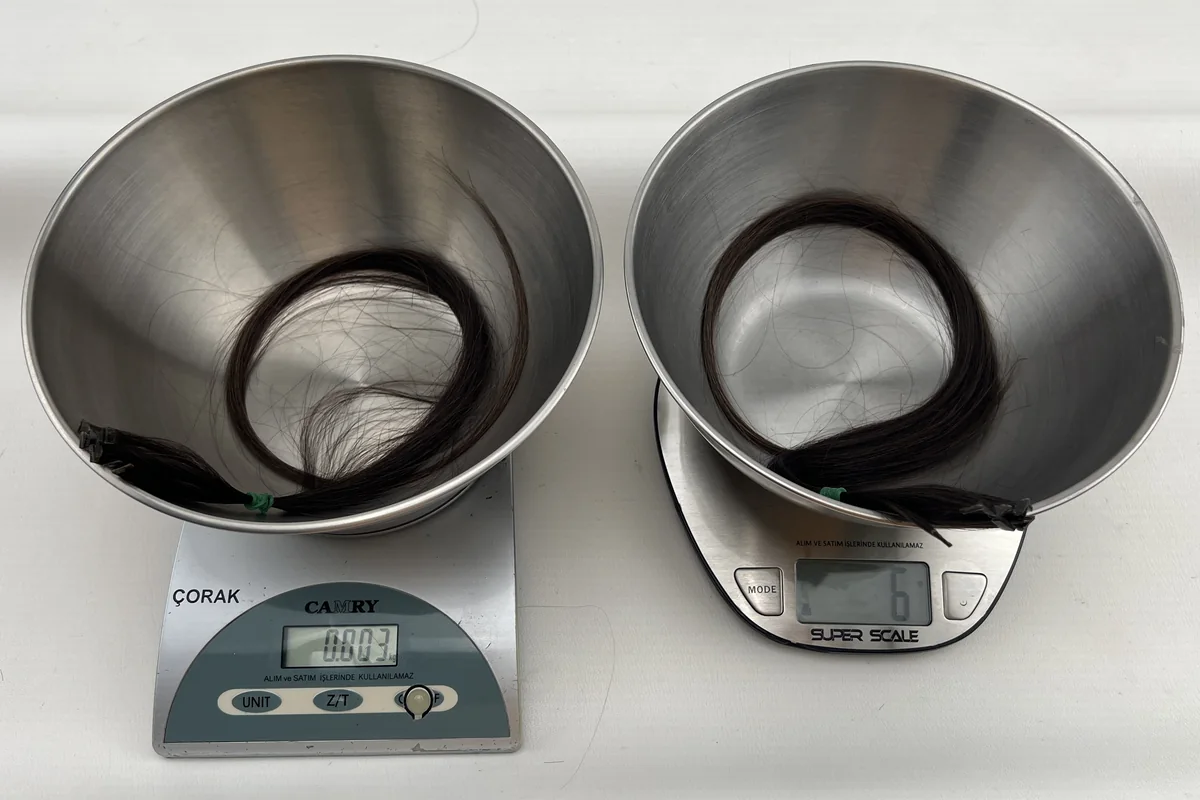
The measurement takes one sentence. Ten Nanofilament strands of the 0.3 g option, weighed together, came to approximately 3 g. Ten Micro strands, weighed together, came to approximately 6 g. Dividing by ten gives approximately 0.3 g and approximately 0.6 g per strand. Everything after this paragraph is the framing that must travel with those numbers wherever they are quoted, including by somebody else.
It is a batch reference comparison carried out in our own production. The per-strand figures are derived by division rather than weighed individually, which makes them batch averages, not measurements of a strand: no individual strand was placed on a scale. We have not characterised how far individual strands sit from those averages, so reading 0.3 g as a tolerance takes more from it than we put in. It is not a laboratory test, not a calibrated commercial measurement, and not legal-for-trade.
The weaknesses, named rather than summarised. Ten units is a reference quantity, not a statistical sample, and no dispersion can be calculated from it. The strands came from our production rather than being randomly drawn across lots and dates. Read it as a single reference comparison, not a series with repeats behind it. The equipment carries no calibration certificate, and ambient humidity was neither controlled nor recorded.
What it establishes is narrow and real: a ratio of roughly two to one between two of our own systems, and the fact that per-strand mass is a quantity somebody put on a scale rather than an adjective somebody typed. About anybody else's product it establishes nothing, since we have never weighed a competitor's bond, tape panel or micro-ring. It is also the standard we would like applied in return: ask any supplier what one attachment unit weighs, then ask whether it was weighed individually or derived from a batch. How the figure is used in our own product argument is on the Nanofilament page.
What a macro photograph establishes, and what it only suggests
Every image here is a photograph of our own product, our own production, or an application we were present for. We publish no generated, rendered or stock imagery, and do not illustrate a system we do not manufacture with somebody else's work. That is a floor rather than evidence: not fabricating an image is the minimum, not an argument.
What a macro photograph establishes is existence — at least one unit looked like this, on one day, under one light, through one lens, at one distance. Scale is the first thing it does not carry: without a reference object of known size in the frame it fixes proportions inside the frame and nothing absolute, and magnification, working distance and depth of field are all choices made by whoever held the camera.
The second limit matters more. A photograph of one sample is not a distribution: it cannot show how the next hundred units vary, and the sample photographed is rarely the one that came randomly to hand, because nobody photographs the unit they would reject. An improvement exists and we have not adopted it — a scale reference in the frame, capture conditions stated, and a rule that the unit photographed is the one that came to hand. Until then the compensation is the caption, which says what is shown, what is not being claimed, and when a photograph was originally shot for a different article.
Why we publish no claim about visibility, in any wording
This is the most commercially expensive decision on this site and the one we are most confident about. We do not state that any system we make is invisible, undetectable, or less visible than any alternative, in any phrasing, because we have run no assessment capable of supporting it. The claim is worth a great deal here, which is why it is made so freely and why so little sits behind it.
What a real concealment assessment needs is listed below, and most of it concerns the assessor rather than the product. A joint that vanishes under warm salon light can separate completely in daylight; concealment on fine light hair and on dense dark hair are different problems. There is also an expectancy problem no amount of good faith removes, because the person best placed to photograph a joint is the person who made it and would like it to look good. Which parting, which angle, which head — all decisions by an interested party.
What can be said instead is mechanical and more useful to a technician. Concealment depends on how much hair falls over the joint, distance from the parting the client actually wears, colour match at the root, support section size, how the hair is worn at that moment, and the light. The product contributes one term; the application contributes most of the rest. The only free test that matters runs before the client leaves the salon: part the hair where you actually part it, tie it up the way you actually tie it, and look in daylight as well as under the salon lights.
- Defined viewing distance and angle, fixed before the assessment
- Stated illuminants, and more than one of them
- A range of natural hair colours, densities and textures
- Assessors unaware of which system they are assessing
- A scoring instrument agreed before anyone looks
- Enough heads for a difference to be distinguishable from noise
- Someone with no commercial interest in the result running it
Movement, application, and the variables set in a chair we do not stand in
Movement observation is the weakest evidence we publish and the easiest to over-read. We can film a section as it moves and see whether a joint catches the light when the hair is lifted. That is a description of one head, on one day, with one placement, filmed by us. It says nothing about week eight, when the joints have travelled out from the scalp, shed hair has collected around them, and two months of somebody's routine have acted on them.
Application observation has the same shape. Applications happen here for training and photography and we watch them closely, which is how a manufacturer learns to separate a product fault from a specification mismatch from a procedure failure. It is not running a salon, and we publish no fitting times, maintenance intervals or retention figures.
The list below is the part of an outcome set in the chair rather than in the factory. Every item materially changes how a set performs and not one is ours — which has a consequence people rarely follow in both directions: a good result is not proof of our product, and a poor one is not proof against it. Attribution needs the application held constant, and we know of nobody in this trade who has published having done that. It is also why a slipping complaint is answered here with questions about sequence rather than with replacement stock, which closes the conversation without touching the cause.
- Support section size — how much of the client's own hair goes into each joint
- Spacing between points, and distance from the parting actually worn
- Tension at the attachment, and the direction the strand is set in
- Heat setting and dwell time, where the system uses heat
- Whether the natural hair was clean and free of product
- Total grams specified, and how they were distributed by zone
- The cut and blend afterwards, without which any set reads as an addition
- The home routine, and whether the maintenance interval was kept
- Which release agent was used, and whether it was given time to work
Hand inspection: cuticle direction, end density, and where a trained eye stops
Incoming hair is judged by hand and eye, by people who have done it many times, and that judgement is better than it sounds and narrower than it is usually sold as. Cuticle direction can be felt: fingers and a comb meet resistance running one way along a bundle and slide the other, and a bundle assembled against itself declares that quickly, first as drag and then as tangling no later step in production corrects. Direction is checked at sorting for that reason.
End density is judged by fanning a bundle out and holding it against the light, where taper shows as a thinning shadow toward the tips. Double Drawn is judged the same way, and the honest label is process check rather than measurement: shorter fibres are pulled out in repeated passes, the bundle is compared with a retained physical reference, and it goes back for another pass if the density at the tip is not acceptable. That is a person's judgement against a reference, repeated until it passes. We publish no percentage of fibres reaching the stated length, because stating one would mean counting fibres in a random sample at that length, and we have not. What the standard is and what it costs is on the Double Drawn page.
One trap belongs in any honest account of this: a heavy silicone finish makes indifferent hair feel excellent and survives long enough to pass a first impression and a first photograph, so hand feel on an unwashed bundle is not a verdict. The remaining limits are where most of this category's confident claims live. A supplier answering them with a bundle in hand is estimating, and an estimate is not knowledge however good it turns out to be.
- CAN BE JUDGED BY HAND — cuticle direction, by resistance and tangling behaviour
- CAN BE JUDGED BY HAND — end density, by fanning against the light versus a reference
- CAN BE JUDGED BY HAND — coarseness, comb behaviour wet and dry, obvious surface coating
- CANNOT BE JUDGED BY HAND — origin, or processing history before collection
- CANNOT BE JUDGED BY HAND — single-donor status
- CANNOT BE JUDGED BY HAND — fibre diameter as a figure, or protein integrity
- CANNOT BE JUDGED BY HAND — behaviour after a defined number of wash cycles
Colour is compared against physical references, never against a screen
Colour assessment here has conditions attached, and they are conditions rather than a preference: physical samples side by side, in daylight, at the same moisture state, since wet hair reads darker than the same hair dry. Where it matters more than one person looks, because colour judgement varies between individuals and fatigues within one.
Screen-based matching has a physical limit rather than a commercial one. A camera decides its own white balance, the receiving screen applies its own profile, and the room that screen sits in adds a third variable nobody controls, so an image carries relationships within its frame and absolute colour not at all. Depth can often be estimated from a photograph; undertone frequently cannot, and undertone is the error that surfaces in daylight after an approval given on a phone. Two samples can also match under one light and separate under another, which is why an approval under salon light and a rejection at a north-facing window can both be sincere.
What we do not publish is any numeric colour claim — no instrumented figure, no tolerance as a number, no fastness rating across a stated number of washes. We hold no spectrophotometer and run no standardised wash protocol, so every colour statement we make is matched to a retained physical reference by eye. That is a reasonable method; it is not a measurement, and we will not write it as one.
Returns are the closest thing we have to field data, and the sample is badly skewed
Returned and re-fitted goods are the only window a factory has onto what happens after a sale, and the bias in that window is severe enough to state before any of its content. Sets that went well are not sent back to a manufacturer. What accumulates here is a dense catalogue of failure modes attached to no base rate at all.
The consequence is a rule about grammar. We can say what usually accompanies a failure — the pattern consistent enough to state alone is that hair destroyed at removal has almost always involved a release carried out without the agent specified for that exact joint. We cannot say how often it occurs, because the denominator never arrives. A supplier quoting a failure rate from returns is quoting a numerator and calling it a fraction.
Two further distortions sit on top. Complaints arrive in application language — it slipped, it matted, it shed — and none of those separates a product fault from a specification mismatch from a procedure failure; the classification is then performed here, by the party with an interest in the answer, with no independent adjudication. And distance filters the sample again, since a dissatisfied buyer far away, or with a small order, is less likely to send anything back. So returns are a source of hypotheses rather than findings: excellent for learning what can go wrong, worthless for frequency.
Five levels: every claim on these pages sits at one of them
The framework below turns the distinctions above into an editorial rule. Before a sentence is published it is placed at one of five levels, and the level decides the wording, the qualifications attached, and whether it can be published at all. A statement that cannot be placed does not get written.
LEVEL 1 — Confirmed internal product specification. Something we set in production and check goods against: Nanofilament supplied at 0.3 g and 0.6 g per strand with bond material included; Double Drawn as our preferred hair standard; length measured with the hair straight from the top of the bond. These can be stated flatly, with one qualification — a specification is a target with a tolerance — and they are not independent verification of anything.
LEVEL 2 — Direct evidence, measurement or real media. Something physically done or recorded here: the ten-strand batch weighing above, and photographs and video of our own production and of applications we were present for. A level 2 statement carries its procedure and limits in the same place as the figure — batch reference, derived by division, individual strands not weighed, not a laboratory test, not calibrated, not legal-for-trade — and media at this level carries a caption saying what is shown and what is not being claimed.
LEVEL 3 — SACH & VOGUE HAIR internal technical evaluation. Our own judgement from real handling, checked by nobody outside: our ordering of seven attachment systems, and comparative statements such as a keratin bond being visibly larger than a strand joint. Level 3 is publishable only with the disclosure attached — the manufacturer's own evaluation of a set containing its own products, criteria and weightings chosen by us, nobody blinded, one characteristic measured and the rest observed. The apparatus for that ranking stays with the evaluation itself rather than being restated wherever the order is mentioned.
LEVEL 4 — External authoritative support. A test report from an accredited laboratory, a certification with a named issuing body and a stated scope, an independent study, or a published measurement by somebody with no interest in our sales. For us this level is currently thin to the point of empty, and we would rather write that than let an absence pass unremarked. We hold no third-party test report on anything we make, and no reader should infer external verification anywhere on this site. General literature about keratin fibres exists, is not evidence about our goods, and is not attached to our claims to borrow its authority.
LEVEL 5 — Not currently publishable. Statements we could write with almost no risk of being caught, and do not: that any system is invisible or undetectable; retention or lifetime figures; damage or safety claims; the weight of a competitor's bond, panel or ring; a minimum natural hair length in centimetres; a service interval in weeks; fitting times in hours; reinstallation cycles survived; a colour tolerance as a number; a percentage of fibres reaching full length in a Double Drawn bundle.
Two rules govern the levels. One cannot be raised by repetition — a level 3 judgement stated confidently, or stated on three pages, is still level 3. And a level 5 subject raised in a sales conversation gets the answer it gets here: we do not know, this is what would be needed in order to know, and this is what we can tell you instead.
- LEVEL 1 — Confirmed internal product specification: we set it and check goods against it
- LEVEL 2 — Direct evidence, measurement or real media: procedure and limits beside the figure
- LEVEL 3 — Internal technical evaluation: only with the full self-assessment disclosure
- LEVEL 4 — External authoritative support: currently thin to empty, and stated as such
- LEVEL 5 — Not currently publishable: written nowhere until evidence exists
What we do not know, and the studies that would settle it
The first part of the list is the current state of our evidence, written as gaps rather than filled in. Publishing it in full is the part of this page we would most like judged, because it is the one signal a company with nothing behind it cannot imitate: any manufacturer can say their bond is lighter, and very few will say they have never weighed a competitor's.
The second part is what would close those gaps. None of it is exotic and none can be done at a bench — each needs an instrument we do not own or an independence we cannot supply ourselves. A list of studies reads like a roadmap, so one boundary: we have commissioned none of them and hold no date for any. If we run one, the protocol will be published before the result, so the design can be judged without knowing which way it came out; and if a result contradicts something we publish, the correction will say what produced it rather than quietly reordering the page.
- Per-strand variance around the 0.3 g and 0.6 g averages — never characterised
- Weight of any competitor bond, tape panel or micro-ring — never weighed by us
- Retention over months of real wear — no wear trial, no panel, no time-to-failure data
- Concealment under standardised lighting across hair types — no controlled assessment
- Load at the follicle for a given unit mass and section size — no instrumented measurement
- Comfort as reported by wearers — never systematically collected
- Fibre diameter, protein integrity and post-processing condition — no instrumented analysis
- Colour reproducibility between lots, and fastness across wash cycles — no protocol here
- Percentage of fibres reaching stated length in a Double Drawn bundle — not counted
- Reinstallation cycles a specification survives — not counted
- Failure rates of any kind — returns give a numerator and never a denominator
- STUDY — individual weighing of a large random sample across lots on a calibrated balance, reporting mean and dispersion
- STUDY — independent comparative weighing of attachment units across systems, including products bought anonymously
- STUDY — a blinded concealment assessment: fixed illuminants, defined distance and angle, a range of hair types
- STUDY — a wear and retention trial on real heads, run by a party with no commercial interest
- STUDY — instrumented measurement of traction load for stated unit masses and section sizes
- STUDY — tensile and cuticle assessment before and after colour processing, and after defined wash cycles
- STUDY — fibre counts at stated length in random samples, turning Double Drawn into a distribution
Frequently asked
Common questions
Do you have a laboratory, a certification or a test report?
No, to all three. We have no test laboratory of our own and none retained elsewhere, no ISO, CE or quality-mark certification, no laboratory report, and no calibrated instruments with traceable certificates. Nothing here has been reviewed by an independent party. Where we publish a figure it was produced on production equipment by our own staff, and the procedure is printed next to it so you can see how much weight it will bear.
What have you actually measured?
One characteristic, for two of our own systems. Ten Nanofilament strands weighed together came to approximately 3 g, and ten Micro strands to approximately 6 g, giving averages of approximately 0.3 g and 0.6 g per strand by division. Individual strands were not weighed. It is a batch reference comparison on uncalibrated production equipment, not a laboratory test and not legal-for-trade. Everything else is a specification we set, an observation we made, or a stated gap.
Why will you not say your bonds are invisible?
Because we have run no assessment that could support it. A concealment claim needs a defined viewing distance and angle, stated illuminants, a range of hair colours and densities, assessors who do not know which system they are looking at, and a scoring instrument agreed before anyone looks. We have none of that. What we can describe is what concealment depends on: hair falling over the joint, distance from the worn parting, root colour match, section size, and the light.
Is anything on this site independently verified or peer-reviewed?
No. That is level 4 in the framework on this page, and for us it is currently empty. No accredited laboratory has tested our products, no certification body has assessed them within a stated scope, and no independent study exists that we could cite about our goods. General scientific literature about keratin fibres is not evidence about anything we manufacture, so we do not attach it to our claims to borrow its authority.
How do I know a specification such as 0.3 g per strand is accurate?
You do not know it from a web page, and you should not. A specification is a decision we make in production and check goods against — a target with a tolerance, not a guarantee about an individual strand. What you can do is ask what tolerance the goods are checked to, have it written on the order, and weigh a reference quantity yourself on receipt. A supplier who puts a tolerance in writing is making a checkable statement; one who will not is offering an adjective.
What would make you change something you currently publish?
Evidence at level 2 or level 4 that contradicts it. Individual weighing of a large sample showing our batch-derived averages do not hold would send the one measurement on this site back for republication. Independent weights for tape panels, keratin bonds or rings landing near our strand figures would collapse the criterion our ranking leans on hardest. A controlled retention study favouring adhesive or weft systems would move places in an order we publish.
Related pages
Continue reading
Ask us for the evidence behind any statement on this site and we will tell you which of the five levels it sits at, including when the honest answer is that we do not know.
Method, colour, length and grams are settled by consultation before anything is quoted.