Who is writing this
About SACH & VOGUE HAIR: Two Vantage Points, and What Neither of Them Sees
SACH & VOGUE HAIR manufactures human hair extensions in Fethiye, Muğla, Türkiye, and holds professional application knowledge alongside the production work. That combination is the whole of our claim to publish technical guidance: a manufacturer knows what was decided about a product, an applicator knows what happens to it in a chair, and most companies here can speak from only one of those positions. Neither reaches the six months a client lives with a set, so this page states what each vantage point sees and the corporate claims we decline to make about ourselves.
You have probably arrived from a technical page, checking whether the source is worth the reading time. That is the only question this page answers. It is not a company profile, and there is no origin story in it.
We manufacture hair extensions in Fethiye, Muğla, and we also hold professional knowledge of how the goods are applied. Everything on this site sits inside the overlap of those two positions, and the useful half of the argument is the boundary — so we would rather mark the edge than let the site imply it goes all the way round.
SACH & VOGUE HAIR, stated without the parts we cannot support
We manufacture human hair extensions in Fethiye, in the province of Muğla, Türkiye. Raw hair is received here, sorted by length and root direction, drawn to the standard an order specifies, colour-processed and blended where the shade requires it, prepared into an attachment system, weighed and packed. Alongside that we hold professional application knowledge — how the systems we build are fitted, released and maintained — which is a different body of knowledge from knowing how they were made.
What is missing is deliberate. No founding year, no headcount, no floor area, no annual output, no count of countries, no client list, no certificate. Those are the standard furniture of an About page and share one property: a reader cannot check any of them from a browser. What replaces them is the shape of what we know and where it stops.
A factory knows what was decided; a chair knows what happened
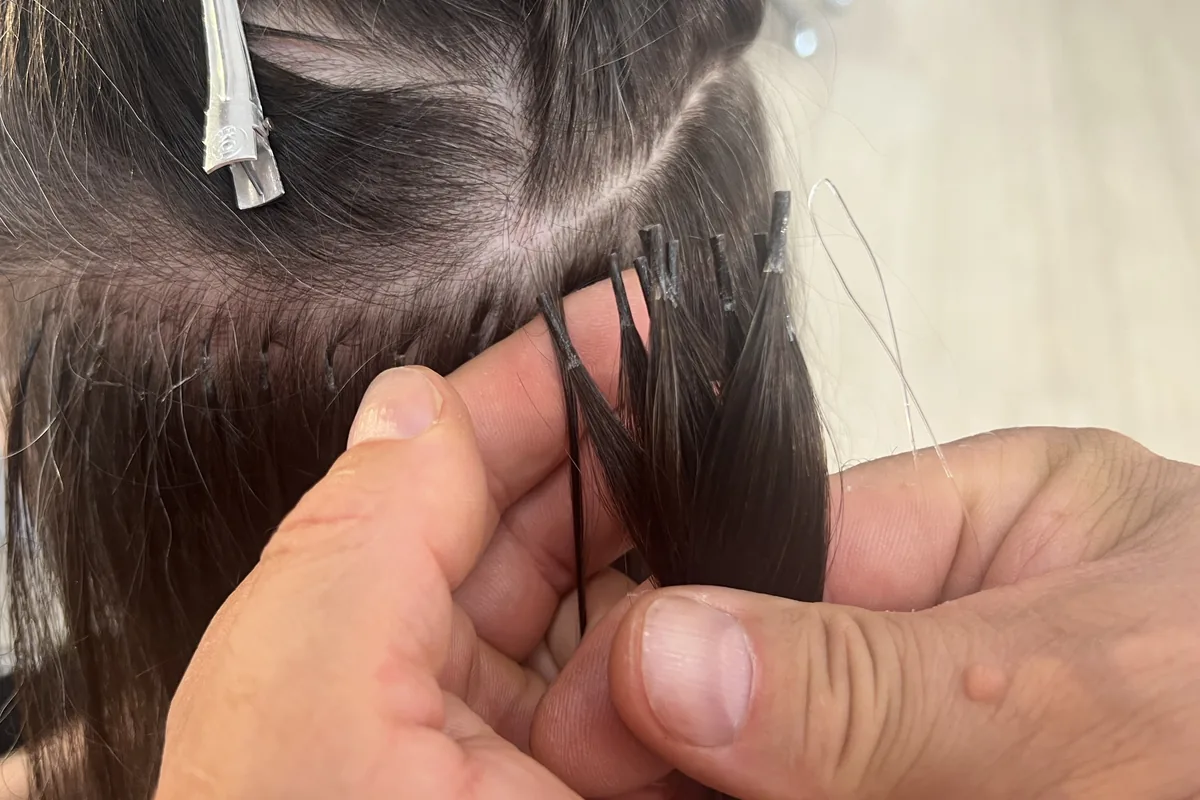
Knowledge about a hair extension comes from two places that rarely sit in the same building: production, where the decisions are made, and the chair, where the consequences arrive. A company standing in one and speaking about the other is not lying; it is repeating what it was told, and the repetition is invisible in the wording.
From production you see the decisions and the material: which raw lot a bundle came from and how it behaved under a comb, how many drawing passes it took, what compound forms the tip and which release agent it answers to, which batches went into a blended shade and in what proportion, what a unit was built to weigh. You also see the parcels that come back when something has gone wrong — a factory's only sight of the outside world, and a badly skewed one.
From the chair you see none of that and all of what follows: how much of the client's own hair went into each support section, where joints sit relative to the parting actually worn, whether the grams were distributed by zone or merely divided, how the set reads at week eight. And the sets that went well, which nobody writes to a manufacturer about.
The failure runs both ways. A complaint arrives in the language of the chair — it slipped, it matted, it shed, it would not come out — and none of those phrases separates a product fault from a specification mismatch from a procedure failure. A supplier who knows only the box hears a defect and sends replacement stock, closing the conversation without touching the cause. A supplier who knows the chair asks about the sequence first, and often the answer is a change in procedure and no goods at all.
It also changes what gets built. A factory reasoning alone standardises on one unit weight, because one specification is cheaper to run. Only the second vantage point shows the cost: the same grams in smaller units means roughly twice the joints and roughly twice the chair time at every appointment, for as long as the client owns the set.
Now the boundary, which matters more than the claim. We manufacture and we also work with extension systems professionally in Fethiye, so we see the product on the bench and in the chair. What neither vantage point reaches is the six months after a client leaves with the set — how it wore, what was neglected, what was rescued. That is why we publish no fitting times in hours, no maintenance intervals in weeks and no retention figures: those depend on a stretch of time we do not observe. Two positions out of three beats one, and still does not settle what a client cares about most.
- VISIBLE FROM PRODUCTION — the raw lot, the drawing passes, the compound, the colour components, the target unit mass
- VISIBLE FROM THE CHAIR — section size, tension, placement against the worn parting, grams by zone, the cut and blend
- VISIBLE FROM BOTH — whether a failure came from the goods, the specification or the procedure
- VISIBLE FROM NEITHER — retention over months, comfort as reported by wearers, load at the follicle
Human hair passes through our hands before it is anybody's set
Hair is a natural fibre bought in lots, and lots differ: two bundles of the same stated length and shade code can behave unlike each other under a comb, take colour at different rates and finish at different weights after drawing. A company buying finished goods meets that variation as a complaint months later; a company processing the material meets it every week, before anything is packed. What handling teaches is narrow and real — cuticle direction is felt rather than inferred, and a bundle assembled against itself declares itself first as drag and then as tangling no later step corrects.
What handling cannot teach is longer, and holds most of this category's confident claims. Origin, processing history before collection and single-donor status cannot be determined by touch: we buy raw hair from suppliers and agents, did not witness collection, and claim no unbroken chain back to a head. Fibre diameter as a figure, protein integrity and behaviour after defined wash cycles are instrument questions, and we own no such instrument.
Made to a specification means decisions with limits, not a name on a box
Most product description in this trade is a label: a system name, a length, a shade code, a weight per pack. A label is a category and cannot be breached, because it commits nobody to anything. A specification is the set of decisions that produce the goods, each carrying a limit that can be checked on arrival.
Preparation is where those decisions become physical. A strand system is divided into units and a tip formed on each one individually, so labour is set by the number of units rather than the total weight. Bundles are weighed against their stated weight before packing, and root direction is checked at sorting. One limit gets blurred whenever a specification is quoted as though it were a measurement: it is a target with a tolerance, not a promise about the individual unit pulled from a pack, which is why the tolerance belongs on an order document rather than on a web page.
- The drawing standard, stated as a process rather than a tier name
- The length, and where on the unit it is measured from
- The colour components and proportions, not only a catalogue code
- The attachment system, and the mass one unit is built to
- The count per pack, and the tolerance the goods are weighed against
- The physical reference retained here for matching the shade again later
The systems we make, and the ranking we publish with its disclosure attached
Three systems carry most of our production. Nanofilament is our flagship: strand-based, supplied at 0.3 g and 0.6 g per strand with bond material included. Micro is our individual bonded strand system, formed with Italian keratin and applied under controlled heat. Butterfly Tape-In sits in the tape-in family and takes the scalloped, winged form the name describes.
Two corrections travel with those names, because generic internet taxonomy garbles both. Nanofilament is not a nano-ring, sharing no mechanism with ring, bead or loop systems. Micro is likewise not a micro-ring, a bead or a loop — it is an individually bonded strand, and confusing bonded strands with ring hardware is the commonest error in English material about this category. Since we make both, it should be said plainly that Micro is an excellent established professional system with a long record in salons.
We publish one ordering of the seven systems in common use: 1 Nanofilament, 2 Micro, 3 Butterfly Tape-In, 4 Standard Tape-In, 5 Keratin, 6 Bead / Micro-Ring, 7 Weft. The disclosure travels with it every time. It is the manufacturer's own evaluation of a set including its own products, and ours hold the top two places; we chose the criteria and the weightings, our own staff assessed, nobody was blinded, and nobody independent reviewed it. Exactly one characteristic was measured — per-strand weight, for two of the seven, by weighing batches and dividing — and the rest is production observation, reported convention or a stated gap. The criteria sit above the result on the systems comparison, which also lists where our first-placed system is the wrong choice.
Colour is where the two vantage points collide
Colour processing and blending happen here, which is where one piece of knowledge comes from: raw hair reaches this trade on predominantly dark bases nearly everywhere it is collected, so almost every light shade in every catalogue is lifted hair rather than found hair. The collision is that a shade is approved on a bench, flat and dry, under one light — then judged in a mirror months later, in daylight and under salon light, against a root that has grown out on its own schedule. Both parties can be sincere and still disagree.
The limits are firm and stated before an order rather than after. We hold no spectrophotometer and run no standardised wash protocol, so we publish no numeric colour claim, no tolerance as a figure and no fastness rating: every colour statement we make is a match by eye against a retained physical reference. That is a reasonable method and it is not a measurement, so we do not write it as one.
Double Drawn is a standard we chose, and it costs us arguments about price
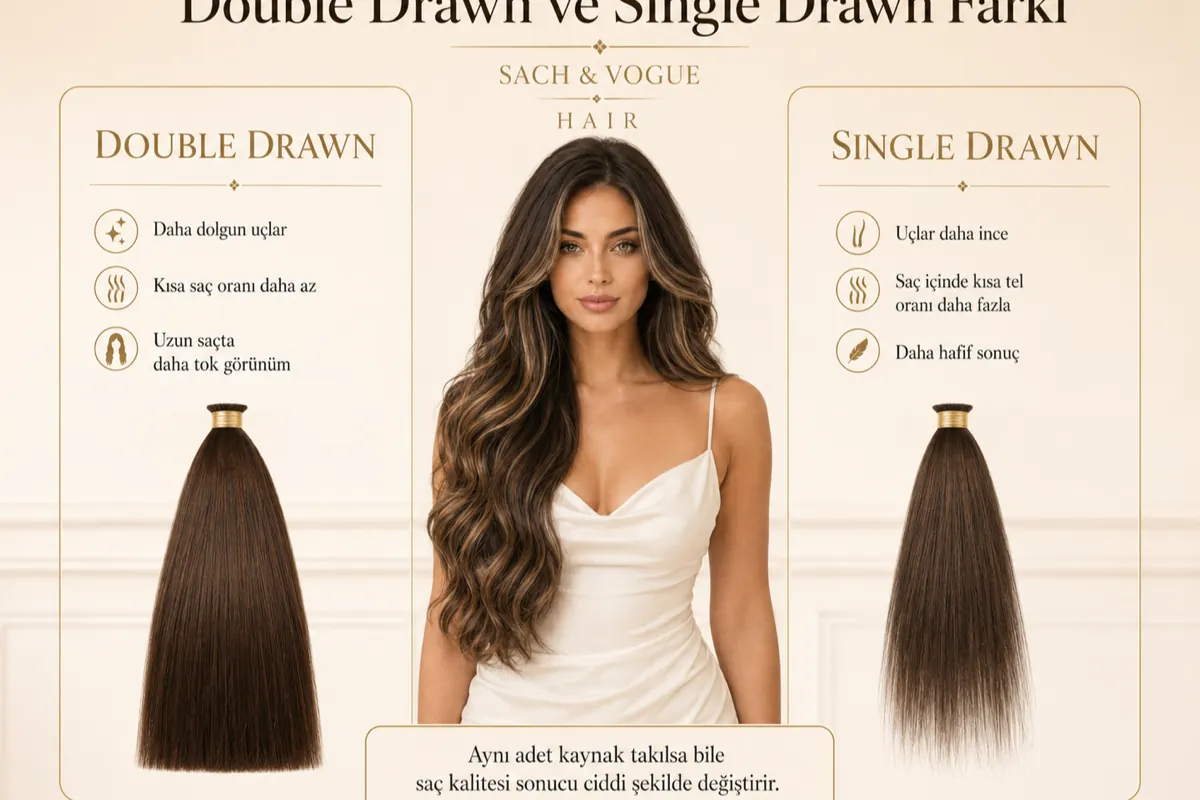
Double Drawn is our preferred standard, and preferring it works against us where most decisions are made. Drawing removes the shorter fibres by hand in repeated passes until density is held most of the way down. Raw hair is bought by weight, so every fibre withdrawn was already paid for at the full rate. The consequence is arithmetic rather than opinion: from one source, Double Drawn is always dearer per gram than single drawn, and the same term offered at a single drawn price should stop a conversation rather than close a sale.
We prefer it for what the second vantage point sees. Density held toward the ends gives a cut and blend material to work with, and its absence is what a client describes months later as the set reading like an addition rather than like their hair. That is a judgement about outcomes rather than a claim of superiority: single drawn remains a legitimate product, and some clients specifically want the taper. Where a purchase is decided on a headline number our specification usually loses, and we would rather write that here than discover it on the third quotation.
One correction, because it circulates constantly. Double Drawn is not inherently heavy and is not disqualified for fine hair. It changes where mass sits along the length; it does not change what one attachment unit weighs. A 0.3 g strand weighs 0.3 g whether the hair inside it was drawn once or repeatedly, and the load at an individual joint is set by unit mass and support section size, both decided independently of the drawing standard. What the operation involves and what it costs are on the Double Drawn page.
Why a manufacturer develops a flagship, and what Nanofilament actually is
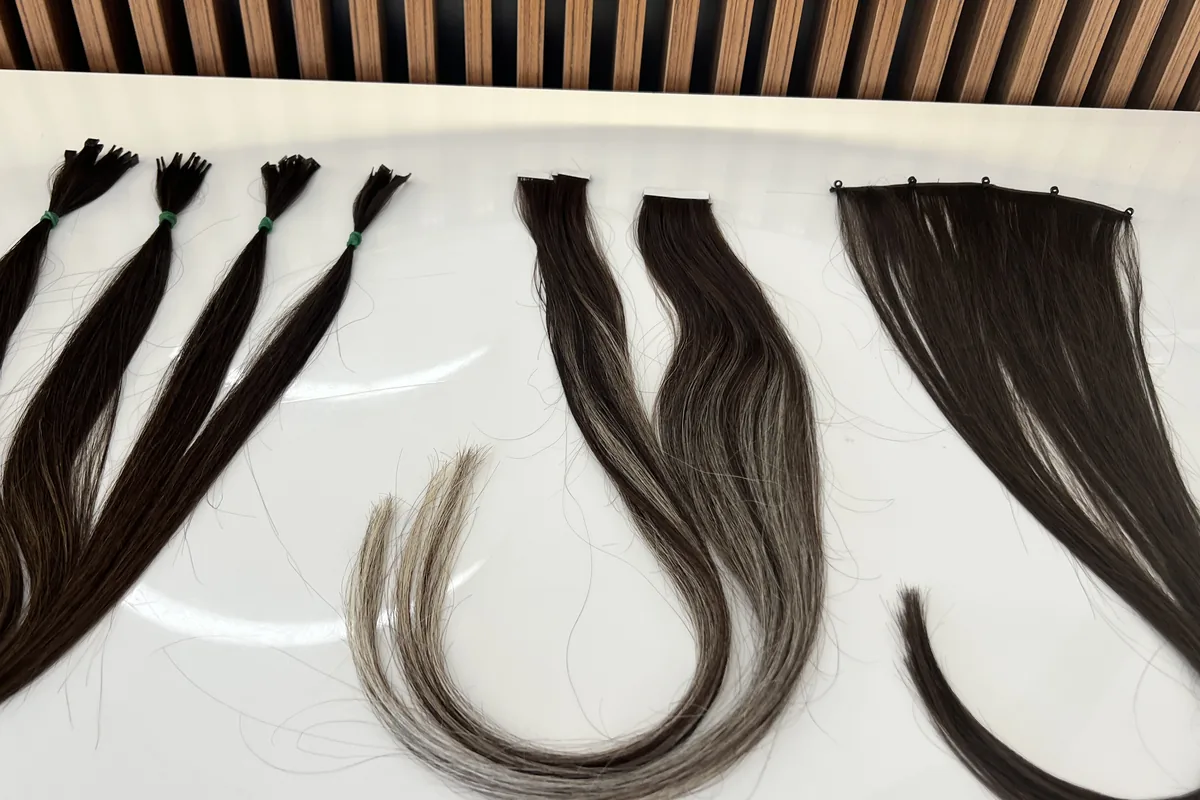
A manufacturer developing its own system deserves scepticism, since the party running the exercise decides the outcome. So here is the reasoning rather than the result. The trade-off governing a strand system is fixed: the same grams divided into smaller units means more joints, so each joint carries less and each appointment takes longer. Production reasoning alone resolves that toward fewer, larger units, because unit count is the labour. Only the second vantage point makes the smaller unit worth building.
Nanofilament is our answer to it, and the description is deliberately flat: a strand-based system supplied at 0.3 g and 0.6 g per strand, bond material included in the stated mass. Not a nano-ring or any other ring system, not a film, scalp or prosthetic base, and not a tape panel cut small. Each denial is here because readers have assumed it from the name.
The measurement we publish is small and carries its framing wherever it goes. Ten Nanofilament strands of the 0.3 g option, weighed together, came to approximately 3 g. Ten Micro strands, weighed together, came to approximately 6 g. Dividing by ten gives approximately 0.3 g and approximately 0.6 g per strand. That is a batch reference comparison on our own production equipment: the per-strand figures are derived by division rather than weighed individually, no individual strand was placed on a scale, it is not a laboratory test, not calibrated and not legal-for-trade. It establishes a ratio of roughly two to one between two of our own systems and nothing about anybody else's product, because we have never weighed one. Nor have we characterised how far individual strands sit from those averages, or run any concealment assessment — which is why no page here states that a system we make is invisible, undetectable or less visible than an alternative, in any wording.
Fethiye, Muğla, and the distance between an answer and the decision behind it
Taşyaka Mah., Ölüdeniz Caddesi (TSK), No: 45/1, Fethiye / Muğla, 48300, Türkiye. Stated plainly, because it is one of the few claims on a supplier site a buyer can test without technical knowledge, and because the rest of this page asks you to test things.
What being here changes is narrow. The ordinary limit of an extension conversation anywhere is that the person answering did not make the goods: ask what compound forms that bond, how many drawing passes produced that bundle, or which codes went into a blended shade, and a good salon relays the question to a supplier and returns with what they were told. Each relay strips detail. Here the distance between the question and the person who made the decision is a few metres — which is also why, when the answer is that we do not know, that is first-hand too.
What it does not change is the part people expect. Proximity to production does not improve an application, since whoever fits the hair still decides most of the outcome, and it does not make us the right party to judge whether our own products suit a particular head. What is practically available here for someone arriving in person is on our Fethiye page.
We supply buyers outside Turkey, and publish no numbers about it
Professional buyers and salons outside Turkey are a normal part of our work, and English here is a working language of the trade rather than a translation of a Turkish sales page. That is the whole of what we will say about the scale of it. There is no export volume on this site, no number of countries and no client count: those figures are unverifiable from a browser and uninformative even when true, since a supplier shipping to thirty countries tells you nothing about whether they can hold your shade across lots.
We name no clients either. A supplier who lists other buyers to impress you will list you to impress somebody else, and a great deal of production in this trade is sold under other people's names by contract. What crossing a border genuinely changes is documentation rather than product — exporter of record, incoterm, declared country of origin, and whatever the destination market requires on paper — all settled per order, in writing.
Why this site is a body of explanation rather than a catalogue
A catalogue would be cheaper to produce and would convert better in the short term. We publish reasoning instead because this category is almost entirely adjectival — lightweight, invisible, premium, natural — and none of those words carries a unit, a procedure or a comparator that a buyer could check.
Reasoning behaves differently because it can be argued with. If we explain why unit count sets the labour, or why lifting has a point past which condition is what is being spent, you can take that to any producer and see whether their answer holds — which works against us as often as for us. Nor is it altruism: a buyer who understands what they ordered complains about the right thing, and since we are rarely the cheapest quotation, an argument conducted on specifications is the one we would prefer to be having.
The rule governing all of it is editorial. Every statement here is one of four things: a specification we set and check goods against, an observation made first-hand at a bench, an internal evaluation we ran on ourselves and disclosed as such, or a gap. Where a figure appears the procedure appears beside it, and where nothing supports a statement it is not written, however useful it would be commercially. The gaps below are published rather than left implicit, because once every characteristic carries a number a reader can no longer tell evidence from estimate. The full framework is on our testing and evidence page.
- Not measured — retention over months of wear: no trial, no panel, no time-to-failure data
- Not measured — comfort as reported by wearers, and load at the follicle
- Not measured — any competitor's bond, tape panel or ring: we have never weighed one
- Not measured — fibre diameter, protein integrity, colour fastness across wash cycles
- Not measured — concealment under controlled lighting, so no visibility claim appears anywhere here
What this company refuses to claim about itself
An About page is where corporate claims normally live and where they are least checkable. Every item below is cheap to write, effectively impossible to disprove from where you are sitting, and carries no information about whether we can make your goods.
The missing founding date deserves a note, being the most conventional item on any company page. We publish no founding year and no years-in-business figure anywhere on this site. Longevity is a weak proxy for capability in any case — a company can be long-established and indifferent, or recent and exact, and neither state is visible in a date.
Attribution follows the same rule. These pages are published under the company name rather than a personal byline, and no individual titles or credentials are attached to them. A named expert with an impressive role is among the easiest things to manufacture on a website and among the hardest to verify, so instead of a title we cannot evidence we publish the position the knowledge comes from and let the technical content be judged on whether it is accurate.
None of this implies that companies publishing the items below are dishonest; many hold genuine certificates and long verified histories. We are simply not publishing what we cannot support, and you are entitled to hold every supplier to that standard.
- No founding date, years-in-business figure, heritage or founder narrative
- No employee numbers, floor area, machine count or production capacity
- No annual output, export volume or number of countries served
- No client count, client names or brand logos
- No certification claim — no ISO, no CE, no quality mark, no laboratory report
- No awards, rankings or memberships presented as endorsement
- No personal titles or credentials attached to individuals as authority
- No reviews, ratings or testimonials presented as evidence
- No superlative — not leading, not largest, not premium, and not the most invisible in any wording
- No medical or safety guarantee: load is mechanical, and suitability is a professional judgement made on a specific head
Where to take this, depending on what you are deciding
If you are a client deciding on a method, the useful conversation is a consultation rather than a product enquiry. Method, colour, length and grams are settled first, because each changes the others and nothing can be quoted honestly before they are settled. Bring your hair's condition and history, and who will maintain the set — that last one decides more than any product argument, and the ordinary consultation never raises it.
If you are a professional buyer, send a specification rather than an enquiry: grams, length, drawing standard, colour components, system and unit mass. The answer will contain a limit — a quantity, a condition, a lead time, or a no. Our Fethiye service prices are published; what this site does not publish is wholesale pricing, minimums or lead times, each being an output of a specification rather than a property of a company; how a quotation is built, and a checklist you can run on us or on anyone else, are on the manufacturer page. For anything technical, ask which of the four categories a statement of ours belongs to, including when the honest answer is that nobody has measured it.
Frequently asked
Common questions
Who writes these pages, and are they attributed to a named person?
They are published under the company name, not a personal byline, and no individual title or credential appears anywhere on this site. That is deliberate: a named expert with an impressive role is trivial to invent on a website and very hard to verify from outside. What is offered instead is the position the knowledge comes from — production in Fethiye, plus professional application knowledge — and content specific enough to check against another manufacturer.
How long has SACH & VOGUE HAIR been operating?
We publish no founding year and no years-in-business figure. A date on a web page is unverifiable from a browser, and longevity is a weak proxy for capability: a long-established company can be indifferent and a newer one exact. Better tests take one email. Ask a specification question at the edge of what is easy and see whether the answer contains a number, a condition or a no; ask which characteristics have been measured, and by what procedure.
You are a manufacturer, so why should I trust you on application?
Because we do both. We manufacture the systems and we also fit them professionally in Fethiye, so the same people who decide a strand weight also place it, maintain it and take it out. What we still do not publish is fitting times, maintenance intervals or retention figures — those depend on months of wear after a client leaves, which is a stretch of time we do not observe. What we do hold is direct knowledge of how the systems we build are fitted, released and maintained, which is what lets a slipping complaint be separated into a product fault, a specification mismatch or a procedure failure rather than answered with replacement stock.
If Micro is ranked second, are you saying it is a weaker system?
No. Micro is an excellent established professional system with a long record in salons, and we manufacture it. The ordering we publish is our own evaluation of a set that includes our own products, with criteria and weightings we chose, nobody blinded, no independent review and exactly one characteristic measured. Read it as a manufacturer's argument with its workings shown rather than a verdict.
Is Double Drawn too heavy for fine hair?
No, and the belief conflates two different things. Double Drawn changes where mass sits along the length — density is held toward the ends rather than tapering — but it does not change what one attachment unit weighs. A 0.3 g strand weighs 0.3 g whether the hair inside it was drawn once or repeatedly. The load at an individual attachment is set by unit mass and support section size, both decided independently of the drawing standard.
Tell us what your hair or your order actually has to do, and we will tell you which of our systems fits, where one of them is the wrong choice, and what we do not know.
Method, colour, length and grams are settled by consultation before anything is quoted.