From the drawing table
Double Drawn: A Sorting Operation, Not a Grade
Double Drawn describes a sorting operation, not a quality grade. Collected hair holds fibres of many different lengths, because a head carries hairs at different stages of growth, and drawing is the hand operation that removes the shorter ones; repeating it narrows what remains until most fibres reach close to the stated length. The result is a bundle that holds its thickness down to the tips instead of tapering away. It changes where mass sits along the length, it does not change what one attachment unit weighs, and no independent body defines or audits the term.
The word drawn describes nothing done to a fibre. Nothing is stretched, thinned, coated or cut. Drawing is a sorting operation: hair is held with its root ends level, and fibres that fail to reach a target length are pulled out of the mass by hand. Single drawn means that operation has been performed once. Double Drawn means it has been performed again, and again, until what stays behind is a narrower band of lengths than the head originally grew.
That is the whole of it, and it is why the term is easy to sell and hard to check. There is no chemistry to test for and no marker left in the fibre. A finished bundle carries no evidence of how many passes it went through beyond how it looks and handles, so this page spends as much time on what an inspection can establish as on the operation itself.
Drawing is a subtractive hand operation, and every commercial bundle has had at least one pass
Hair reaches a workshop as a cut ponytail or a tied hank. One end is level because a blade went through it; the other is not, because those are natural tips of fibres at different points in their growth when they were cut. Drawing begins by holding the level end firm, so the operation works from a common datum.
The operator then removes fibres. Working from the tip region, handfuls are drawn away from the mass: fibres long enough to be gripped come with the hand, the ones that stop short stay behind. Reset, repeat. Nothing is trimmed, because a cut would run across the fibres and destroy both the natural tip and the root alignment. What comes out is not scrap — shorter fibre goes into shorter products, which is the only reason the operation is economic at all.
Single drawn is not undrawn, which most English descriptions miss. A hank straight off the collection round holds debris, reversed fibres and hair far too short for anything, and nobody ships that. The first pass makes a saleable bundle and leaves most of the natural length spread intact. Double Drawn means the operation was kept going past that point, to change the spread rather than to clean the hair.
Drawing standard and the Remy claim are unrelated claims that constantly arrive in one sentence: one sorts by length, the other preserves cuticle direction. A bundle can be Remy and single drawn, or heavily drawn and non-Remy. Both describe the hair rather than the joint that will hold it, which is the separation the hair extensions page sets out in full.
Drawing is also one-way: a bundle can always be drawn further at the cost of the weight removed, and nothing puts short fibres back. Which is how single drawn stock becomes something a supplier will call Double Drawn on the day an order lands.
The bundle is a distribution of lengths, and drawing narrows it
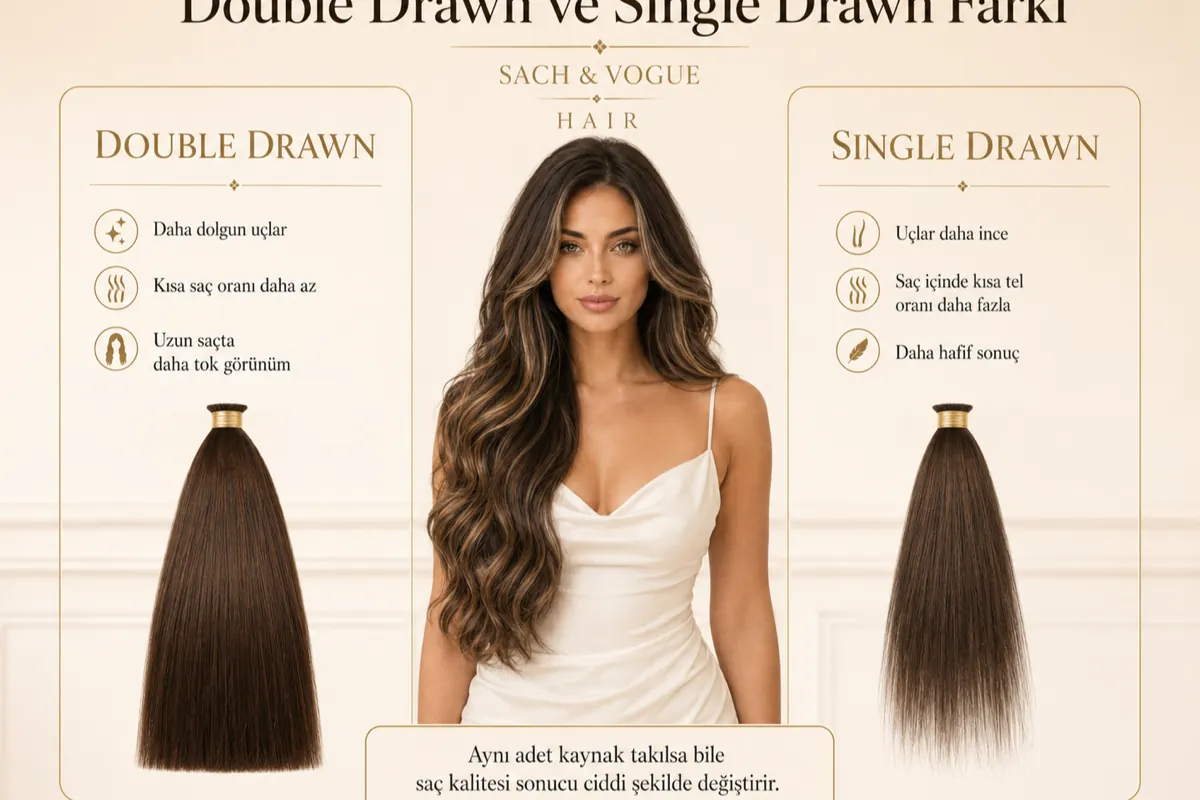
A head does not grow one length of hair. Its fibres sit at different points in their growth cycle: some growing for years, some for months, some emerged weeks ago. Cut them all at once at the nape and the bundle runs from full length down to a few centimetres, with the count falling away towards the long end. That spread is not damage and not a fault in collection. It is what a head is.
So the useful mental picture is a distribution rather than a bundle: a large population in the middle, a shoulder towards the longest fibres, a tail of short ones. Every question about drawing standard is a question about what a manufacturer did to that shape.
Single drawn keeps most of it. The bundle is sold at a length its longest fibres reach, and below that the count declines continuously, so cross-section falls as you travel down. Hold one at the root and its width at the midpoint is visibly greater than its width a hand's breadth from the tip, because many of the fibres you are holding stopped somewhere in between.
Double Drawn cuts the tail off. Pass after pass removes the fibres that fall short, each taking less than the one before, until the survivors sit in a narrow band close to the stated length. Cross-section then stays close to constant and drops only in the last stretch, where even a narrowed distribution runs out. The bundle behaves like the idealised object people imagine they are buying: hair that is all the length on the label.
Percentages circulate for all of this — a figure for single drawn, a higher one for Double Drawn, higher again for the tier above. We publish none, because we have not measured our own distribution in a way that would support a number, and no supplier quoting one has been audited.
One hundred grams does not describe one visual result
Weight is conserved and the eye is not. Two orders of the same weight, length and colour look different on the head if the distributions inside them differ. Take 100 g at 50 cm. In a single drawn version that weight is made up of a larger number of fibres, many stopping well before 50 cm. All of them exist near the root, so the upper part of the set is crowded; fewer and fewer continue downwards, so the lower part is sparse. In a Double Drawn version of the same 100 g the fibres are longer and individually heavier, so there are fewer of them — and all run the full distance.
The consequence is a trade rather than an upgrade, and it is stated less often than it should be. At equal weight, single drawn is denser near the roots and Double Drawn is denser at the ends. A technician who moves a client to Double Drawn at an unchanged gram figure may be told the set feels lighter at the top, and that report is correct rather than imagined. Mass was moved down the length, and it had to come from somewhere.
It also explains how one number can delight and disappoint the same client from two sources with neither supplier at fault: the specification omitted the variable that decided the outcome. And a client whose own hair is fine and tapering may be matched better by a distribution that tapers. Double Drawn is the right answer when the ends are meant to hold, not to every brief.
Single, Double and Super Double Drawn are three points on one axis, defined by nobody
The three terms are usually presented as a ladder of quality, implying each rung is a defined thing a supplier either meets or does not. They are better read as three named points on a continuous axis: how much of the short tail has been taken out. Nowhere on that axis does a bundle stop being one thing and start being another. There is only how many passes were run, and how strictly judged.
Single drawn sits at one pass and a wide spread. Double Drawn sits at repeated passes and a band close to the stated length. Super Double Drawn — a term varying by supplier and by country — sits further along again: more passes, a tighter hand standard, close to full cross-section nearly to the tip. Our own order specification carries three drawing positions, and Double Drawn is the one we prefer and default to.
None of it is standardised. No trade body defines drawing standard, no legal instrument governs the words, no laboratory certifies them, no auditor visits anybody's drawing table. Two factories using the term in good faith can sit a long way apart on the axis, and a third using it in bad faith is doing nothing any authority can act on. So the practical unit of trust is not the term but the reference: a retained sample of the specification you bought, against which the next delivery can be compared by hand.
Each step along the axis costs more, and the cost is real rather than a tier invented to sell an upgrade: raw hair is bought by weight, and everything drawing removes was already paid for at the full rate. That mechanism, and how it compounds with length, is set out on the pricing page and not repeated here.
The ends are where the difference is visible, because that is where the fibres run out
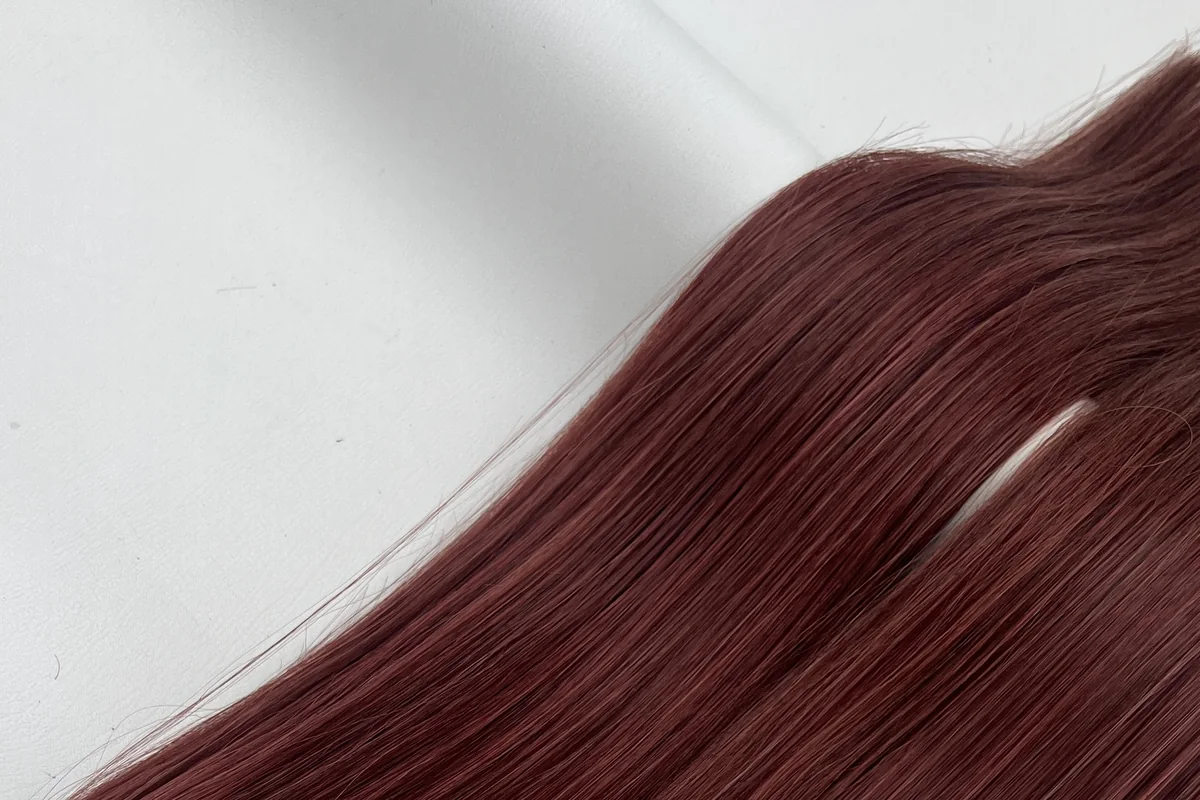
Everything above the last few centimetres looks much the same across drawing standards, because at the top of a bundle every fibre is present regardless of how far it goes. The difference has nowhere to appear until fibres begin dropping out, and they drop out from the bottom.
Visual density at the ends is not the same quantity as weight. The eye reads how much background the hair hides, which depends on how many fibre cross-sections occupy that area. A tapering end lets light through between the surviving fibres — what people mean by wispy, stringy or see-through ends. It reads most strongly against a light background, in daylight and from behind: where the client sees it in photographs and rarely in the mirror.
The cut interacts with this more sharply than anything else. A blunt line asks every fibre in the section to end at the same point, and a tapering distribution cannot produce one: the line looks soft at best, ragged at worst, and styling does not fix it because the fibres are not there. Double Drawn holds a blunt line, which is why one-length briefs drive so much of the demand for it. A layered, texturised brief asks the opposite question and is far more forgiving.
Hair density and attachment load are two different quantities, and the whole argument turns on separating them
Almost every unresolvable argument about Double Drawn — whether it is too heavy, whether fine hair can take it, whether it damages more — comes from collapsing two quantities into one word.
Hair density is a property of the finished set as seen: how much fibre occupies a given area at a given distance down the length. Drawing standard changes it, specifically in the lower half, and that is the entire effect of the operation.
Attachment load is a mechanical quantity at a joint: the mass one attachment point holds, borne by the wearer's own fibres recruited into it. It acts on a specific small group of follicles, it is what the traction argument is actually about, and it is settled before any hair is drawn.
The bridge between them is one sentence, and it is the claim on this page we state flatly. Drawing standard rearranges a fixed mass along the length; it does not create mass. A strand specified at 0.6 g weighs 0.6 g whether the hair inside it was drawn once or four times — the same 0.6 g, distributed along the strand in one version and concentrated in its upper portion in the other. The joint does not know which.
One honest qualification, which we would rather state than have someone else find. Moving mass down the length moves the centre of mass further from the joint, so the same head movement acts through a longer lever. Static load at the bond is unchanged; peak dynamic force during vigorous movement plausibly is not. We have not measured that, know of no published measurement of it, and will not use it as a claim in either direction.
Six decisions set the load, and drawing standard is not one of them
If load is what you are managing — and with fine, fragile or recovering hair it should be — a short list of variables moves it, each settled at consultation or at the chair, and each available identically in single drawn and Double Drawn hair.
Run the arithmetic and the drawing standard never enters. One hundred grams in 0.3 g units is roughly 330 joints; the same 100 g in 0.6 g units is roughly 170. Identical hair on the head, half as many attachment points, twice the mass at each, and a different quantity of the client's own hair recruited into each one.
Our own strand systems are made in two per-strand weights, and the figures carry every limit they require. A batch of ten Nanofilament strands weighed together came to approximately 3 g; a batch of ten Micro strands to approximately 6 g. Dividing gives approximately 0.3 g and approximately 0.6 g per strand. This is a batch reference comparison. The per-strand figures are derived by division, individual strands were not directly weighed, and it is not a laboratory test, not calibrated, not legal-for-trade and not a direct single-strand measurement. What it establishes is a ratio of roughly two to one between two of our own systems. What matters here is that neither figure moves when the drawing standard changes.
We will not convert that into a maximum number of grams a head can carry. We have not measured retention or traction on real scalps under controlled conditions, and know of no such study published in this industry. A supplier stating a hard gram ceiling is asserting something the field has not established.
The six terms that do decide it, roughly in the order they move the number:
- Strand weight — what one unit weighs. The largest single term, and the one most often left unstated in a quotation.
- Attachment size and mass — the bond, tip, tab or ring is a component with its own weight and footprint, carried in addition to the hair.
- Section size — how much of the wearer's own hair goes into each joint. The same unit weight across twice as many fibres is half the stress on each.
- Placement — where each joint sits. Hairline, temples, nape and any thinning region carry less than the occipital area.
- Number of strands — total joints installed, which follows from grams divided by unit weight rather than being chosen freely.
- Total installed grams — the whole mass on the head, and the figure the client actually feels.
Where the too heavy for fine hair claim comes from, and why it is a category error
The claim deserves taking apart rather than contradicting, because there is a version of it that is true.
The false version is the common one: that Double Drawn hair is intrinsically heavier and therefore unsuitable for fine hair. It is a category error. Drawing standard changes where a fixed mass sits along the length; it does not change what a joint carries. A specification given in grams has already fixed the load, and drawing standard describes the appearance of those grams once installed.
The true version depends entirely on how the product is specified, and this distinction resolves the whole argument. Where a product is specified by weight — a strand at 0.3 g, a tab at a stated gram figure, a set at 100 g — the drawing standard cannot change the load, because the weight is the thing you bought. Where a product is specified by dimension — a weft sold by width, a bundle sold as a bundle, a tab described only as a tab — the drawing standard absolutely does change the load, because more fibre reaching full length means more mass hanging on the same dimension. The claim is sound for dimension-specified goods and empty for weight-specified ones, and almost nobody making it says which they mean.
A third origin is commercial. Some suppliers offer Double Drawn only in their heavier formats, so a buyer meets Double Drawn and a heavier unit weight in one product and attributes to one what belongs to the other.
For fine hair the real considerations are different and mostly aesthetic. A blunt, dense end can read as a shelf against fine, tapering natural hair, which a technician resolves by softening the tips — a choice made with scissors, not a limitation of the hair. The load questions that genuinely matter for that hair type are unit weight, section size and total grams, and they are treated on the fine hair page.
Drawing standard behaves differently in strand, tape and weft products
The same operation produces three different commercial situations, following directly from the weight-versus-dimension distinction above. Strand systems are specified by weight per unit, so drawing standard is a purely visual variable for them and load is untouched. Its effect is unusually visible all the same, because a strand set presents many small groups of fibre with the tip of each separately in view. Single drawn strands taper individually and read soft; Double Drawn strands hold their thickness to the end and read as a continuous mass.
Tape products mount hair on a carrier, root end into the adhesive. The panel is a small flat sheet, so a taper shows as the panel narrowing towards the bottom, and a single drawn panel can read as a pointed wedge where a Double Drawn one stays rectangular. The load question turns on the specification: a tab quoted in grams is fixed regardless, a tab quoted only as a tab is not.
Wefts are the case where the folk claim is genuinely right. A weft is bought by width and by hair length, and the seam carrying it is a fixed construction. Fill that same width with hair that all reaches full length and it weighs more than a single drawn weft of identical width — the extra mass hangs on the same track and anchor points. Anyone fitting Double Drawn wefts should plan around a heavier panel per centimetre of track, and have weight per weft in grams before ordering.
Grams are necessary and not sufficient
Grams remain the primary number, and buying by strand count or by pack instead of by weight is the most expensive habit in this trade. But a specification stopping at grams has left the visual outcome undetermined, and the person blamed for that is the technician behind the chair. Two invoices can both be correct and produce two different heads, because the variable that decided the difference was never written down.
The minimum that determines an outcome is short. Total weight in grams; length measured from the top of the attachment; drawing standard; weight per attachment unit; colour reference against a physical sample; attachment system. Six lines. A supplier who answers all six in nouns and units holds the information about their own goods, and one who answers in adjectives usually does not — generally the sign that the goods were bought finished rather than made. That test sits with the rest of what to ask of a factory on the manufacturer page.
Lifting and toning act hardest on the ends, which is where the drawing standard lives
Colour work and drawing standard meet at the same few centimetres of the bundle, and they meet twice. The first meeting is in the fibre. A tip is the oldest part of a hair — more washing, more sun, more handling, a thinner cuticle. Under lift the tips of any bundle take more damage than the mid-lengths; under toner they are more porous, take pigment faster, and can finish cooler or deeper than the length above.
The second meeting is in the geometry of the bundle during processing. A single drawn bundle holds less hair per centimetre towards the tip, so under product that region sits at a higher ratio of chemical to fibre than the mid-length and processes faster than the part it is attached to. A Double Drawn bundle presents a more even cross-section, so the ratio stays closer to constant and the length processes more evenly. That is the mechanism we work with in production, and it is a working understanding rather than something we have quantified.
Put the two together and a lifted single drawn set is thin at the ends for two reasons at once: fewer fibres reached that far, and those that did are the most compromised. That is where drawing standard earns its cost most clearly.
The bounded part. We have not run a controlled comparison of end breakage between our own single drawn and Double Drawn hair after identical lifting, so the above describes mechanisms rather than a result we can put a figure to. Nothing in it says Double Drawn resists bleach better. The fibres are the same. There are simply more of them at the end.
A technician plans a Double Drawn set differently from the first consultation
The most useful way to hold this professionally: single drawn hands you the factory's taper, Double Drawn hands you an undecided end. That is a statement about who makes the decision, not about quality, and it changes four things.
Grams first. A client moving to Double Drawn at an unchanged gram figure may report less density at the roots even while the ends improve. That conversation belongs before the order rather than at the mirror, and where root density is the brief, the gram figure or the placement plan has to move with the drawing standard.
The cut second. A Double Drawn set arrives blunt and stays blunt, so any softness has to be cut in — point cutting, slide cutting, notching through the tips. That work removes hair bought at Double Drawn prices, so the budget should carry it rather than discover it, and the fitting needs chair time at the end that a single drawn set would not.
Layering third. Because the fibres are close to one length, a Double Drawn set does not layer itself. Graduation is built with scissors, or by ordering two or three lengths and installing them in bands. The second usually reads better, because each layer keeps its own end density instead of being cut into existence — and it has to be decided at the order, since it changes what is bought.
Reinstallation fourth. A set is moved up several times and every service costs it some fibre. A distribution already thin at the ends thins further and visibly; a narrowed one has more margin before the taper shows. We see that pattern in hair returning to us and offer it as an observation from returned goods, not a measured service life. It supports no claim that Double Drawn lasts longer — only that it has further to fall before the ends read thin.
Checking a Double Drawn claim on the bench is an inspection, and calling it a measurement would be dishonest
There is no test for this. There is an inspection of about ten minutes, and its limits belong before the procedure rather than after it, so nobody carries away a number they did not obtain.
What it establishes is real but modest: whether a bundle broadly matches what that supplier sent last time, and whether a claim is grossly false. A bundle sold as Double Drawn that thins away through its lower third is not a borderline case and needs no instruments.
What it cannot do should be stated as plainly. It produces no percentage and no tolerance. It will not reliably separate Double Drawn from the tier above, because those sit close together on a continuous axis. Two competent people can inspect the same bundle and disagree. Wet hair, product residue, static, a dark background and a bundle that has been shaken out all change how strongly a taper reads.
A real measurement exists and is not practical per batch: weigh a sub-sample, sort it into length classes, weigh each class. It is destructive, slow, and characterises one sub-sample rather than a delivery. We do not run it on production batches and know of no manufacturer here who does — which leaves drawing standard as a trust relationship dressed as a specification, sold that way by the whole industry, ourselves included. Where the line falls between what we measure and what we merely observe is set out on our testing methodology page.
Do it on arrival, before the hair is cut, coloured, mounted or installed, while a delivery can still be discussed. Work under even light, against a matt background that contrasts with the hair.
- Identify the root end and hold the bundle there. Everything below depends on working from the level end.
- Comb it through once, gently, from the tips upward, then let it hang free and settle.
- Fan it flat and look at the silhouette rather than the hair. Note the distance from the tip at which the outline starts to lose width — that distance is the finding.
- Compare by hand as well: grip the bundle at the mid-length, then a few centimetres from the tip, and judge how much thinner the second handful feels.
- Run a drawing pass yourself. Draw a small handful away from the tip end; single drawn leaves a noticeable population of shorter fibres behind, heavily drawn leaves very little.
- Lay twenty or thirty random fibres against a rule. Thirty fibres out of tens of thousands is an indication, not a sample.
- Compare against a retained reference from the previous delivery of the same specification — the only comparison carrying real weight.
- Photograph the fanned bundle, dated, on the same background each time, so deliveries can be set side by side later.
What we have not measured about our own drawing standard
This page argues that drawing standard is sold on trust, so it would be inconsistent to end without saying where our own claim is unverified.
We hold no published length-distribution histogram for our Double Drawn hair, at any length. We have not established what proportion of fibres in a finished bundle reaches the stated length, so we quote no percentage and no tolerance. The standard is maintained by trained hand inspection against retained references and by the number of passes run, not by a numeric threshold a bundle either clears or fails.
We have not characterised batch-to-batch variation in our own drawing, nor how the standard holds across lengths, although the raw material makes it near certain that a long specification is harder to hold than a short one. Nor have we defined Super Double Drawn against a number: it is a further pass and a stricter hand standard — a real difference in the workshop and an unfalsifiable one on paper.
We have not measured end retention over months of wear, the dynamic-load question raised earlier, or how differently drawn hair behaves after identical colour processing. We are not in the salon chair for the six months after a set leaves here, and returned goods are the closest thing we have to field data — a sample badly skewed towards what went wrong.
None of that stops Double Drawn being our preferred standard, and none of it argues against buying it. It sets what the claim is worth: an operation we genuinely perform, held to a standard we can describe but have not quantified, under a term no authority defines. Anyone offering more certainty than that is offering something the category does not contain.
Frequently asked
Common questions
Is Double Drawn worth the extra cost at shorter lengths?
Less so, for a geometric reason. The taper region of a single drawn bundle occupies a share of its length, so at 35 or 40 cm the visibly thin stretch is a shorter absolute distance and reads far less strongly than the same proportion at 60 cm. The price gap is narrower there too, because less raw material is discarded to reach the target. Short, layered, softly finished briefs are where single drawn often gives better value.
Can I tell Double Drawn from a photograph?
Not with any confidence. A bundle photographed from the root end, on a dark background, gathered rather than fanned, hides a taper completely, and none of those choices need be deliberate. Light-through-the-ends shots exaggerate the opposite way. The only photographs worth much are ones you take yourself, fanned flat under even light, in a series across deliveries. A supplier photograph shows what the supplier chose to show, ours included.
Is Super Double Drawn always the better choice over Double Drawn?
No, and treating the axis as a ladder leads people to overbuy. Past a point, a very narrow distribution gives an end so solid it reads as a cut edge rather than as hair, and the technician then spends chair time and paid-for grams cutting softness back in. It also costs more for a difference many briefs never show. Where the finished look is layered or textured, Double Drawn is usually sufficient.
What should I ask a supplier who says their single drawn is close to Double Drawn?
Ask how many drawing passes, and against what reference, because those are the only answers with content. A pass count is a fact about their process; close to and almost are positions on an axis nobody has scaled. Then ask for a retained sample of that specification, so the next delivery can be checked by hand against this one. If neither is available, the phrase describes a hope rather than a standard.
Related pages
Continue reading
Tell us the result you need at the ends, and we will say which drawing standard actually gets you there and where the cheaper one would serve you just as well.
Method, colour, length and grams are settled by consultation before anything is quoted.